




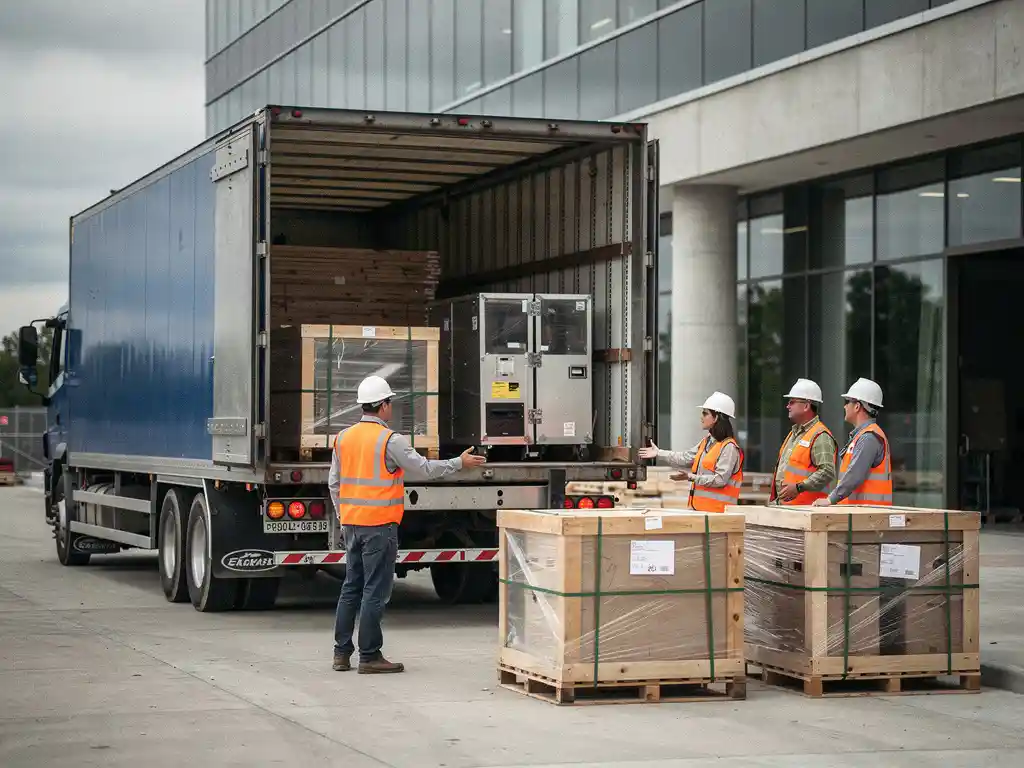
Large commercial fit-out projects require several types of insurance working together to cover the full scope of risk. At a minimum, you should expect contractor’s all-risk insurance, public liability insurance, goods-in-transit coverage, and professional indemnity insurance to be in place. Responsibility for arranging these policies is typically shared between the main contractor, specialist subcontractors, and any logistics partners involved in the project. The sections below break down each insurance type, who carries it, and what happens when things go wrong.
Who is responsible for insurance on a commercial fit-out project?
Responsibility for insurance on a commercial fit-out project is shared across multiple parties. The main contractor typically holds the primary project insurance policy, while specialist subcontractors and logistics partners are each required to carry their own cover relevant to their scope of work. The client or building owner may also hold separate property insurance that applies during the fit-out period.
In practice, the main contractor is usually the central figure when it comes to coordinating insurance requirements across the project. Their contract with the client will specify minimum coverage levels, and they are responsible for ensuring that every subcontractor and supplier operating on site can demonstrate adequate insurance before work begins.
That said, the client retains an important role too. Before any work starts, the building owner should confirm whether their existing property policy covers third-party contractors working on the premises, or whether a separate works policy needs to be arranged. Gaps between the client’s property insurance and the contractor’s project insurance are a common source of disputes when damage occurs.
For complex, multi-phase fit-outs involving furniture delivery, installation, and warehousing, logistics providers carry their own layer of cover that sits alongside the contractor’s policy. Each party’s insurance should be clearly documented in the project contract, with certificates of insurance exchanged before any goods are moved or work begins on site.
What types of insurance are typically required for large fit-out projects?
Large commercial fit-out projects typically require five core types of insurance: contractor’s all-risk insurance, public liability insurance, employer’s liability insurance, goods-in-transit insurance, and professional indemnity insurance. Together, these policies cover physical damage to the works, injury to third parties, damage to goods in transit, and errors in design or specification.
Here is a breakdown of each type and what it addresses:
- Contractor’s all-risk (CAR) insurance: Covers physical loss or damage to the works themselves during the construction and fit-out phase, including materials on site.
- Public liability insurance: Covers claims from third parties for bodily injury or property damage caused by the contractor’s activities on site.
- Employer’s liability insurance: Legally required in most jurisdictions for any business with employees. Covers claims from workers injured during the project.
- Goods-in-transit insurance: Covers furniture, fixtures, fittings, and equipment while being transported to and from the project site.
- Professional indemnity insurance: Relevant where designers, project managers, or specialist consultants are involved. Covers claims arising from errors, omissions, or negligent advice.
For very large or high-value fit-outs, project-specific policies are sometimes arranged rather than relying on each party’s standard annual cover. This approach gives the client and main contractor greater certainty about the total insured value and avoids disputes about which party’s policy responds first when an incident occurs.
What does contractor’s all-risk insurance cover on a fit-out?
Contractor’s all-risk insurance covers physical loss or damage to the works being carried out, including materials and equipment on site, from the moment the project starts until practical completion. On a commercial fit-out, this typically includes damage caused by fire, flood, theft, accidental impact, and vandalism. It does not generally cover defective workmanship itself, but it does cover resulting damage to surrounding elements.
On a fit-out specifically, the policy covers the installed works as they progress. If a partition wall is damaged before handover, or newly installed flooring is ruined by a water leak, the CAR policy responds to the cost of repair or reinstatement. This is distinct from the building owner’s property insurance, which covers the existing structure rather than the new works being added.
Most CAR policies also include a section covering contractors’ plant and equipment, which is relevant on fit-out sites where specialist installation tools and machinery are brought in temporarily. However, the limits and exclusions vary significantly between insurers, so it is important to review the policy schedule carefully against the specific scope of the project.
One area that often causes confusion is the treatment of materials stored off-site or in transit. Standard CAR policies may not automatically extend to cover goods held in a third-party warehouse or being moved between locations. This is where goods-in-transit insurance and the logistics partner’s own cover become critical, particularly on projects involving large volumes of furniture and fixtures.
Does goods-in-transit insurance cover furniture and fixtures during installation?
Goods-in-transit insurance covers furniture and fixtures while they are being transported, but coverage typically ends once goods are unloaded and accepted at the delivery point. The installation phase itself, where items are being unpacked, assembled, and fixed in place, usually falls outside a standard transit policy and needs to be covered by either the contractor’s all-risk policy or a specialist installation floater.
This distinction matters a great deal on large fit-out projects. A delivery of high-value office furniture may be fully covered during road transport, but the moment it is unloaded onto the site, responsibility shifts. If a piece is damaged during assembly or installation, the transit insurer is unlikely to accept a claim because the goods are no longer in transit.
To close this gap, fit-out projects should confirm at the outset which policy covers each stage of the goods’ journey:
- In the warehouse: The logistics provider’s storage or warehousing insurance.
- During transport: The logistics provider’s goods-in-transit policy.
- On site before installation: Typically the contractor’s all-risk policy, or the logistics provider’s policy if goods are still in their care.
- During installation: The contractor’s all-risk policy or an installation floater.
- After handover: The client’s property insurance.
Mapping this chain clearly before the project starts prevents costly disputes about who is liable when damage occurs mid-installation.
What insurance should a logistics partner carry for fit-out projects?
A logistics partner working on commercial fit-out projects should carry goods-in-transit insurance, public liability insurance, and storage or warehousing insurance as a minimum. For projects involving assembly and installation services, employer’s liability insurance and an installation floater are also expected. The coverage limits should be proportionate to the value of the goods being handled.
On large-scale fit-out projects, the logistics partner is often responsible for far more than simple delivery. They may warehouse furniture and fixtures for weeks before a site is ready, coordinate phased deliveries to match the installation programme, and provide on-site assembly teams. Each of these activities carries distinct risks that need to be covered.
When evaluating a logistics partner for a fit-out project, it is worth asking for certificates of insurance before contracts are signed, and checking that the declared coverage limits are sufficient for the value of the goods involved. A provider handling several hundred thousand euros’ worth of furniture and fittings should carry correspondingly high per-shipment limits, not just a standard annual policy designed for general cargo.
Our project logistics services are structured to handle exactly this kind of complexity, with appropriate insurance coverage supporting every stage from warehousing through to on-site installation across more than 150 locations worldwide. Clients working with us on fit-out projects receive full documentation of our coverage as part of the project onboarding process.
What happens if goods are damaged during a commercial fit-out?
If goods are damaged during a commercial fit-out, the first step is to identify at which stage the damage occurred and which party had care, custody, and control of the goods at that moment. This determines which insurance policy responds. The damaged items should be documented immediately with photographs and written records, and the relevant insurer notified as quickly as possible to avoid prejudicing the claim.
The process typically follows these steps:
- Document the damage immediately: Photographs, written descriptions, and a record of who was present when the damage was discovered.
- Identify the responsible party: Was the damage caused during transit, on-site storage, installation, or by another contractor working nearby?
- Notify the relevant insurer: The party responsible for the goods at the time of damage notifies their insurer. Delay in notification can complicate or invalidate a claim.
- Preserve the damaged goods: Do not dispose of or repair damaged items until the insurer has had the opportunity to inspect them.
- Obtain a replacement or repair estimate: The insurer will typically require a professional assessment of the cost to repair or replace the damaged items.
Where liability is disputed between parties, for example if a contractor’s team damages furniture that a logistics provider has just delivered, the claim can become more complex. This is why clear contractual language about who holds responsibility at each handover point is so important, and why all parties should carry their own insurance rather than relying on a single project policy to cover everything.
For ongoing guidance on how we approach risk management and insurance documentation across our furniture transport and project logistics work, you are welcome to get in touch with our team directly.