




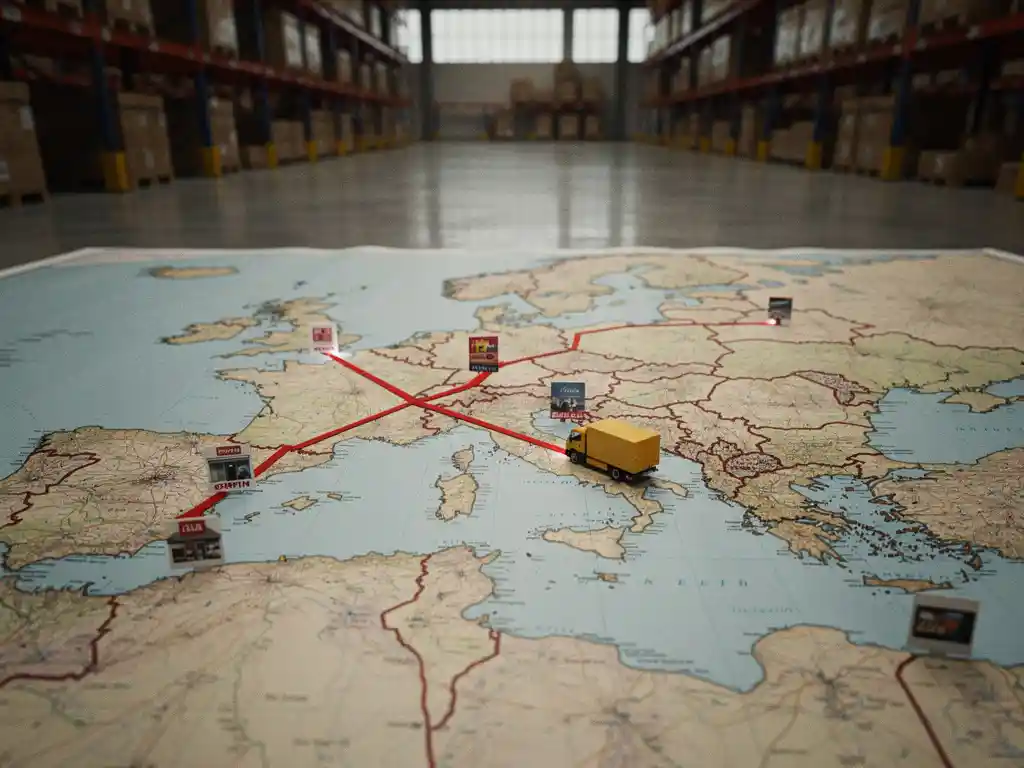
Expanding a retail brand across Europe is one of the most rewarding growth moves a business can make, and one of the most logistically complex. A poorly sequenced rollout can result in missed store opening dates, damaged stock, frustrated partners, and a brand reputation that takes years to rebuild. Getting the logistics right from the very beginning, starting with a controlled pilot and building toward a full national or multi-market launch, is what separates successful European retail expansions from costly ones.
This guide walks you through every stage of that process, from mapping your requirements before the pilot begins to optimising your supply chain once the national launch is live. Whether you are entering one new market or several simultaneously, these steps give you a practical framework for managing your European retail rollout with confidence.
Map your logistics requirements before the pilot launches
Before a single product moves, you need a complete picture of what your logistics operation must deliver. This is not just about transport routes. It covers everything from product dimensions and packaging standards to import regulations, local delivery restrictions, and the infrastructure available at each pilot location.
- List every product category and define its handling requirements, including fragility, weight, volume, and any assembly needs at the destination.
- Identify the countries or regions included in the pilot and research their specific customs rules, carrier access, and last-mile delivery conditions.
- Document the store or site specifications, including access hours, loading bay dimensions, lift availability, and any local permit requirements for delivery vehicles.
- Map your current supplier locations against the pilot sites to understand lead times and identify potential bottlenecks before they occur.
Once this groundwork is complete, you will have a realistic logistics brief rather than a set of assumptions. This brief becomes the foundation for every decision that follows. If gaps appear at this stage, such as a supplier located far from your first pilot market or a product range that requires specialist handling, address them now rather than during the live rollout.
Design a pilot logistics model that scales
The purpose of a pilot is not just to test whether your product sells. It is to test whether your logistics model can support growth. Design the pilot with scalability in mind from day one, because a model built purely for convenience at small volume will break under the pressure of a national launch.
Choose a warehousing solution that can flex as volume increases, rather than locking yourself into fixed capacity that suits only the pilot phase. Establish clear carrier partnerships and agree on service level expectations in writing. Decide early whether you will use centralised European distribution or regional hubs, as this structural choice becomes much harder to reverse once you scale.
- Select a primary distribution hub that is geographically positioned to serve both your pilot markets and your planned expansion markets.
- Build your inbound and outbound processes with documentation standards that can be replicated across multiple sites without retraining from scratch.
- Test your reverse logistics process during the pilot, including returns handling and damaged goods procedures, so these are resolved before volume increases.
After the pilot logistics model is operational, run a structured review at the four-week mark to identify any process steps that are creating manual workarounds. These workarounds are warning signs of design flaws that will become significant problems at scale.
Define the KPIs that validate your pilot before scaling
Scaling before your pilot is validated is one of the most common and expensive mistakes in retail expansion logistics. Define your success criteria before the pilot launches, not after, so that the decision to proceed is based on evidence rather than enthusiasm.
The metrics you track should reflect the full logistics chain, not just transport performance. A delivery arriving on time is only part of the picture if the product arrives damaged or the store team spends three hours unpacking and assembling items that should have arrived ready to display.
- On-time, in-full delivery rate (OTIF): Target a benchmark that reflects your brand standards and customer expectations.
- Damage rate: Track both transit damage and packaging failure separately to identify root causes.
- Lead time accuracy: Measure the gap between promised and actual delivery windows at each site.
- Cost per delivery: Establish a baseline cost model that you can compare against as volume grows.
- Store readiness time: How long does it take the receiving team to go from delivery arrival to store-ready product?
Set a minimum threshold for each KPI that must be met before you commit to the national rollout. If the pilot does not reach those thresholds, use the data to diagnose the specific failure points and redesign those elements before expanding.
Build the cross-border logistics framework for national rollout
With a validated pilot behind you, the next step is constructing the cross-border logistics framework that will support your full European expansion. This is where logistics planning becomes genuinely complex, because you are now coordinating multiple carriers, customs regimes, warehousing nodes, and delivery standards across different national markets simultaneously.
Our project logistics expertise covers exactly this kind of multi-market coordination, including customs clearance, local partner management, and on-site delivery and installation across more than 150 locations worldwide. For brands managing this internally, the framework needs to address the following elements explicitly.
- Establish a master transport plan that identifies primary routes, transit times, and carrier responsibilities for each country in scope.
- Appoint a single point of coordination for cross-border documentation, including commercial invoices, packing lists, certificates of origin, and any product-specific compliance documents.
- Agree on incoterms with each supplier and carrier so that responsibility for goods in transit is unambiguous at every handover point.
- Build contingency routes for your highest-risk lanes, particularly those crossing borders with longer customs processing times or limited carrier options.
Verify the framework by running a tabletop simulation before the first national launch wave. Walk through the complete journey of a product from supplier to store shelf, identifying every decision point and potential delay. This exercise consistently surfaces gaps that documentation alone does not reveal.
Coordinate store-opening sequences and delivery scheduling
A national retail rollout rarely means opening all stores on the same day. More commonly, you are managing a sequenced programme of openings across weeks or months, each with its own delivery window, site readiness status, and local constraints. Coordinating this well is what keeps your rollout on schedule and your logistics costs under control.
Build a master opening schedule that works backward from each store’s confirmed opening date. Assign a logistics milestone to each date, including stock arrival at the regional warehouse, transfer to last-mile carrier, delivery window at the store, and installation or assembly completion. Share this schedule with every party in the chain and update it in real time as conditions change.
- Group store openings by geographic cluster where possible to maximise delivery route efficiency and reduce cost per drop.
- Confirm site readiness criteria with each store manager at least two weeks before the scheduled delivery, covering access, staffing, and storage capacity.
- Build buffer time into the schedule for your highest-complexity sites, such as city centre locations with restricted delivery hours or upper-floor installations requiring specialist equipment.
- Establish an escalation protocol for missed milestones so that delays are flagged and resolved before they cascade into the next opening in the sequence.
After each store opening wave, run a brief debrief with the delivery and installation teams. The operational insights gathered at this stage are invaluable for refining the process for subsequent waves and are often the difference between a smooth programme and a chaotic one.
Optimise the supply chain after the national launch
A successful national launch is not the end of the logistics work. It is the point at which you have enough real operational data to make meaningful improvements. The weeks immediately following a full launch are the best time to identify inefficiencies that were masked by the urgency of the rollout itself.
Review your KPI performance against the benchmarks you set during the pilot. Where performance has slipped, investigate whether the root cause is a carrier issue, a warehousing process gap, a packaging failure, or a forecasting problem. Each cause has a different solution, and treating them all the same way leads to ineffective fixes. Our contract logistics services are designed to support exactly this kind of ongoing optimisation, combining warehousing, distribution, and value-added services under one coordinated framework.
- Renegotiate carrier rates and service levels based on the actual volumes you are now delivering, as your leverage increases significantly post-launch.
- Consolidate slow-moving stock and review your replenishment cycles to reduce unnecessary inventory holding costs.
- Assess whether your current warehouse network configuration still matches your store distribution pattern, or whether a hub adjustment would reduce transit times and costs.
- Introduce regular supply chain reviews with your key logistics partners, using shared data to drive continuous improvement rather than reactive problem-solving.
The most resilient European retail operations are those that treat the post-launch phase as the beginning of a continuous improvement cycle rather than a wind-down. With the right logistics partner and a structured review process in place, each subsequent product range, store opening, or market entry becomes faster, smoother, and more cost-effective than the last. If you would like to discuss how we can support your next retail expansion logistics project, get in touch with our team to explore what a tailored solution looks like for your business.