




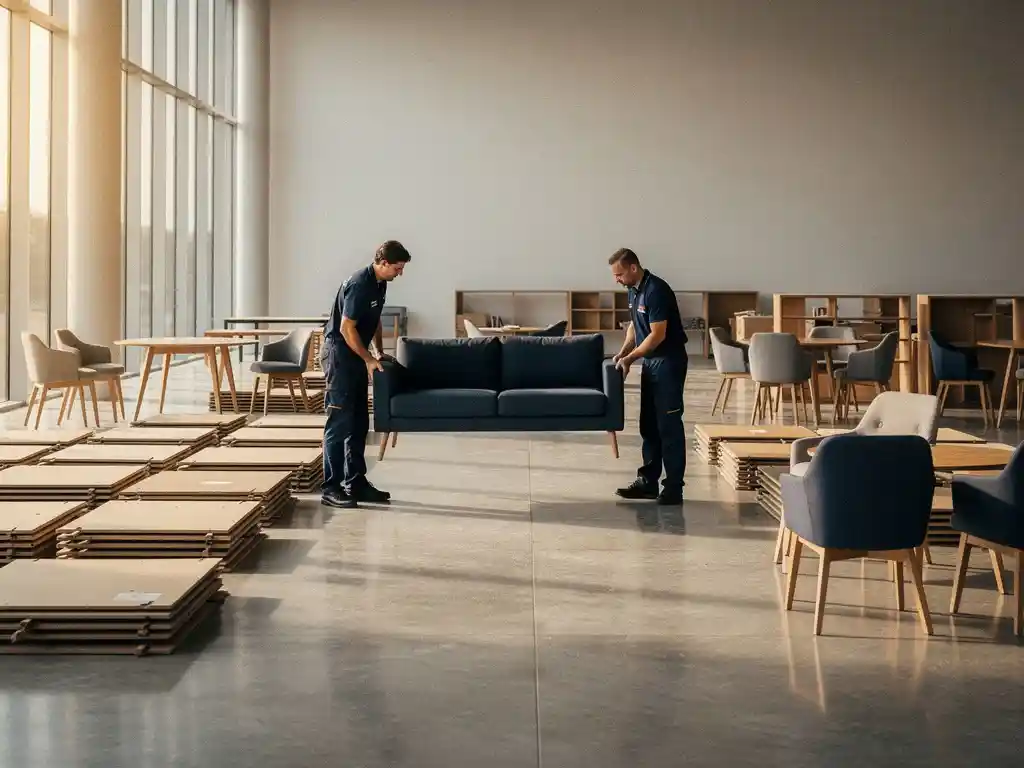
Project logistics is used across a wide range of industries that require large-scale, coordinated furniture installation rather than simple delivery. Sectors including hospitality, healthcare, education, corporate real estate, and retail regularly rely on project logistics services to furnish entire buildings on tight schedules, often across multiple locations simultaneously. The questions below unpack exactly which industries depend on furniture logistics most heavily and why.
Which sectors handle the largest furniture logistics projects?
The sectors that handle the largest furniture logistics projects are hospitality, healthcare, corporate real estate, education, and retail. These industries share a common need: furnishing large, complex spaces within defined timeframes where delays directly affect operations, revenue, or occupancy. Each sector brings its own logistical demands, but all require far more than a standard delivery service.
Hotel chains and resort developers regularly commission thousands of pieces of furniture for a single property opening. A new hotel with 300 rooms, multiple restaurants, and conference facilities may require coordinated delivery and installation across dozens of distinct spaces, all timed to meet a fixed opening date. Corporate real estate follows a similar pattern, with office fit-outs for headquarters or coworking buildings involving hundreds of workstations, meeting rooms, and breakout areas that must be installed floor by floor.
Education is another major sector. School refurbishments during holiday periods, university campus expansions, and new campus builds all require furniture to be delivered, assembled, and positioned within narrow windows. Government and public sector buildings, including courthouses, civic offices, and embassies, also generate substantial furniture logistics projects, particularly when relocation or renovation affects multiple departments at once.
Retail rollouts, where a brand opens multiple stores within the same quarter, represent a growing area of project logistics demand. Each location must receive the correct fixtures, displays, and furniture in the right sequence to meet a coordinated launch date.
Why does the hospitality industry depend on project logistics for furniture?
The hospitality industry depends on project logistics for furniture because hotel and resort openings are driven by fixed, non-negotiable deadlines where every room must be fully furnished before the first guest arrives. A single delayed shipment can stall an entire floor. The scale, precision, and time pressure involved make standard delivery completely inadequate for this sector.
A hotel opening is not just a furniture delivery. It is a coordinated sequence of transport, warehousing, floor-by-floor installation, assembly, and final placement, all happening in a building that may still have other contractors working on site. Project logistics providers manage this complexity by mapping out every step in advance, using floor plans and delivery schedules to ensure each item arrives at the right location at the right time.
Hospitality projects also tend to involve custom or imported furniture, which adds lead time and customs clearance requirements. Pieces may originate from multiple manufacturers across different countries, requiring consolidation before final delivery. We handle exactly this kind of multi-origin coordination, including warehousing and customs formalities, so that all items arrive together and on schedule.
Beyond the opening, hospitality clients also use project logistics for refurbishments. Replacing furniture across an operating hotel requires careful staging to minimise disruption to guests, which demands the same level of planning and coordination as a new build.
How does project logistics differ from standard furniture delivery?
Project logistics differs from standard furniture delivery in scope, coordination, and responsibility. Standard delivery moves items from A to B. Project logistics manages the entire process, including planning, transport, warehousing, assembly, installation, and final positioning, across complex sites and tight schedules. The logistics provider takes end-to-end ownership rather than simply dropping off goods.
In a standard furniture delivery, the supplier or carrier is responsible for getting items to the door. What happens after that, including who assembles the furniture, where it goes, and how the space is set up, falls to the client. For a single office or home purchase, this is manageable. For a 400-room hotel or a hospital wing, it is not.
Project logistics introduces a layer of pre-project planning that standard delivery does not include. Before a single truck moves, the project team works from data, floor plans, and site surveys to map the entire installation sequence. This includes identifying access constraints, elevator capacities, delivery windows, and the order in which spaces need to be completed.
The difference also shows in problem-solving. When something unexpected happens on a large project, such as a delayed customs clearance or a last-minute change to a floor plan, a project logistics team has the experience and network to adapt quickly. Standard delivery services are not built for that kind of dynamic response.
What makes healthcare facilities complex clients for furniture project logistics?
Healthcare facilities are complex clients for furniture project logistics because they combine strict hygiene standards, continuous operational demands, and highly specific furniture requirements. Hospitals and clinics cannot shut down for a refurbishment, which means installations must happen around active patient care, often in phases, during nights or weekends, and with zero tolerance for disruption.
The furniture itself adds another layer of complexity. Healthcare environments require specialist items, including patient beds, examination tables, modular storage systems, and infection-control-compliant seating, that are heavier, more technical to install, and more sensitive to damage than standard commercial furniture. Delivery teams must understand how to handle and position these items correctly.
Coordination with hospital management is particularly demanding. Access to wards, operating areas, and patient rooms must be timed to avoid conflict with medical procedures and staff schedules. A project logistics provider working in healthcare needs to communicate continuously with facility managers and adapt the delivery and installation plan as conditions change on the ground.
Regulatory compliance also plays a role. Furniture installations in healthcare settings may need to meet fire safety, accessibility, and infection prevention standards, which must be factored into both product selection and installation methods. For clients in this sector, choosing a logistics partner with genuine experience in complex, regulated environments is essential.
When should a business use project logistics instead of in-house coordination?
A business should use project logistics instead of in-house coordination when the scale, complexity, or time pressure of a furniture installation exceeds what internal teams can realistically manage. If a project involves multiple locations, imported goods, tight deadlines, specialist assembly, or coordination across different contractors and suppliers, in-house coordination quickly becomes a liability rather than a cost-saving measure.
Internal teams are typically equipped to handle routine procurement and office moves. They are rarely resourced to manage customs clearance, multi-country transport consolidation, on-site installation crews, and real-time problem resolution simultaneously. Attempting to do so often results in delays, damage, and cost overruns that far exceed what a professional project logistics service would have cost.
There are several clear signals that a project has outgrown in-house capability:
- The project spans more than one building or location
- Furniture is sourced from multiple suppliers or countries
- There is a fixed opening or handover date with no flexibility
- Assembly and installation require specialist skills or tools
- The site has access restrictions, such as limited delivery hours or no goods lift
- The project runs in parallel with other construction or fit-out work
We work with businesses across multiple industries to take on exactly this kind of end-to-end responsibility. From the initial planning phase through to final installation, our project team maps every detail in advance and stays on site to manage what happens when circumstances change. For businesses that need certainty on a large-scale furniture project, that level of professional oversight is not a luxury. It is the difference between a smooth opening and a costly delay.