




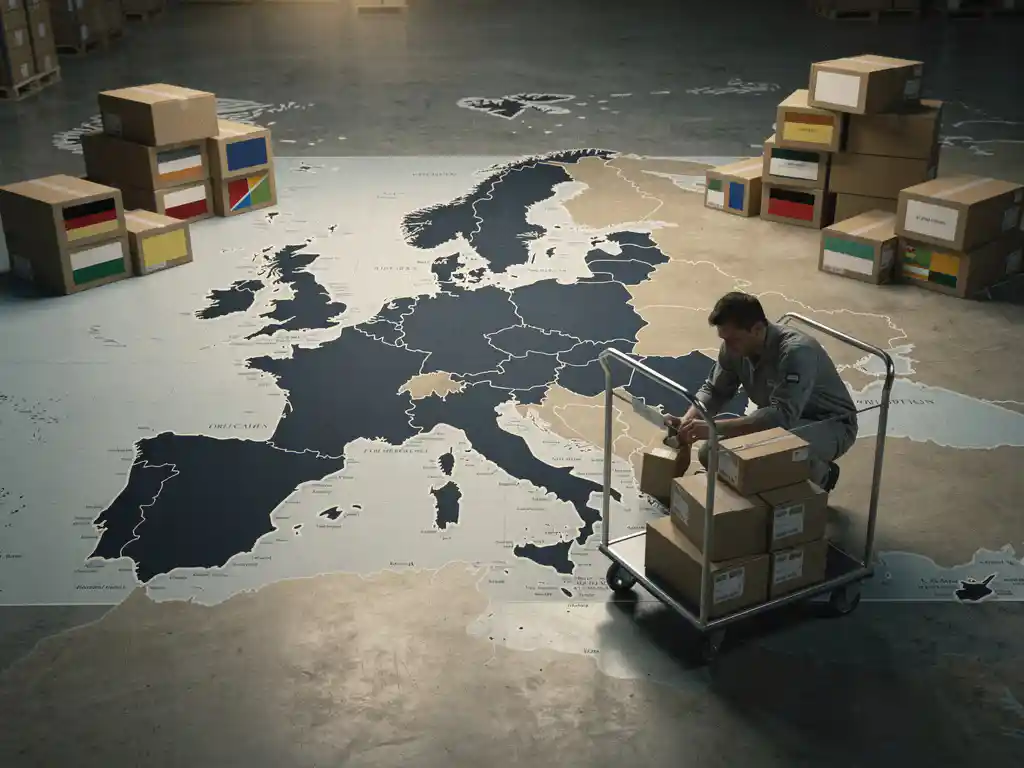
Expanding your retail brand across multiple countries is an exciting growth milestone, but the logistics behind it can quickly become overwhelming. Each market comes with its own infrastructure, regulations, customer expectations, and delivery norms. Without a structured approach to retail rollout logistics, even well-funded expansions can stall at the border or fall apart in the final mile. This guide walks you through exactly how to organise logistics per country so your international retail expansion runs smoothly from day one.
Whether you are rolling out five stores across Europe or launching an e-commerce operation in a new region, the steps below give you a repeatable framework for building country-specific logistics that scale.
Map your retail rollout requirements per country
Before selecting any logistics provider or booking warehouse space, you need a clear picture of what each country actually demands. Retail logistics planning starts with requirements mapping, and skipping this step is the single biggest reason rollouts run over budget or miss their launch dates.
- List every country in your rollout scope and assign a dedicated requirements document to each one.
- Define the product types you are shipping into each market, including dimensions, weight, fragility, and any special handling requirements such as assembly or installation.
- Identify the volume and frequency of deliveries: is this a one-time store fit-out, a recurring replenishment cycle, or a combination of both?
- Document the end-point requirements for each country, including delivery address types (retail stores, distribution hubs, or end consumers), access restrictions, and appointment windows.
- Note any country-specific constraints such as urban delivery restrictions, seasonal demand peaks, or local public holidays that affect lead times.
After completing this mapping exercise, you should have a country-by-country requirements matrix. If two countries have nearly identical profiles, you may be able to use a shared logistics model. If they differ significantly, treat them as separate planning tracks from this point forward.
Select the right logistics model for each market
With your requirements mapped, the next step is choosing the logistics organisation model that fits each market. There is no single model that works everywhere, and forcing one approach across all countries is a common and costly mistake in international retail expansion.
Consider the following models and match them to each country’s profile:
- Direct cross-border shipping: Suitable for low-volume, high-value markets where local warehousing is not yet justified.
- Regional hub with local distribution: Effective when you are serving multiple locations within a country or region from a single consolidation point.
- In-country warehousing: The right choice when delivery speed, replenishment frequency, or volume makes local stock holding economically sensible.
- Partner-led fulfilment: Works well in markets where you lack local knowledge or infrastructure, and a trusted local partner can manage last-mile delivery on your behalf.
Evaluate each model against your volume projections, service level requirements, and cost constraints. Document your chosen model per country and the reasoning behind it. This decision log will be valuable when you review performance after launch.
Handle customs and compliance across borders
Customs and regulatory compliance is where many retail rollouts lose time and money. Cross-border distribution requires accurate documentation, correct tariff classifications, and an understanding of each country’s import rules before your first shipment moves.
- Identify the correct HS (Harmonised System) codes for every product category you are shipping. Misclassification leads to delays, fines, and potential seizure of goods.
- Determine the applicable import duties and VAT rates for each destination country. These vary significantly and affect your landed cost calculations.
- Establish whether your goods require any certificates of origin, product conformity declarations, or country-specific labelling before they can enter the market.
- Decide who handles customs clearance: your logistics partner, a dedicated customs broker, or an in-house team. Assign responsibility clearly and document it.
- Set up a document management process so that commercial invoices, packing lists, and any required permits are always accurate and available before shipment.
A useful verification checkpoint here: run a test shipment or a paper simulation with your customs broker before your official launch date. This surfaces documentation gaps early, when they are still easy to fix. Our project logistics team handles customs clearance as part of an integrated service, which is particularly useful when you are managing simultaneous rollouts across multiple countries.
Coordinate warehousing and last-mile delivery locally
With your logistics model chosen and compliance processes in place, you can now set up the physical infrastructure for each country. Country-specific logistics depends heavily on how well your warehousing and last-mile delivery are coordinated at the local level.
- Select warehouse locations based on proximity to your delivery points, not just on cost. A cheaper facility far from your stores will erode savings through higher distribution costs.
- Define your inbound process: how goods arrive at the warehouse, how they are checked and stored, and how they are picked and packed for outbound delivery.
- Establish your last-mile delivery requirements per country. In some markets, white-glove delivery with assembly and installation is expected; in others, kerbside drop-off is standard.
- Agree on delivery time windows and appointment booking processes with your local carriers. Retail store deliveries in particular often require strict scheduling.
- Set up a returns process for each country from the start, even if you expect low return volumes initially. Retrofitting a returns flow after launch is significantly harder.
Once your warehousing and last-mile processes are documented, walk through a full order cycle on paper before going live. Identify any handoff points where responsibility is unclear and resolve them before they become operational failures. Our warehousing solutions cover inbound handling, storage, and outbound distribution, giving you a single point of coordination for these activities.
Align your logistics partners and communication structure
A retail rollout across multiple countries typically involves several logistics partners operating in parallel. Without a clear communication structure, instructions get lost, priorities conflict, and accountability gaps appear exactly when you can least afford them.
- Create a partner map that lists every logistics provider involved in each country, their role, and their primary contact person.
- Define escalation paths for each country: who gets contacted first when something goes wrong, and who has the authority to make decisions quickly.
- Establish a shared reporting format so that all partners provide status updates in a consistent way. Tracking shipments across five different partner portals with five different formats wastes time and creates confusion.
- Schedule regular alignment calls during the rollout period, particularly in the weeks before and after each country goes live.
- Document all agreed service levels, lead times, and performance metrics in writing before the rollout begins. Verbal agreements do not hold up when problems arise.
Strong partner alignment is what separates retail rollouts that feel controlled from those that feel chaotic. Even if your logistics model is sound, poor communication will undermine it. Treat your logistics partners as an extension of your own team and invest time in onboarding them properly.
Validate and scale your rollout logistics setup
Before committing to a full-scale launch in each country, validate your logistics setup with a controlled pilot. This is the step most teams skip when they are under pressure to move fast, and it is also the step that prevents the most expensive mistakes.
- Run a pilot delivery cycle in each country using real shipments, real partners, and real delivery addresses. Keep volumes low enough to manage manually if needed.
- Measure actual lead times, cost per delivery, and exception rates against your planned targets. Where actuals diverge significantly from plan, investigate the root cause before scaling.
- Gather feedback from store managers, project coordinators, or end recipients about the delivery experience. Operational metrics tell you what happened; feedback tells you why.
- Identify the two or three highest-risk points in your logistics chain for each country and put contingency plans in place before increasing volume.
- Document what worked well in each country so that you can replicate it when you add new markets to your rollout scope.
Once your pilot results meet your performance thresholds, you are ready to scale. Increase volumes gradually rather than all at once, and maintain close monitoring during the ramp-up phase. A logistics setup that works at low volume sometimes reveals capacity or coordination issues at scale that were not visible during the pilot. Catching these early keeps your retail rollout logistics on track as your international presence grows.
Organising logistics across multiple countries is genuinely complex, but it becomes manageable when you break it into these structured steps. If you are planning a retail rollout and want to discuss how we can support your cross-border distribution and project logistics, get in touch with our team.