




The most common mistakes in furniture project logistics fall into four core categories: poor planning, inadequate packaging, weak communication, and underestimating last-mile complexity. These errors compound quickly in large-scale furniture projects because every stage of the supply chain depends on the one before it. Understanding where things go wrong is the first step toward building a logistics process that consistently delivers on time and in perfect condition.
Why do furniture project logistics fail so often?
Furniture project logistics fail so often because they involve multiple interdependent variables that all need to align simultaneously: delivery windows, installation sequences, site access, packaging standards, and coordination across suppliers and carriers. When any one of these breaks down, the entire project can stall. Unlike standard freight, furniture deliveries often cannot be rescheduled without significant cost and disruption to the end client.
Large-scale furniture projects, such as outfitting a hotel, office building, or school, require every item to arrive at the right place, at the right time, and in the right condition. The stakes are high because delays affect not just logistics costs but also construction timelines, contractor schedules, and client satisfaction. The complexity scales quickly, and without experienced project coordination, small oversights become expensive problems.
What planning mistakes cause the most delays in furniture projects?
The planning mistakes that cause the most delays in furniture project logistics include insufficient lead time, failure to map delivery sequences, and not accounting for site-specific constraints. When logistics planning begins too late or relies on assumptions rather than confirmed data, the entire delivery schedule becomes fragile. A single missing item or blocked access route can cascade into days of lost time.
Effective project logistics planning starts well before the first truck is loaded. Floor plans, building access details, elevator capacities, and installation sequences all need to be mapped in advance. Common planning errors include:
- Failing to confirm site readiness before scheduling delivery
- Not sequencing furniture delivery to match installation order
- Underestimating lead times for custom or imported pieces
- Ignoring local regulations around delivery hours or vehicle access
- Assuming warehouse buffer capacity is always available
Projects that span multiple locations or countries add another layer of complexity. Customs clearance, import documentation, and cross-border coordination all require time that is frequently underestimated in initial project timelines.
How does poor packaging damage furniture during transport?
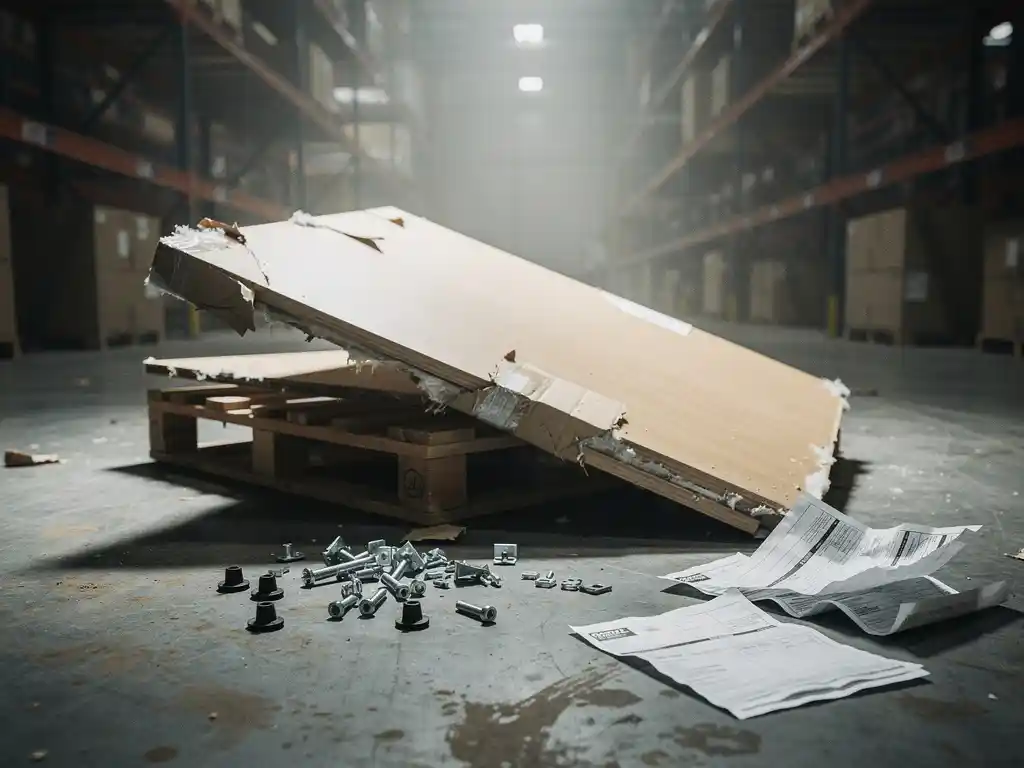
Poor packaging damages furniture during transport by leaving items vulnerable to impact, moisture, vibration, and compression. Furniture is particularly susceptible because of its size, irregular shapes, and often delicate finishes. Inadequate protection during loading, transit, or unloading leads to scratches, dents, broken components, and structural damage that may not be immediately visible but can cause issues during installation.
One of the most frequent furniture transport mistakes is using generic packaging that is not designed for the specific dimensions or fragility of the item. Flat-pack furniture may shift inside oversized boxes, while upholstered pieces can be compressed or stained if not wrapped correctly. Corners and edges are especially vulnerable and require targeted protection.
Packaging failures also create downstream problems. Damaged goods must be returned, replaced, or repaired, all of which delay installation and increase costs. For high-value or custom furniture, the financial and reputational impact can be significant. Matching packaging specifications to the product type and transport method is not optional in professional furniture logistics, it is a baseline requirement.
What communication errors derail furniture project deliveries?
Communication errors that most commonly derail furniture project deliveries include unclear handover protocols between suppliers and carriers, missing delivery confirmations, and failure to notify site contacts about schedule changes. In multi-party logistics projects, information gaps between stakeholders create situations where trucks arrive at locked buildings, installation teams are absent, or items are delivered to the wrong floor or location.
These errors are often systemic rather than one-off. When there is no single point of coordination overseeing the entire project, each party operates on partial information. A supplier confirms dispatch but does not communicate the exact delivery window to the site manager. A carrier updates a delivery date but the installation team is not informed. These are small failures individually, but together they stop projects in their tracks.
Effective communication in furniture project logistics requires a clear chain of responsibility, real-time updates across all parties, and documented confirmation at each handover point. Projects that use a dedicated logistics coordinator, someone who owns the information flow from origin to final placement, consistently outperform those that rely on informal communication between separate teams.
When should last-mile logistics be handled differently for furniture projects?
Last-mile logistics should be handled differently for furniture projects whenever the delivery involves complex installation, restricted site access, white-glove placement, or time-sensitive coordination with other trades on site. Standard last-mile freight processes are designed for volume and speed, not for the precision and care that furniture project deliveries require. Treating them the same way is one of the most overlooked furniture logistics errors.
Consider a project involving the installation of office furniture across multiple floors of a commercial building. Standard courier-style delivery assumes ground-floor drop-off. Furniture project logistics requires vertical transport, room-by-room placement, packaging removal, and often assembly. None of that is compatible with a standard last-mile approach.
Situations that demand a specialist last-mile approach include:
- High-rise buildings where elevator booking and floor access must be pre-arranged
- Healthcare or education environments with strict delivery hour restrictions
- Projects requiring same-day installation after delivery
- Deliveries to locations in city centres with limited vehicle access
- International projects where local partners must handle the final leg
We operate across more than 150 locations worldwide and work with local partners to ensure last-mile execution matches the specific demands of each project site, whether that is a school in the Netherlands or a corporate office in Milan.
How can furniture project logistics mistakes be prevented?
Furniture project logistics mistakes can be prevented by combining detailed upfront planning, standardised packaging protocols, clear communication structures, and experienced coordination from a single accountable partner. Prevention is far more cost-effective than recovery. Most logistics planning errors, packaging failures, and communication breakdowns are predictable and avoidable when the right processes are in place before the project begins.
The most reliable prevention strategy involves treating each project as unique rather than applying a standard freight template. This means conducting a thorough pre-project assessment that covers site conditions, delivery sequences, customs requirements, and contingency scenarios. It also means assigning a dedicated project coordinator who maintains visibility across all parties throughout the entire delivery process.
Practical steps that reduce common furniture logistics errors include:
- Building detailed project plans using floor plans and confirmed site data before scheduling any transport
- Specifying packaging requirements per product type rather than using generic solutions
- Establishing a single communication channel and escalation path for all project stakeholders
- Building buffer time into schedules to absorb customs delays or site access issues
- Conducting pre-delivery site visits for complex or large-scale installations
- Partnering with a logistics provider that has proven experience in furniture and project logistics
At Jan Krediet, we have been delivering complex furniture and project logistics solutions since 1924. Our team maps every detail in advance, using data and floor plans to coordinate each stage before work begins on site. When unexpected challenges arise, our experienced project team acts quickly and finds solutions that keep your project on track. If you want to know more about how we approach projects like yours, get in touch with our team directly.