




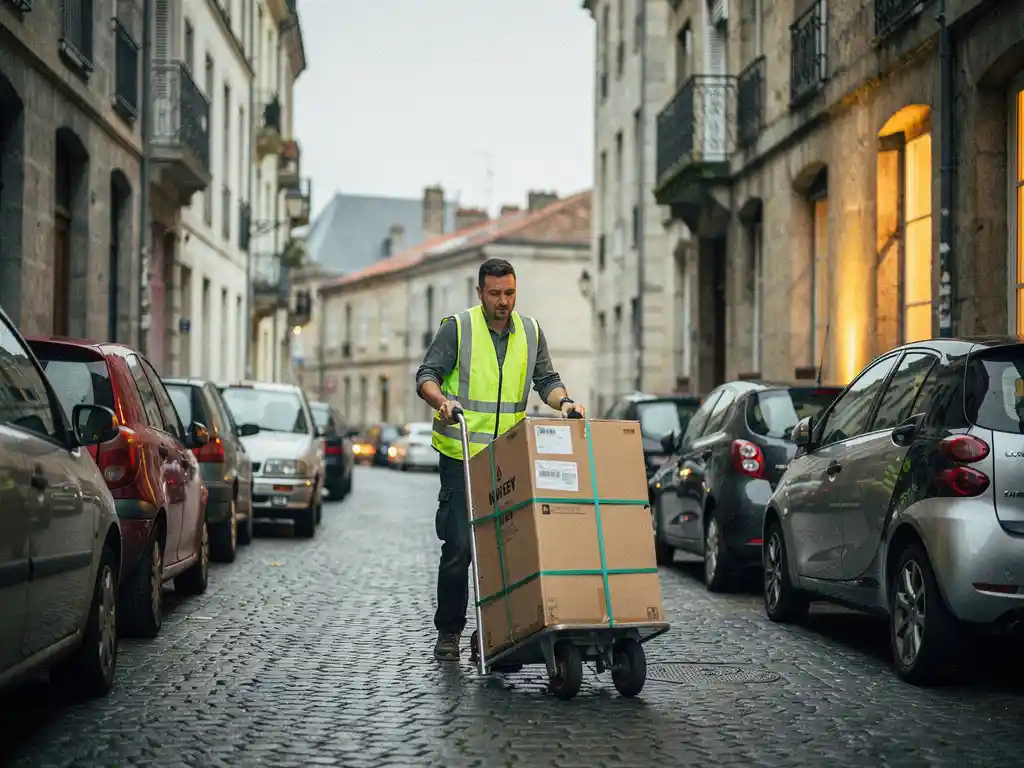
Last mile delivery is the hardest stage in European project delivery because it combines physical complexity with the highest cost per kilometre, the most variables, and the greatest risk of failure. Unlike earlier stages of the supply chain, the final leg requires precise coordination at the exact moment a customer or project site is waiting. The sections below break down why this stage is so demanding and what practical solutions exist for businesses operating across Europe.
What makes last mile delivery different from other logistics stages?
Last mile delivery is fundamentally different because it is the only stage where a single shipment must reach a specific person, room, or installation point rather than a warehouse dock or distribution hub. Every other stage in the supply chain moves goods in bulk between controlled locations. The last mile fragments that volume into individual, time-sensitive deliveries at unpredictable endpoints.
In project delivery logistics, this distinction becomes even sharper. Delivering furniture to a commercial office fit-out, for example, is not simply dropping a pallet at a loading bay. It means coordinating lift access, managing floor protection, sequencing assembly teams, and meeting a fixed handover deadline. The final kilometre carries more operational weight than the previous thousand combined.
Three characteristics separate last mile from all other logistics stages:
- Density drops sharply: Vehicles that were full during long-haul transport often make multiple stops with partial loads, increasing cost and time per delivery.
- Human interaction increases: Recipients, site managers, and installation teams all introduce scheduling dependencies that do not exist in automated warehouse environments.
- Error visibility is highest: A mistake in the last mile is immediately visible to the end client. Earlier supply chain errors can often be corrected before delivery. Last mile errors cannot.
Why is last mile delivery so expensive in Europe?
Last mile delivery in Europe is expensive primarily because of low load efficiency combined with high labour, fuel, and compliance costs. Delivering to fragmented urban and semi-urban destinations means vehicles travel further per unit delivered, and drivers spend significant time waiting, navigating access restrictions, and handling goods on site rather than in transit.
In project logistics specifically, costs compound further. Specialist vehicles, trained installation crews, and time-window commitments all carry premium rates. When a delivery must reach a specific floor of a hospital or a hotel under renovation, the logistics provider cannot simply reroute or reschedule without financial and contractual consequences.
Fuel and tolls vary considerably across European countries, adding unpredictability to route costing. Labour regulations differ by nation, affecting driver hours and crew requirements. Insurance for high-value project cargo adds another layer. Taken together, last mile costs in European project delivery can represent a disproportionately large share of total transport spend relative to the distance covered.
What are the biggest last mile challenges in European cities?
The biggest last mile challenges in European cities are urban access restrictions, traffic congestion, parking limitations, and the physical constraints of older city infrastructure. Many European city centres were built centuries before modern freight vehicles existed, and their narrow streets, low bridges, and restricted loading zones create genuine operational barriers for project delivery teams.
Low Emission Zones (LEZs) are now active in dozens of major European cities, including London, Amsterdam, Brussels, Milan, and Stockholm. These zones restrict which vehicles can enter based on emission standards, which means logistics providers must either invest in compliant fleets or pay access charges that increase delivery costs. For project logistics, where large specialist vehicles are often necessary, LEZ compliance is a recurring operational challenge.
Beyond infrastructure, city deliveries face time pressure from building management rules. Office buildings, hotels, and public institutions typically restrict freight access to specific windows, often early morning or outside business hours. Coordinating a full project delivery team, including installers and assembly crews, within a two-hour access window in a congested city centre requires precise planning and strong local knowledge.
How do cross-border regulations complicate last mile project delivery?
Cross-border regulations complicate last mile project delivery in Europe because each country maintains its own rules on driver working hours, vehicle weights, road permits, and customs documentation, even within the EU single market. A project moving from the Netherlands to Italy, for instance, must navigate multiple regulatory frameworks before the final delivery team even arrives on site.
For non-EU deliveries, customs clearance adds a further layer. Goods entering or leaving the UK, Switzerland, or Norway require documentation that must be accurate before the shipment moves. Errors or delays at customs can hold up a full project delivery while installation teams wait on site, generating costs that have nothing to do with the physical transport itself.
Cabotage rules within the EU restrict how many domestic deliveries a foreign-registered carrier can make in a single country. For project logistics providers coordinating multi-site deliveries across several countries, these restrictions influence routing decisions and may require local partner arrangements to complete the final leg legally. Understanding these rules in advance is essential to building a realistic project delivery plan.
How do logistics providers solve last mile problems in project delivery?
Logistics providers solve last mile problems in project delivery through detailed pre-project planning, local partner networks, and integrated service capabilities that cover transport, installation, and on-site coordination in a single managed operation. The most effective approach treats the last mile not as a separate delivery event but as the culmination of a carefully sequenced project plan.
We approach project logistics by mapping every delivery location in detail before the first vehicle moves. Floor plans, access routes, lift dimensions, and site contact schedules are all confirmed in advance so that the delivery team arrives prepared rather than problem-solving on the spot. This preparation eliminates the majority of last mile surprises before they occur.
Local partner networks are critical for cross-border project delivery. Rather than relying on a single fleet to cover all of Europe, experienced providers maintain relationships with trusted local operators who understand city-specific access rules, building regulations, and scheduling norms. This local knowledge reduces delays and ensures that the final leg of delivery is handled by teams who know the terrain.
Technology also plays a growing role. Real-time tracking, digital proof of delivery, and route optimisation tools give project managers visibility over every stage of the last mile, enabling faster responses when conditions change. Combined with experienced on-site teams, these tools make last mile delivery more predictable and more manageable.
When should a business outsource last mile project delivery in Europe?
A business should outsource last mile project delivery in Europe when the complexity, geographic spread, or regulatory requirements of a project exceed its internal logistics capabilities. If a project involves multiple countries, specialist installation, time-critical access windows, or high-value goods, the risk of managing last mile delivery in-house typically outweighs the cost of working with a specialist provider.
Outsourcing makes particular sense in three scenarios:
- Cross-border projects: When delivery crosses national borders, a provider with established customs expertise and local partner networks will execute faster and more reliably than an internal team building those relationships from scratch.
- High-value or sensitive cargo: Project deliveries involving commercial interiors, technical equipment, or fragile goods require trained handling teams and appropriate vehicles. Specialist providers carry this capability as standard.
- Fixed project deadlines: When a school must be ready for the new term or a hotel must open on a set date, the cost of a last mile failure is far greater than the cost of engaging a provider with a proven track record in deadline-driven project delivery.
Businesses that attempt to manage complex European project logistics internally often discover that the last mile is where time and budget overruns accumulate. Partnering with an experienced provider that offers contract logistics solutions from planning through to on-site completion reduces that risk significantly and allows internal teams to focus on the project itself rather than its supply chain.
If you are planning a project delivery across Europe and want to discuss how we can support the last mile, get in touch with our team to explore the right approach for your project.