




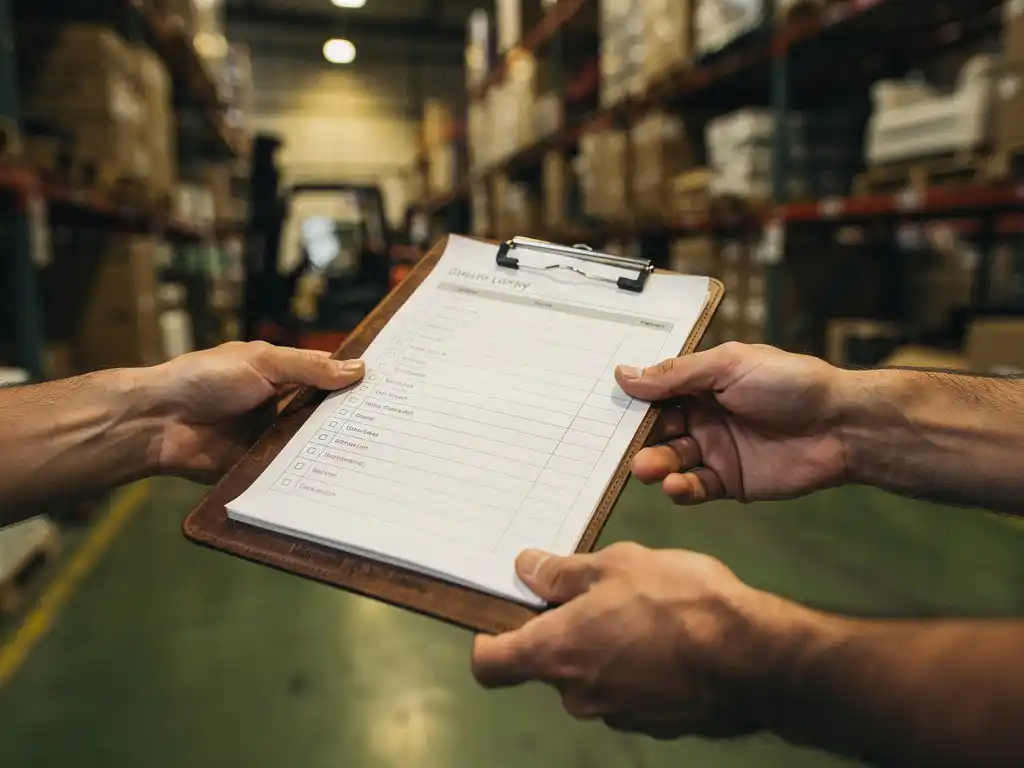
The handover moment is almost always the weakest point in a project because it is where responsibility shifts between parties without a guaranteed transfer of context, documentation, or accountability. When one team finishes and another takes over, the gaps between what was communicated and what was understood become visible in the worst possible way. The sections below unpack exactly why this happens and what you can do about it.
What actually happens during a project handover in logistics?
A project handover in logistics is the moment when operational responsibility for a shipment, installation, or delivery is formally transferred from one party to another. This can mean handing off from a transport team to an installation crew, from a warehouse to a final-mile carrier, or from a logistics coordinator to the end client. It is the point where everything that was planned must now be executed by someone who was not present for the planning.
In practice, a handover involves far more than signing a delivery note. It requires the receiving party to have full situational awareness: what is being delivered, in what condition, how it must be handled, what the site access situation is, who the contact person is, and what the fallback plan looks like if something goes wrong. In project logistics specifically, where deliveries may involve complex assemblies, sensitive equipment, or time-critical installations across multiple locations, the handover carries even greater weight.
When it works well, a handover is almost invisible. When it fails, it tends to fail loudly and expensively.
Why do most handover failures happen at the last step?
Most handover failures occur at the last step because that is where the pressure is highest and the preparation is thinnest. By the time a project reaches its final delivery or installation phase, teams are often fatigued, timelines are compressed, and the assumption is that the hard work is already done. That assumption is where things go wrong.
The last step in a logistics chain, often referred to as last mile delivery, is statistically the most complex and costly part of the entire journey. It involves the most variables: building access, elevator bookings, site readiness, the presence of the right personnel, and real-time coordination with the end client. These are all factors that cannot be fully controlled in advance, and they require the handover team to be fully briefed and empowered to act.
There is also a psychological dimension. Earlier stages of a project tend to receive detailed planning attention. The final handover moment is sometimes treated as a formality rather than a critical operational event. This creates a structural blind spot where the most exposed moment in the chain receives the least preparation.
What information is most often missing at handover?
The information most often missing at a project handover falls into three categories: site-specific access details, condition documentation for goods in transit, and escalation contacts. These are the three areas where assumptions replace facts, and where those assumptions most frequently prove wrong.
- Site access details: Elevator dimensions, loading dock availability, building entry codes, parking restrictions, and floor protection requirements are frequently underdocumented. A delivery team arriving at a high-rise office building without this information faces immediate delays.
- Condition documentation: Without a clear record of how goods were received at each stage, disputes about damage become impossible to resolve. This is especially relevant for furniture, kitchen units, and other high-value items where cosmetic damage matters.
- Escalation contacts: Who do you call when the site contact is unreachable? Who authorises a change to the delivery window? These contacts are often missing or out of date by the time the final handover occurs.
A well-structured handover package addresses all three of these categories explicitly. Anything left to verbal communication or informal memory is a liability.
How does a multi-party supply chain make handovers harder?
A multi-party supply chain makes handovers harder because every additional party introduces a new interface where information can be lost, delayed, or misinterpreted. Each transition point between carriers, freight forwarders, warehouses, and installation teams is a potential handover failure waiting to happen.
In a chain involving an international freight forwarder, a customs agent, a regional warehouse, a last-mile carrier, and an on-site installation team, there are at least four distinct handover moments. Each one requires a complete and accurate transfer of information. In practice, information tends to degrade as it passes through more hands. Details that seemed obvious to the original planner become assumptions, and assumptions become errors.
Coordination overhead also increases exponentially with the number of parties involved. When something goes wrong at the final handover, tracing the root cause back through a multi-party chain is time-consuming and often inconclusive. Accountability becomes diffuse, and the client bears the consequences while the parties involved debate responsibility.
This is one of the core reasons why contract logistics models that consolidate multiple functions under a single provider have become increasingly attractive to project owners who cannot afford handover failures.
How can a single logistics partner reduce handover risk?
A single logistics partner reduces handover risk by eliminating the external interfaces where information loss occurs most frequently. When transport, warehousing, assembly, installation, and final delivery are managed by one coordinated team, the handover becomes an internal process rather than an inter-company transfer. Context is preserved, accountability is clear, and the same team that planned the project sees it through to completion.
We work exactly this way at Jan Krediet. Before any project begins on site, our team maps every detail using data and floor plans, so that the people executing the final delivery are working from the same information base as the people who planned the logistics. Our project logistics approach covers the full chain from transport and warehousing through to assembly and installation, operating across more than 150 locations worldwide.
The practical benefit is that when an unexpected situation arises at the handover moment, there is no gap between the party with the information and the party with the authority to act. The same team that knows the project can make the call.
What should a reliable project handover checklist include?
A reliable project handover checklist should include confirmed site access details, a complete condition report for all goods, named contacts for both the delivering and receiving parties, a signed acknowledgement of delivery, and a documented escalation path for any issues that arise after handover. These five elements cover the most common points of failure in logistics coordination.
- Site access confirmation: Elevator dimensions, dock availability, access codes, parking, and any building-specific requirements verified in advance.
- Goods condition report: A photographic and written record of item condition at the point of handover, signed by both parties.
- Named contacts: Full names and direct contact numbers for the delivery lead, the site contact, and the client representative, all verified as current.
- Delivery acknowledgement: A formal sign-off confirming what was delivered, when, and by whom. This should be digital where possible for real-time record keeping.
- Post-handover escalation path: A clear process for reporting damage, missing items, or installation issues discovered after the handover is complete, with defined response times.
The checklist itself is less important than the discipline of using it consistently. A handover checklist that is completed under pressure at the last moment provides less value than one that is prepared and shared with all parties well in advance. The goal is to make the handover moment a confirmation of what was already agreed, not a scramble to establish what was supposed to happen.
If you are planning a complex project and want to understand how we approach logistics coordination from start to finish, you are welcome to get in touch with our team directly.