




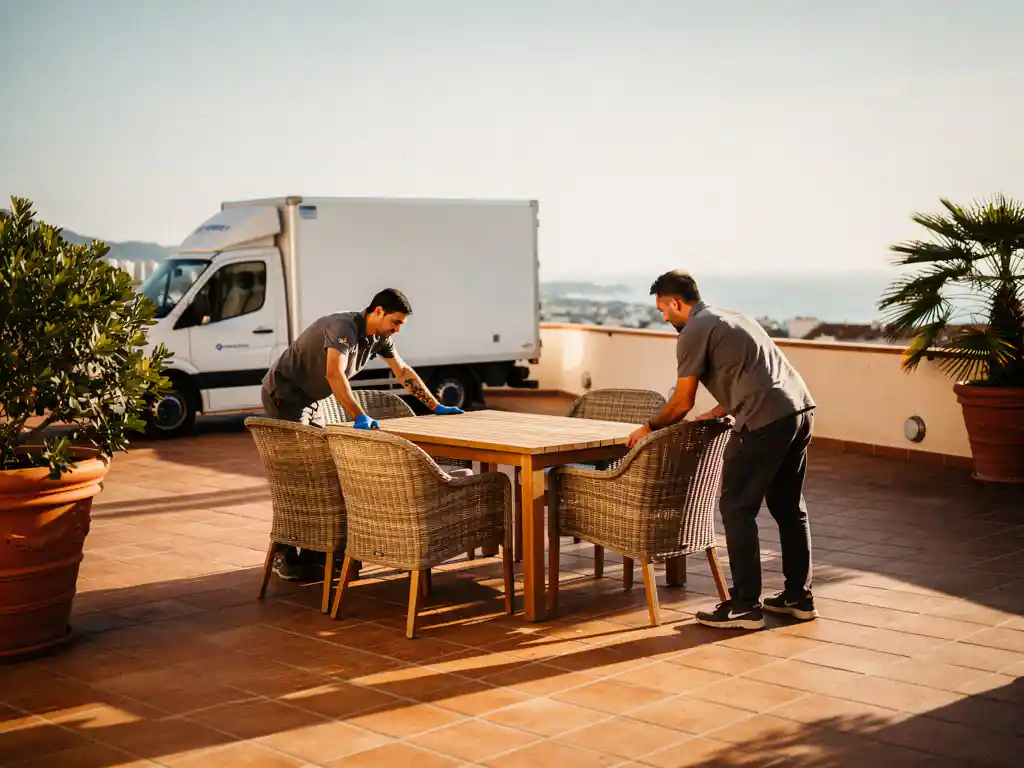
A specialist logistics provider handles delivery and placement for a hospitality terrace refit, typically one with experience in commercial furniture logistics rather than standard parcel or general freight services. The operator or project manager coordinates the process, but the physical work of transporting, positioning, and often assembling outdoor furniture falls to a dedicated logistics partner. The sections below break down each stage of that process and what to look for when planning a refit.
Who is responsible for coordinating a terrace refit delivery?
Responsibility for coordinating a hospitality terrace refit delivery sits with the hospitality operator or their appointed project manager, working in close partnership with a specialist logistics provider. The operator defines the timeline, access requirements, and placement brief, while the logistics partner takes ownership of transport planning, crew management, and on-site execution.
In practice, this coordination involves several parties. The furniture supplier confirms dispatch dates and packaging specifications. The logistics provider plans the route, vehicle type, and crew size. The venue manager ensures site access, clears the area, and confirms any permit requirements for deliveries in public or semi-public spaces. When these roles are clearly assigned from the outset, refits run on schedule and avoid costly delays.
For larger refurbishment projects, a dedicated project coordinator at the logistics company often acts as a single point of contact, managing communication between all parties. This is particularly valuable for hospitality venues that are refitting while remaining partially operational, where disruption to guests must be minimised.
What does ‘placement’ actually include in a terrace refit?
In the context of a hospitality terrace refit, placement goes well beyond simply unloading furniture from a vehicle. It covers the physical positioning of each item according to a floor plan or layout brief, including chairs, tables, parasols, planters, and decorative elements, often followed by assembly and final adjustment to ensure everything is level, stable, and guest-ready.
A full outdoor furniture placement service typically includes:
- Unloading and carrying items to the exact terrace location, including navigating stairs, narrow passages, or restricted access points
- Unpacking and removing all packaging waste from site
- Assembly of flat-pack or component-based furniture
- Positioning items according to a supplied layout plan
- Securing or anchoring items where required for safety
- Final quality check and sign-off with the venue manager
Some logistics providers also handle the installation of fixed elements such as wall-mounted screens, lighting rigs, or branded signage as part of a broader project logistics service. The scope of placement should always be agreed in writing before the delivery date to avoid misunderstandings on the day.
How does logistics for a hospitality terrace differ from regular furniture delivery?
Hospitality terrace refit logistics differs from standard furniture delivery in three key ways: the scale of the operation, the complexity of the site, and the time pressure involved. A residential delivery might involve one or two items dropped at a front door. A terrace refit typically involves dozens of pieces, tight access, and a hard deadline tied to the venue’s opening schedule or seasonal trading window.
Outdoor hospitality environments present specific challenges that general freight services are not equipped to handle. Terraces may be located on rooftops, inner courtyards, or pedestrianised streets with restricted vehicle access. Deliveries often need to happen outside trading hours, early morning or late evening, to avoid disrupting guests or neighbouring businesses. Furniture pieces are frequently oversized, fragile, or weather-treated, requiring specialist handling and protective wrapping during transit.
There is also the question of volume. A full terrace refurbishment for a mid-sized restaurant or hotel might involve 50 to 150 individual items arriving in a coordinated sequence. Unlike a single-item home delivery, this requires a logistics team that can manage multi-drop scheduling, crew coordination, and real-time communication with the venue. Specialist furniture transport services are built around exactly these demands.
What should a hospitality operator check before booking a refit delivery?
Before booking a terrace furniture delivery for a hospitality refit, an operator should confirm six key details: site access dimensions, delivery time restrictions, assembly requirements, packaging removal arrangements, liability coverage, and the logistics provider’s experience with commercial hospitality projects.
Here is what each of those checks involves in practice:
- Site access: Measure doorways, corridors, stairwells, and any gates or barriers the delivery crew will need to pass through. Share these measurements with the logistics provider before booking.
- Time restrictions: Check whether the local authority or landlord imposes delivery hours, particularly for venues in pedestrianised zones or shared commercial buildings.
- Assembly scope: Clarify which items arrive flat-packed and which are pre-assembled. Confirm whether the logistics provider’s crew will handle assembly on site.
- Packaging removal: Agree in advance whether the logistics team will remove and dispose of all packaging. Leaving this unresolved creates unnecessary waste management problems for the venue.
- Insurance and liability: Confirm that the logistics provider carries adequate goods-in-transit insurance for the value of the furniture being delivered.
- Sector experience: Ask for examples of previous hospitality or commercial furniture projects. A provider familiar with the demands of terrace refurbishment logistics will anticipate problems that a general carrier would not.
Getting these details confirmed before the delivery date prevents the most common causes of delay and additional cost during a terrace refit.
Can one logistics partner handle both delivery and installation for a terrace refit?
Yes, a single specialist logistics partner can handle both delivery and installation for a hospitality terrace refit, and doing so through one provider is generally more efficient than splitting the work across multiple contractors. It reduces handover risk, simplifies scheduling, and gives the venue a single point of accountability for the entire process.
We work with hospitality operators and large developers to deliver and install complete interior and exterior environments, from furniture and wall decoration to plants and branded fixtures. That end-to-end capability means the same team that transports the furniture also places, assembles, and signs off every item on site, eliminating the coordination gaps that arise when delivery and installation are managed separately.
For operators planning a terrace refurbishment in 2026, the practical advantage of a combined service is speed. A crew that arrives with both transport and installation expertise can complete a full terrace setup in a single visit, rather than requiring a delivery day followed by a separate installation appointment. This matters significantly when venues are working to tight seasonal deadlines or need to minimise closure time.
When evaluating a logistics partner for furniture installation in a hospitality setting, look for demonstrated experience with commercial projects, a structured approach to layout planning, and clear communication throughout. You can explore our full range of hospitality logistics capabilities on our industries page, or get in touch to discuss the specifics of your terrace refit project.