




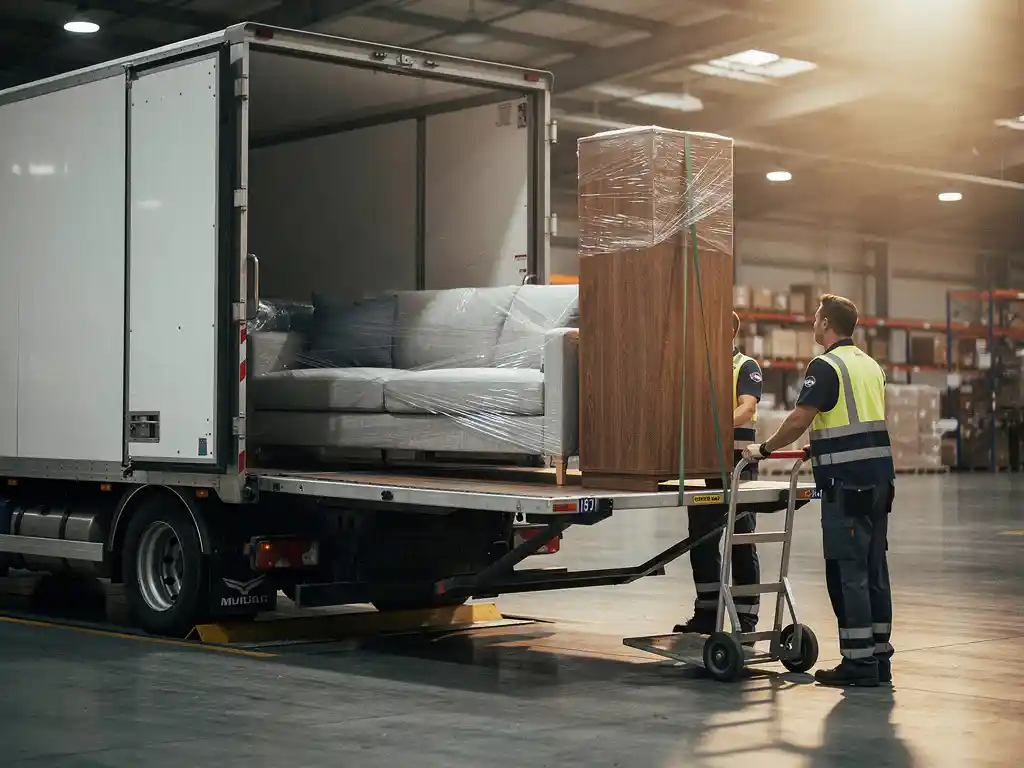
A dedicated furniture transport service is a specialist logistics solution designed specifically for moving furniture safely, efficiently, and on schedule — from the manufacturer or warehouse to the end customer or installation site. Unlike general freight, it accounts for the size, fragility, and handling requirements unique to furniture. Below, we answer the most common questions retailers ask when evaluating a furniture delivery service.
How does a dedicated furniture transport service differ from general freight?
A dedicated furniture transport service differs from general freight in that every element of the operation is built around the specific demands of furniture: oversized dimensions, fragile surfaces, assembly requirements, and white-glove delivery expectations. General freight prioritises volume and speed; furniture logistics prioritises care, precision, and the customer experience at the point of delivery.
In practical terms, this means purpose-built vehicles with protective interiors, trained handling crews who know how to manoeuvre large items without damage, and routing that accounts for delivery windows and access constraints. General cargo transport is optimised for palletised goods that can be stacked and scanned; specialist furniture transport is optimised for items that arrive intact and presentation-ready.
The difference also shows up in accountability. A dedicated provider tracks each piece individually, manages exceptions at the item level, and coordinates directly with end recipients. General freight carriers typically hand off at the kerbside and move on.
What services are typically included in a furniture transport solution?
A full furniture transport solution typically includes collection, linehaul transport, warehousing, assembly, installation, and final-mile delivery to the end customer or project site. Many specialist providers also offer returns handling, packaging disposal, and quality inspection as part of an integrated service.
For retailers, the most relevant inclusions are:
- Dedicated vehicles and equipment fitted with protective interiors and innovative swap-body systems that reduce loading and unloading times
- Warehousing and consolidation to buffer stock between production and delivery windows
- Assembly services carried out by trained specialists, whether that means flat-pack furniture in a warehouse or office chairs assembled for home-working setups
- White-glove installation at the delivery address, including placement, unpacking, and removal of packaging
- Returns and reverse logistics for damaged, rejected, or exchanged items
We also offer warehousing solutions that allow retailers to hold stock close to demand centres, reducing lead times and improving delivery reliability. The exact scope depends on the retailer’s supply chain model, but a strong provider will offer all of these under one roof.
Why do furniture retailers need a specialist logistics partner?
Furniture retailers need a specialist logistics partner because furniture is one of the most operationally demanding product categories to move. Items are large, heavy, fragile, and high-value. A single delivery failure — a damaged sofa, a missed installation window, a missing component — directly affects customer satisfaction and brand reputation in a way that a delayed parcel rarely does.
Retail furniture logistics also involves coordination across multiple parties: manufacturers, importers, warehouses, installation crews, and end customers who have often waited weeks for their order. A specialist partner manages this complexity as a core competency rather than an afterthought.
Beyond damage and coordination, there is the question of scale. As retail operations grow, managing furniture delivery in-house becomes increasingly difficult. A dedicated logistics partner brings infrastructure, technology, and network reach that most retailers cannot replicate independently. For retailers operating across borders, access to an established European network is particularly valuable for maintaining consistent service standards across markets.
What should retailers look for when choosing a furniture transport provider?
When choosing a furniture transport provider, retailers should prioritise specialist experience, network coverage, service breadth, and a demonstrable track record in retail furniture logistics. The right partner must handle the full delivery journey, not just the linehaul leg, and must be able to scale with the retailer’s growth.
Key criteria to evaluate include:
- Sector-specific expertise: Has the provider handled furniture of similar size, value, and complexity? Do their crews receive specialist training?
- End-to-end capability: Can they manage warehousing, assembly, installation, and returns, or will you need to coordinate multiple subcontractors?
- Geographic reach: For retailers selling across Europe or further, does the provider have an established network or partnerships that ensure consistent standards internationally?
- Technology and visibility: Can you and your customers track shipments in real time? Does the provider offer integration with retail management systems?
- Flexibility: Can the provider accommodate seasonal peaks, project-based surges, or changes in delivery volume without service degradation?
- Compliance and standards: Does the provider meet relevant transport regulations, including customs handling for cross-border shipments?
Reviewing a provider’s client cases is one of the most reliable ways to assess whether their capabilities match your operational needs.
How does furniture transport work for large-scale retail projects?
For large-scale retail projects, furniture transport operates as a coordinated project logistics operation rather than a series of individual deliveries. A specialist team plans the entire supply chain from production or warehouse through to on-site installation, managing sequencing, access logistics, crew deployment, and quality control across potentially hundreds of items and multiple locations.
This type of project work is common in contract furnishing for hotels, offices, care homes, and new residential developments. The logistics provider acts as an extension of the project management team, aligning delivery schedules with construction or fit-out timelines and ensuring that every item arrives in the right condition, at the right time, in the right sequence for installation.
We deliver project logistics solutions across more than 150 locations worldwide, covering everything from workstations and meeting room furniture to decorative elements and specialist installations. Our membership of the MACH-3000 network, the leading European network of specialist furniture carriers, means we can maintain consistent standards regardless of where a project is located.
For retailers taking on large contracts, the ability to hand off the entire logistics operation to a single accountable partner is a significant advantage. It reduces coordination overhead, protects delivery timelines, and ensures that the end result reflects the quality of the product itself.