




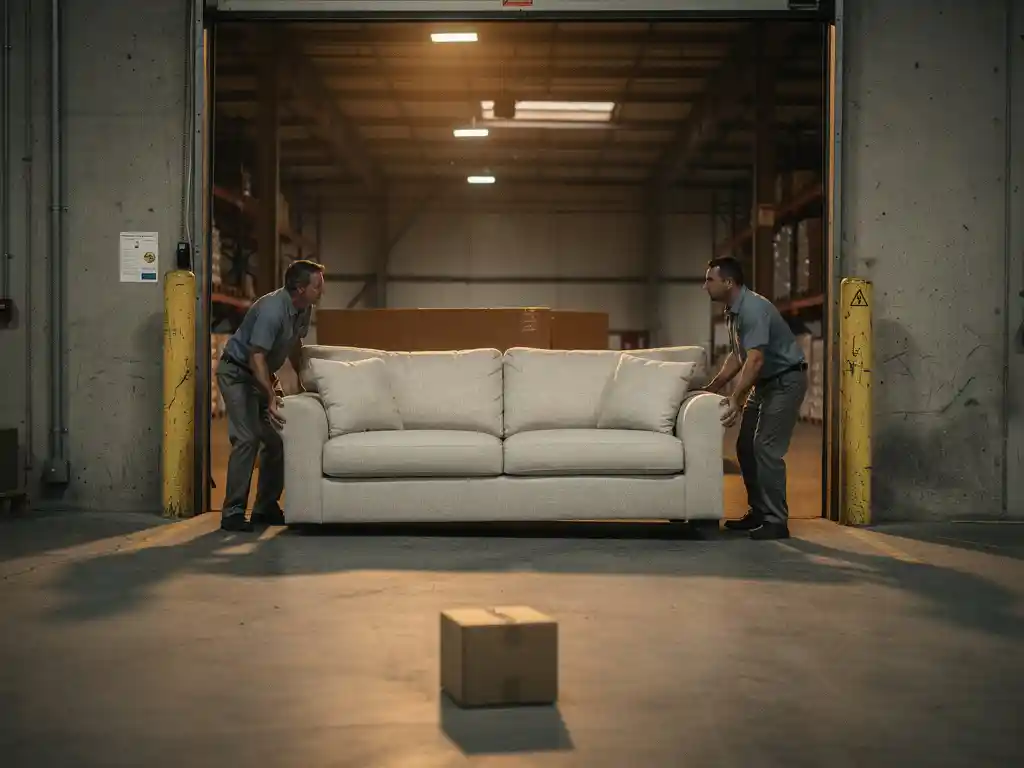
Furniture transport differs from parcel delivery because furniture is large, heavy, fragile, and often requires specialist handling at every stage of the journey. Standard parcel networks are built for speed and volume, with small, standardised packages. Furniture demands dedicated vehicles, trained crews, and tailored processes that a conventional courier simply cannot provide. The sections below break down exactly where those differences lie and what they mean in practice.
What makes furniture so difficult to transport safely?
Furniture is difficult to transport safely because of its combination of size, weight, fragility, and irregular shape. Unlike a boxed parcel that can be stacked uniformly on a conveyor belt, a sofa, wardrobe, or dining table presents unique physical challenges at every touchpoint, from loading and transit to final delivery. No two pieces behave the same way in transit.
The core risks in furniture transport come from several directions at once. Heavy items can shift during transit and damage themselves or other cargo. Delicate surfaces, such as glass panels, lacquered finishes, or upholstered fabrics, are vulnerable to scratches, pressure marks, and moisture. Flat-pack components can warp or crack if stacked incorrectly. And oversized items often require specialist lifting equipment or multi-person crews simply to move them safely from A to B.
There is also the structural reality of furniture itself. Many pieces are designed to look beautiful in a room but were never engineered for the stresses of road vibration, sharp cornering, or repeated loading and unloading. Specialist furniture logistics accounts for all of these factors before a single item leaves the warehouse.
Why can’t furniture go through a standard parcel network?
Furniture cannot go through a standard parcel network because those networks are optimised for small, uniform packages that move through automated sorting hubs. Furniture is too large for conveyor systems, too heavy for standard handling equipment, and too fragile for the repeated transfer points that define parcel delivery. Sending a large item through a parcel carrier dramatically increases the risk of damage and delay.
Parcel carriers operate on a model built around volume and speed. Packages change hands multiple times between collection and delivery, passing through sorting facilities where automated systems and fast-moving staff handle thousands of items per hour. A wardrobe or a glass-topped coffee table simply does not survive that environment intact.
Beyond the physical limitations, parcel networks also lack the service infrastructure that furniture shipping requires. There is no provision for two-person delivery teams, no room booking or pre-delivery communication, and no process for handling items that need to be carried up several flights of stairs or installed in a specific room. Large item delivery is a fundamentally different operation that requires dedicated vehicles, trained personnel, and a purpose-built logistics process.
What’s the difference between white glove delivery and standard drop-off?
White glove delivery is a premium furniture delivery service where trained specialists bring items into the home or workspace, position them in the correct room, and handle any unpacking or assembly. Standard drop-off means leaving the item at the door or in a ground-floor location, with no further service beyond that point. The difference is significant in terms of effort, expertise, and customer experience.
Standard drop-off is appropriate for small, lightweight items that the recipient can easily manage. For furniture, it often creates an immediate problem: the customer is left with a heavy, bulky item they may not be able to move on their own. This leads to damage, frustration, and a poor brand experience for the retailer or manufacturer.
White glove delivery eliminates those problems. A specialist team arrives with the right equipment, carries the item to the designated room, and ensures it is placed exactly where the customer wants it. Packaging is removed and taken away, and the delivery is completed to a professional standard. For high-value furniture, this level of service is not a luxury but a logical requirement. We deliver to this standard across more than 150 locations worldwide, ensuring that the final step in the supply chain matches the quality of the product itself.
How does furniture transport handle assembly and installation?
Specialist furniture transport providers handle assembly and installation by integrating these services directly into the delivery process. Rather than leaving flat-pack items for the customer to manage, trained technicians assemble furniture on-site, whether in a private home, a corporate office, or a large-scale project environment. This turns delivery into a complete, end-to-end solution.
Assembly during transport logistics can take several forms. Some items are partially assembled in the warehouse before loading, reducing the time spent on-site and minimising the risk of error. Others require full on-site assembly by specialists who know the product range and have the tools to complete the job efficiently and correctly.
For large-scale project installations, the scope extends well beyond individual pieces. We manage the full installation of furniture, wall decorations, plants, and related goods across entire commercial spaces, from open-plan offices and workstations to hospitality environments. This level of service requires precise coordination, experienced crews, and deep familiarity with the products being installed. It is a capability that no standard parcel or courier service can replicate.
What are the packaging requirements for furniture shipments?
Furniture shipments require packaging that is specifically designed to protect large, heavy, and often fragile items through the stresses of road transport. This typically means custom-fitted cardboard, protective foam or blanket wrapping, corner guards, and in some cases bespoke crating for high-value or particularly vulnerable pieces. Standard parcel packaging is not sufficient for most furniture items.
The packaging approach depends on the type of furniture, the distance it is travelling, and the number of handling points in the journey. A solid oak dining table shipped across Europe has very different packaging needs from a flat-pack shelving unit being delivered locally. Getting this right is essential because packaging failure at any point in transit can result in surface damage, structural breakage, or contamination that makes the item unsellable or unusable.
Specialist furniture logistics providers also think about packaging in terms of efficiency. Oversized or poorly packed items take up more vehicle space, increase handling time, and raise the risk of movement during transit. Well-designed packaging protects the product and makes the entire operation more cost-effective. Our innovative interchangeable loading systems are one example of how purpose-built infrastructure reduces loading and unloading times while keeping items secure throughout the journey.
When should a business choose specialist furniture logistics over a parcel carrier?
A business should choose specialist furniture logistics over a parcel carrier whenever the items being shipped are large, heavy, high-value, or require any form of handling beyond basic drop-off. If the product needs to arrive undamaged, be placed in a specific room, or be assembled on delivery, a parcel carrier is the wrong tool for the job. The cost of damage, returns, and poor customer experience will always outweigh any short-term saving on shipping rates.
The decision becomes straightforward when you consider what is actually at stake. For furniture retailers, manufacturers, and interior project companies, the delivery experience is a direct extension of the brand. A scratched surface or a missed delivery window reflects on the product and the business, not just the carrier. Specialist furniture shipping providers are accountable for the full journey and have the processes in place to manage exceptions when they arise.
There are also practical thresholds that make the choice clear. Items over a certain weight or dimension simply cannot move through parcel networks. Products requiring two-person handling, room-of-choice delivery, or installation require dedicated crews. And businesses operating at scale, whether supplying retail chains, fitting out commercial spaces, or managing warehousing and distribution, need a logistics partner with the infrastructure to handle volume reliably. We have been building that infrastructure since 1924, and it is precisely why specialist furniture logistics exists as a distinct discipline from general parcel delivery.