




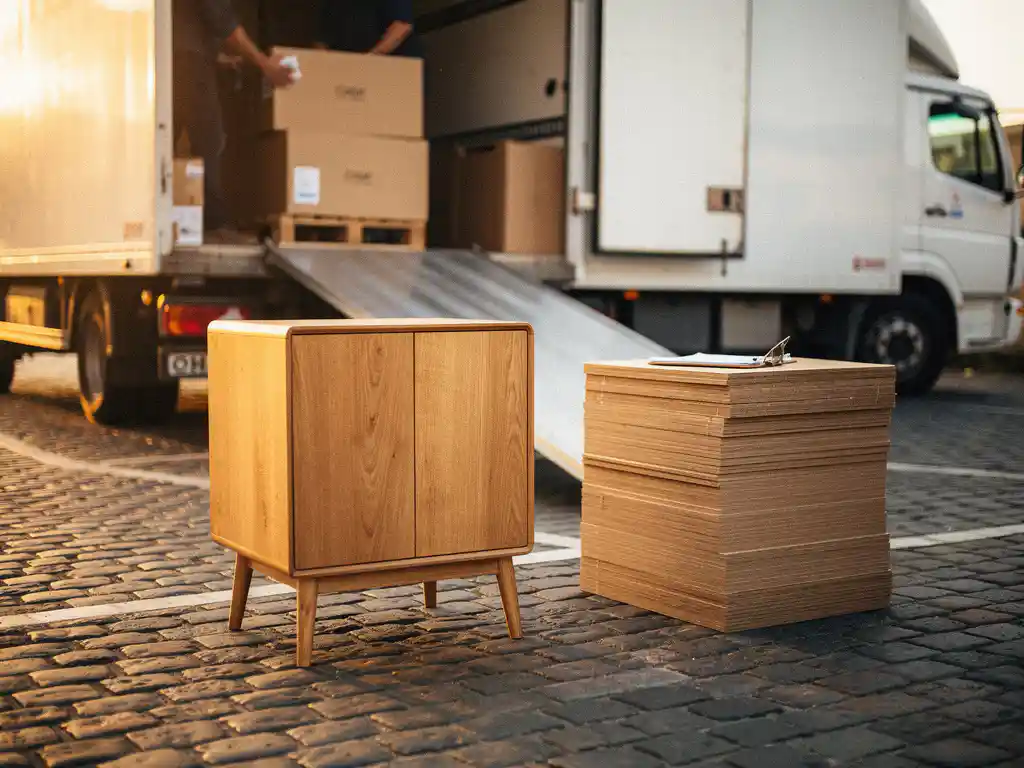
Breaking into European B2B distribution as a small furniture brand is genuinely complex. You are not just shipping products across borders — you are building a supply chain that needs to handle retailer expectations, customs requirements, last-mile delivery to commercial addresses, and the kind of inventory visibility that professional buyers demand. Get it right, and Europe becomes a significant growth market. Get it wrong, and delayed shipments, compliance issues, or poor delivery experiences can damage relationships with buyers before they even fully begin.
This guide walks you through each stage of setting up B2B distribution in Europe as a small furniture brand, from mapping your requirements to scaling as order volumes increase. Follow these steps in sequence, and you will have a clear, executable distribution strategy built for the realities of the European market.
Map your distribution requirements before entering Europe
Before committing to any logistics infrastructure, define exactly what your European B2B distribution needs to handle. Small furniture brands often underestimate how different their requirements are from consumer shipping — B2B buyers place larger, less frequent orders, expect delivery to warehouses or showrooms, and often have strict receiving windows and documentation requirements.
- List your target markets by country and identify which ones represent your primary volume in the first 12 to 18 months.
- Document your product range: dimensions, weight, fragility, and whether items ship flat-packed or assembled.
- Identify your typical B2B order profile — average order size, frequency, lead time expectations, and any white-glove delivery requirements.
- Map the receiving infrastructure of your target buyers: do they have loading docks, forklifts, or do deliveries need to go up stairs or through narrow commercial entrances?
- Determine whether you need returns handling, and if so, at what volume and complexity.
Once you have this information documented, you will have a clear picture of the service level your logistics setup needs to deliver. This prevents you from choosing a distribution model that fits your current volume but breaks down the moment a major retailer places a larger order.
Choose the right European distribution model for your brand
There is no single correct furniture brand distribution strategy for Europe. The right model depends on your order volumes, the countries you are targeting, and how much control you want over the customer experience. Understanding the available options before committing saves significant cost and operational disruption later.
The three most common models for small furniture brands entering European B2B distribution are:
- Direct shipping from origin: You ship each order directly from your production facility or home-country warehouse to the European buyer. Low upfront cost, but slow lead times and high per-shipment costs at low volumes.
- Central European hub: You consolidate inventory in a single European warehouse (commonly the Netherlands, Belgium, or Germany) and distribute from there. Faster lead times across the continent and more cost-effective at moderate volumes.
- Regional multi-hub model: You split inventory across two or more regional warehouses to serve northern, southern, and eastern Europe more efficiently. Best suited for brands with established, high-volume B2B relationships across multiple regions.
For most small furniture brands entering Europe, a central hub model is the most practical starting point. It gives you enough speed and coverage without requiring the capital investment of multiple locations. As your European furniture supply chain matures, you can layer in regional capacity where volumes justify it.
Set up warehousing and inventory management across Europe
With your distribution model chosen, the next step is establishing the physical warehousing infrastructure and the systems to manage inventory accurately. Furniture logistics places specific demands on warehousing — large footprints, careful handling to prevent damage, and often the need for pre-delivery assembly or quality inspection before goods go out.
- Select a warehouse location that sits within a strong transport corridor, with easy access to major motorways and ideally a nearby port or rail connection for inbound shipments.
- Confirm that the facility has appropriate racking, floor space, and handling equipment for your product dimensions and weight class.
- Implement a warehouse management system (WMS) that gives you real-time stock visibility and integrates with your order management platform.
- Define your inbound receiving process: how goods are checked, labelled, and booked into stock when they arrive from your supplier or production site.
- Set minimum stock thresholds for each SKU and establish a replenishment trigger process so you do not run out of fast-moving lines.
Verify this step is working correctly by placing a test order and tracking it from inbound receipt through to pick, pack, and dispatch. If your WMS cannot give you accurate stock counts and order status in real time, fix that before going live with B2B buyers. Professional buyers will ask for stock availability and order status updates — you need to be able to answer accurately and quickly.
If you need specialist furniture warehousing in Europe, working with a logistics partner that already has the right infrastructure in place is often faster and more cost-effective than building your own from scratch.
Configure last-mile delivery for B2B furniture buyers
Last-mile delivery for B2B furniture is significantly more demanding than standard parcel delivery. Your buyers are retailers, interior designers, project developers, or corporate clients — they expect professional handling, accurate delivery windows, and often require installation or placement services on arrival.
- Define your delivery service levels: standard pallet delivery, two-person carry-in, room of choice placement, or full assembly and installation.
- Identify which service levels apply to which buyer segments and build this into your pricing and order process.
- Select last-mile delivery partners in each target country who have specific experience with furniture and can meet your service level requirements.
- Establish a delivery booking process that allows buyers to schedule delivery windows that suit their receiving operations.
- Set up proof-of-delivery documentation, including condition reports, so you have a clear record if damage claims arise.
After your first wave of deliveries, review proof-of-delivery records and any damage reports. A high damage rate at delivery usually points to a packaging issue or a handling problem during last-mile transport — address it early before it affects buyer relationships. We have seen that furniture brands that invest in two-person delivery teams and proper carry-in services consistently receive better buyer feedback and generate stronger repeat order rates.
For complex project deliveries — such as furnishing entire office spaces or hospitality venues — consider a specialist partner with project logistics capabilities who can coordinate multi-location installations across Europe.
Handle customs and cross-border compliance in the EU
If you are shipping furniture into Europe from outside the EU — for example, from Asia, the UK, or the US — customs compliance is not optional and not simple. Getting this wrong creates delays, unexpected costs, and can put your products on a customs hold just when a buyer is expecting delivery.
- Classify your products correctly under the EU’s Combined Nomenclature (CN) codes. Furniture falls under Chapter 94, but the specific subheading affects the duty rate applied.
- Confirm the country of origin for each product, as this determines whether preferential trade agreement rates apply and affects anti-dumping duty calculations.
- Ensure your commercial invoices, packing lists, and certificates of origin are accurate and consistent — discrepancies between documents are a common cause of customs delays.
- Register for VAT in each EU country where you hold stock or exceed the distance selling threshold, or appoint a fiscal representative to manage this on your behalf.
- Decide whether you will import goods under DDP (Delivered Duty Paid) terms, which means you handle all import costs, or DAP (Delivered at Place), where the buyer handles import duties. DDP is typically preferred by B2B buyers as it simplifies their process.
Once your first shipment clears customs without delays, you will have confirmed that your documentation process is working. If you encounter issues, work backwards from the customs authority’s query to identify which document or data point caused the problem, then fix it at the source. Partnering with a customs broker or a logistics provider experienced in furniture logistics Europe can significantly reduce the learning curve here.
Scale your B2B distribution as order volumes grow
With your distribution infrastructure running and your first B2B buyers receiving orders reliably, the focus shifts to scaling without losing the service quality that won those relationships. Growth in B2B furniture distribution tends to come in waves — a new retail partnership or a large project win can double your volume quickly, and your logistics setup needs to absorb that without breaking.
- Review your warehousing capacity every quarter and identify at what order volume you will need to expand space or add a second location.
- Negotiate volume-based rates with your transport partners in advance so that as your shipment frequency increases, your per-unit cost decreases.
- Automate your order processing and inventory replenishment as much as possible — manual processes that work at low volume become bottlenecks at scale.
- Add value-added services progressively: assembly, product customisation, labelling, or kitting can differentiate your offer and deepen buyer relationships without requiring a new logistics setup.
- Evaluate your distribution model annually — what worked as a central hub model may benefit from a regional warehouse in Scandinavia or southern Europe once volumes in those markets justify it.
The clearest sign that your B2B distribution in Europe is scaling well is when new buyer onboarding no longer requires manual intervention at every step. If your systems and processes can absorb a new retail partner without a scramble, you have built something that can grow. For brands looking to expand their European reach further, exploring contract logistics solutions can provide the flexible capacity and specialist expertise needed to support that next phase of growth.