




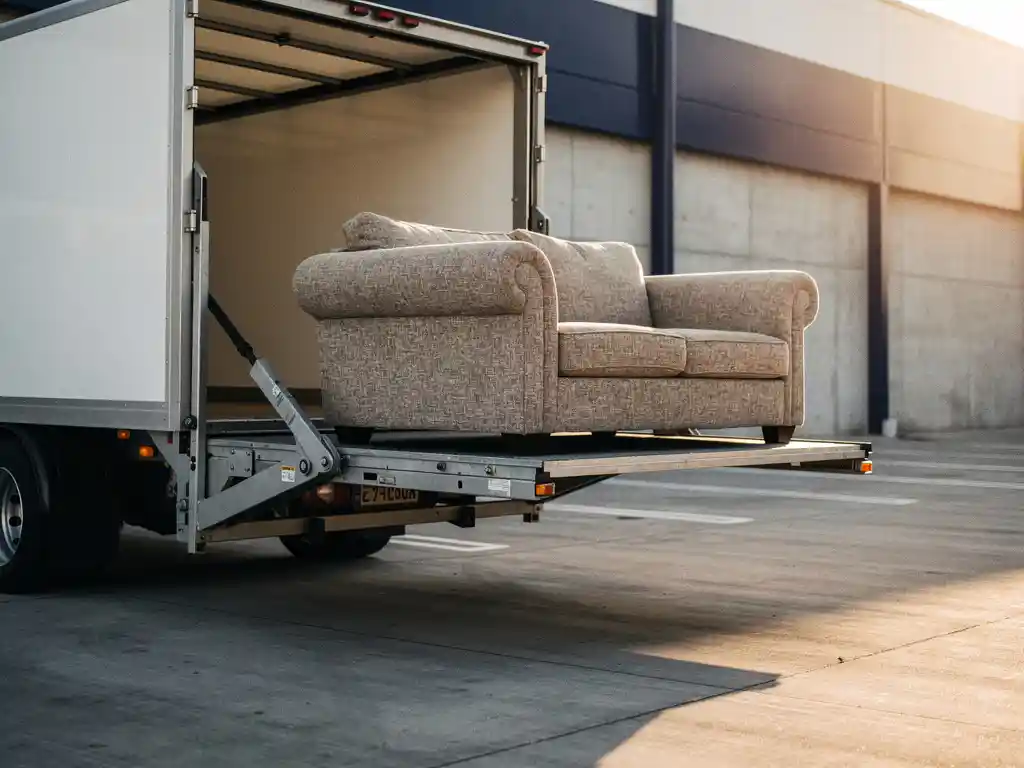
To transport heavy sofas safely, you need a vehicle with sufficient load volume and a tail lift rated to handle the weight. For most large or sectional sofas, a 3.5-tonne box van or a larger curtainsider truck is the right starting point, paired with a column or cantilever tail lift rated at 500 kg or more. The right combination depends on sofa size, delivery location, and whether you are working with a loading dock or a residential address. The sections below break down each factor in detail.
What size vehicle do you need to transport heavy sofas?
For transporting heavy sofas, a vehicle with a minimum load capacity of 1,000 kg and a cargo area of at least 10 to 14 cubic metres is typically required. A 3.5-tonne box van handles most standard sofa deliveries, while large sectional sofas, corner units, or multi-item furniture consignments require a 7.5-tonne or larger curtainsider truck with a full-height cargo bay.
The key measurement to check is not just weight capacity but internal load height and width. Many large sofas, particularly L-shaped or modular designs, are bulky rather than heavy. A cargo bay that is too low or too narrow forces awkward tilting, which risks damage to both the furniture and the vehicle. For residential deliveries where access is limited, a 3.5-tonne van with a long wheelbase offers a good balance between load space and manoeuvrability on narrow streets.
For commercial or project deliveries involving multiple sofas, a larger rigid truck or an articulated vehicle with a swap body system is far more efficient. We use innovative swap body systems at Jan Krediet that significantly reduce loading and unloading times, which matters when you are delivering to multiple addresses in a single run. If you are regularly handling furniture transport at scale, vehicle selection should be part of a broader logistics plan rather than a one-off decision.
What type of tail lift is best for heavy sofa delivery?
A column tail lift or a cantilever tail lift is best for heavy sofa delivery. Column lifts, which use vertical posts on either side of the vehicle’s rear, offer high stability and are well-suited to heavy or awkwardly shaped loads. Cantilever lifts fold under the vehicle when not in use, making them practical for urban deliveries where rear clearance is limited.
For sofa logistics specifically, the platform size of the tail lift matters as much as its weight rating. A wider and deeper platform gives handlers more room to position a large sofa correctly before lowering it to the ground. Foldable or tuck-away tail lifts are popular in residential delivery fleets because they do not protrude beyond the vehicle’s footprint when stowed, which helps with parking and manoeuvring.
Tuck-under lifts are another option worth considering for high-frequency sofa delivery routes. They sit flush under the load floor when retracted and deploy quickly, reducing dwell time at each stop. For very heavy items such as large leather sofas or solid-frame modular units, a column lift with a rated capacity of 750 kg or more provides the safest and most controlled descent.
How much weight can a tail lift handle for furniture transport?
Most standard tail lifts used in furniture transport are rated between 500 kg and 1,500 kg. For typical sofa delivery, a 500 kg to 750 kg rated tail lift is sufficient, as even large sectional sofas rarely exceed 300 to 400 kg. However, when transporting heavy furniture loads that include multiple items at once, a higher-rated lift reduces risk and speeds up the loading process.
It is important to note that the rated capacity of a tail lift refers to the maximum load the platform can safely carry, not the total vehicle payload. You must account for the combined weight of the furniture and any handling equipment such as trolleys or skates placed on the platform at the same time. Overloading a tail lift, even marginally, increases wear on the hydraulic system and creates a safety risk for the handlers involved.
When selecting a tail lift truck for sofa logistics, always check the manufacturer’s rated capacity against your heaviest expected single lift. If you regularly move complete room sets or large corner sofas in one lift, choosing a platform rated at 1,000 kg gives you a reliable safety margin and ensures compliance with equipment operating guidelines.
What are the legal requirements for using a tail lift on public roads?
In most European countries, vehicles fitted with a tail lift must comply with specific equipment standards, operator training requirements, and regular inspection schedules. In the UK and across the EU, tail lifts must meet the requirements of EN 1756-1 (for tail lifts on vehicles), and operators must ensure that anyone using the lift has received documented training. The vehicle itself must also be included in the operator’s maintenance programme.
Beyond the equipment standards, drivers and handlers using a tail lift on public roads must follow safe working procedures at every delivery point. This includes checking that the platform is fully lowered before loading, ensuring the vehicle is stable on level ground before operating the lift, and never exceeding the rated capacity. In the UK, the Lifting Operations and Lifting Equipment Regulations (LOLER) apply to tail lifts used in the course of work, requiring regular thorough examinations by a competent person.
For fleet operators running regular sofa delivery vehicle routes, keeping maintenance records and examination certificates up to date is both a legal obligation and a practical safeguard. Non-compliance can result in prohibition notices, fines, or liability in the event of an incident. If your operation spans multiple countries, it is worth verifying the specific national regulations in each market, as inspection intervals and documentation requirements can vary.
When should you use a tail lift versus a loading dock for sofa delivery?
Use a tail lift when delivering to residential addresses, smaller retail outlets, or any location that does not have a fixed loading dock. Use a loading dock when delivering to warehouses, large furniture showrooms, or distribution centres where the dock height matches the vehicle’s load floor, allowing direct roll-off handling without the need for a lift platform.
The practical distinction comes down to speed and access. A loading dock allows handlers to move heavy sofas directly from the vehicle to the receiving area using trolleys or pallet trucks, which is faster and reduces manual handling risk. However, loading docks are fixed infrastructure and only useful when the vehicle’s floor height aligns with the dock. Mismatched heights can actually create more risk than using a tail lift correctly.
For residential sofa delivery, a tail lift is almost always the better choice. Most homes and apartment buildings have no dock access, and carrying heavy sofas down ramps or over kerbs increases the chance of damage and injury. A well-rated tail lift brings the sofa to ground level in a controlled, smooth movement, protecting both the furniture and the delivery team.
In project logistics scenarios, such as furnishing a new hotel or office building, the choice often shifts depending on the build stage. Early in a project, a loading dock or goods lift may not yet be operational, making a tail lift essential. Later in the project, once the building’s infrastructure is in place, dock deliveries become more efficient. We handle exactly these kinds of complex, phased delivery environments through our project logistics solutions, adapting equipment and access methods to whatever the site requires at each stage.