


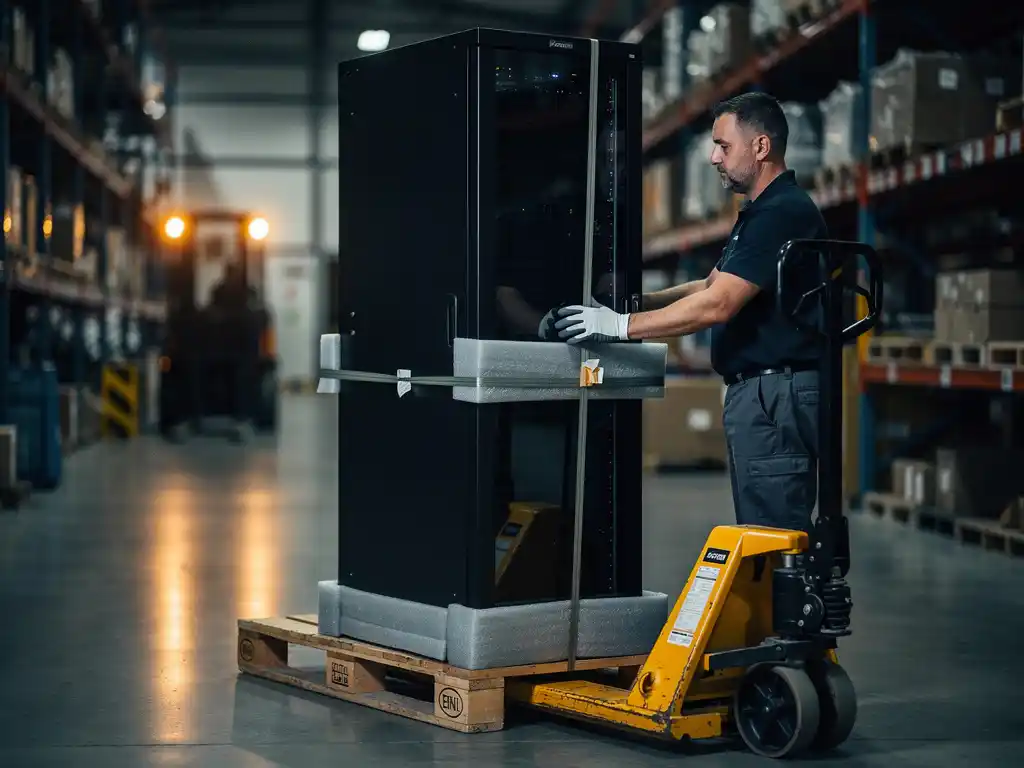
The safest way to relocate server racks is to combine thorough pre-move preparation with specialist handling, purpose-built equipment, and a carefully controlled process at every stage. Server racks contain sensitive, high-value hardware that can be damaged by vibration, static discharge, dust, or improper lifting. The sections below walk through each phase of a safe server rack move, from the risks you need to plan around to the steps that protect your infrastructure after it arrives.
What are the biggest risks when moving server racks?
The biggest risks when moving server racks are physical shock and vibration, electrostatic discharge, dust contamination, and data loss caused by abrupt power interruption. Even a short drop or a sharp jolt during transit can damage hard drives, loosen cable connections, or crack circuit boards. Understanding these risks before the move begins is the foundation of moving server racks without disruption.
Physical impact is the most immediate concern. Server racks are heavy, often exceeding several hundred kilograms when fully loaded, and their internal components are precision-engineered to tight tolerances. Vibration during road transport can loosen rack-mounted components, and any tilting beyond a safe angle risks stressing mounting rails and cable runs.
Electrostatic discharge is a less visible but equally serious threat. Without proper anti-static precautions during handling, a single discharge can silently damage components in ways that only become apparent days or weeks after the move. Dust is a related hazard: server hardware exposed to uncontrolled environments during transit can suffer cooling failures caused by particulate contamination.
Finally, data integrity must be treated as a risk category in its own right. If servers are not shut down correctly before the move, file system corruption or drive failure can result in permanent data loss that no amount of careful physical handling can reverse.
How should server racks be prepared before transport?
Server racks should be prepared for transport by performing a controlled shutdown of all systems, documenting every cable connection, removing removable components where possible, and conducting a full inventory and backup. Preparation is where the majority of risk is either eliminated or locked in, making it the most important phase of moving server racks without disruption.
Start with a complete data backup verified against a recovery test. No other preparation step matters if data is lost in transit. Once backups are confirmed, shut down all servers according to their correct sequence, allowing operating systems to close gracefully rather than cutting power abruptly.
Before any cables are disconnected, photograph or diagram every connection in detail. Colour-coded cable labels applied at both ends of each cable dramatically reduce reassembly time and eliminate guesswork at the destination. Rack diagrams showing the position of every unit in the rack should be created or updated at this stage.
Where the rack design allows, remove particularly fragile or heavy components such as UPS units, large storage arrays, or blade server chassis and pack them separately. This reduces the total weight of the rack during transit and removes the most vibration-sensitive items from the most exposed position. All remaining components should be secured within the rack using blanking panels and cable management tools to prevent internal movement.
What packaging and equipment is needed to transport server racks safely?
Transporting server racks safely requires anti-static packaging for individual components, purpose-built rack transport cases or custom crating, vibration-dampening materials, climate-controlled or air-ride suspension vehicles, and mechanical lifting equipment rated for the load. Using the wrong equipment is one of the most common causes of damage during server rack relocation.
Anti-static bags and foam inserts are essential for any components removed from the rack before the move. Standard bubble wrap or cardboard is not sufficient for sensitive electronics because it can generate static charge. Purpose-built anti-static foam is the correct choice.
For the rack itself, custom-built transit cases with internal foam lining and shock-absorbing mounts offer the highest level of protection. Where a transit case is not practical, the rack should at a minimum be wrapped in anti-static blankets, secured to a pallet with ratchet straps, and loaded onto a vehicle with air-ride suspension to absorb road vibration.
Mechanical handling equipment is non-negotiable for safety. Server racks should never be manually carried over any meaningful distance. Specialist server rack trolleys with tilt control, pallet trucks rated for the load, and tail-lift vehicles are the standard tools for this type of move. The vehicle itself should be loaded so the rack travels upright unless the manufacturer specifies otherwise, and it should be braced against movement in all directions during transit.
Should you hire a specialist logistics provider for server rack relocation?
Yes, hiring a specialist logistics provider for server rack relocation is strongly advisable for any move involving production systems, large rack counts, or tight recovery time objectives. The combination of trained personnel, appropriate equipment, and a structured process significantly reduces the risk of damage, data loss, and extended downtime compared to managing the move internally.
A general removals company is not equipped for this type of work. Server rack relocation requires knowledge of anti-static handling, correct shutdown and startup procedures, load-bearing equipment, and clean-room or controlled-environment protocols. Without these, even a carefully planned move can result in costly hardware failure.
We at Jan Krediet handle exactly this kind of complex, high-stakes logistics. Our project logistics team assembles server cabinets in a dust-free clean-room environment and provides warehousing, worldwide distribution, and on-site installation for technology clients. Every project is built around a dedicated team with the specific skills and equipment the work demands.
When evaluating a logistics provider for server rack relocation, look for demonstrated experience with IT hardware, clean-room or controlled-environment capability, anti-static handling protocols, and a clear chain of accountability from collection to final installation. A provider who can also manage customs documentation and international coordination adds further value for cross-border moves.
How is server rack safety maintained during the actual move?
Server rack safety during the actual move is maintained through controlled loading procedures, secure bracing inside the vehicle, vibration-monitored transport where required, and a dedicated escort or supervision protocol for high-value loads. The physical move itself is the phase where preparation either pays off or falls short.
Loading should follow a planned sequence. The heaviest racks are positioned low and close to the vehicle’s axle to minimise load shift. Each rack is secured individually using load straps or ratchet systems attached to anchor points, not to the rack’s own components. The interior of the transport vehicle should be checked for cleanliness before loading to prevent dust contamination.
For particularly sensitive loads, vibration data loggers can be attached to the rack to record any impacts or excessive movement during transit. These devices provide evidence of handling quality and can help identify whether any damage originated during transport or during loading and unloading.
Throughout the move, a single point of contact should coordinate between the logistics team, the IT team at the origin, and the receiving team at the destination. Communication gaps during a live server rack move are a common source of delays and errors. The receiving location should be prepared and accessible before the transport vehicle departs, so there is no waiting period during which the rack sits in an uncontrolled environment.
What should happen after server racks arrive at the new location?
After server racks arrive at the new location, they should be allowed to acclimatise to room temperature before being powered on, then inspected for transit damage, reconnected according to the pre-move documentation, and brought online in a controlled sequence with system checks at each stage. A structured post-arrival process is what converts a successful physical move into a fully operational system.
Acclimatisation is a step that is frequently skipped and frequently causes problems. If racks have been transported in a cold vehicle and moved into a warm data centre, condensation can form on internal components. Allowing the equipment to reach ambient temperature before powering on prevents moisture-related failures.
Once the equipment is at temperature, a physical inspection of every rack and component should be completed before any cables are reconnected. Look for loose mounting hardware, dislodged cables, and any visible signs of impact. Compare the current state against the pre-move photographs and inventory.
Reconnection should follow the documented cable diagrams created during preparation. Bring systems online one at a time rather than powering everything simultaneously, and run diagnostics on each server before moving to the next. This staged approach means that if a problem exists, it can be isolated and addressed without cascading into a wider failure.
Finally, verify that backups taken before the move are still accessible and intact, and run a full system test against the operational requirements of each server. Document the completed move, including any issues encountered and how they were resolved, so the process can be improved for future relocations. If you want to learn more about how we approach complex logistics challenges like this, visit our about us page or explore our client cases for real-world examples.