


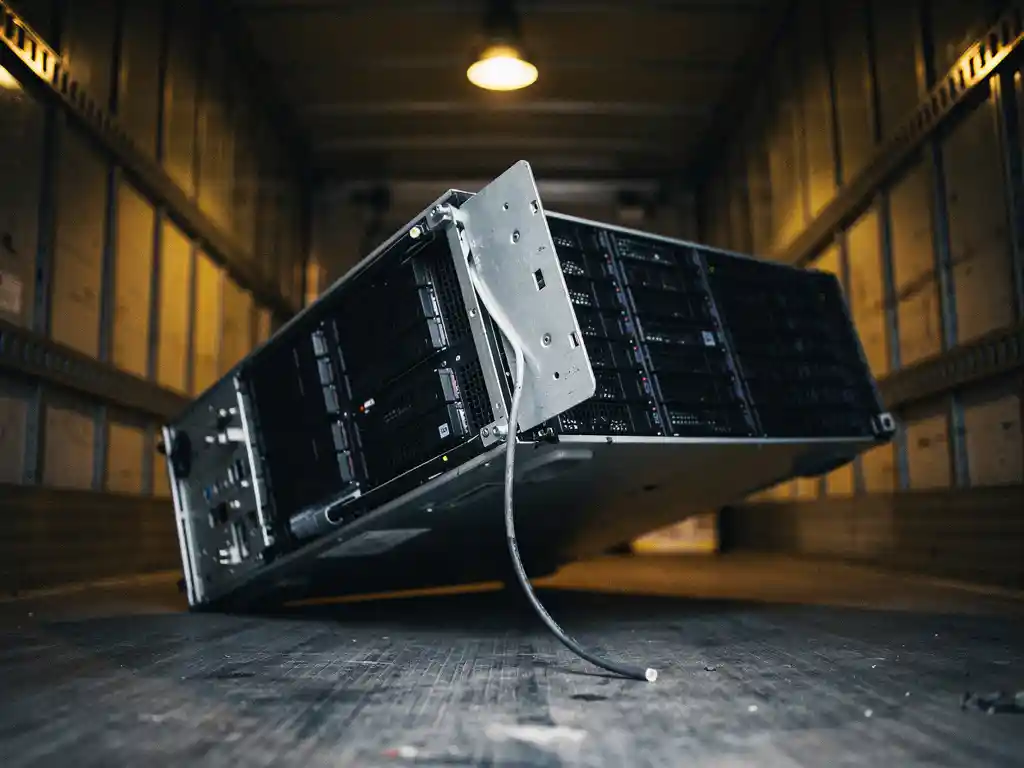
Server racks get damaged during transport primarily because of vibration, shock, improper packaging, and climate exposure. These systems contain precision components, including drives, circuit boards, and cable assemblies, that are highly sensitive to mechanical stress and environmental changes. The sections below break down the most common causes and what proper high-tech logistics actually looks like in practice.
What types of damage do server racks typically suffer in transit?
Server racks most commonly suffer from physical impact damage, vibration-induced component failure, bent or misaligned rack frames, loose or disconnected internal cabling, and corrosion or condensation damage caused by humidity exposure. Because a single rack can house dozens of interdependent components, even minor damage to one part can render the entire unit non-functional on arrival.
The most visible form of damage is structural: dented panels, cracked bezels, and bent mounting rails. These tend to occur when a rack tips, is dropped, or is struck by another load in the vehicle. Less visible but equally serious is internal damage, where hard drives suffer head crashes, solid-state components crack at their solder joints, or memory modules are dislodged from their slots. This type of damage is often only discovered when the rack is powered on at its destination.
Cabling is another frequent casualty. Server racks are typically pre-wired before shipping to save installation time at the destination. During transit, vibration and movement can loosen connectors, pull cables free from their routing clips, or cause abrasion damage to cable sheaths where they rub against rack edges. Diagnosing and correcting this at the destination adds significant time and cost to deployment.
How does improper packaging cause server rack damage?
Improper packaging causes server rack damage by failing to absorb impact, allowing movement within the packaging, and leaving components exposed to environmental conditions. When a rack is not secured inside its outer packaging, even modest road vibration causes it to shift repeatedly, and a single sharp stop or corner can produce enough force to crack components or bend the frame.
A common packaging mistake is using generic pallets and stretch wrap without internal bracing. Stretch wrap holds the rack to the pallet but does nothing to cushion shock. Without foam inserts, air cushions, or custom-formed crating around sensitive areas, the rack absorbs every jolt directly. For tall, heavy racks, the leverage effect amplifies movement at the top of the unit, meaning the upper components experience far more stress than the packaging is designed to handle.
Custom crating, foam-in-place packaging, and anti-static materials are the standard for server rack shipments. Anti-static packaging matters because standard foam and plastic can generate electrostatic discharge that damages circuit boards without leaving any visible mark. A rack that arrives looking pristine can still carry invisible electrostatic damage that only manifests as component failure weeks later.
Why does vibration during transport damage server rack components?
Vibration during transport damages server rack components because sustained mechanical oscillation causes fatigue failure in solder joints, loosens fasteners, and creates micro-movement between connectors and their sockets. Unlike a single impact, vibration is cumulative: each cycle of movement is small, but thousands of cycles over a long journey add up to structural failure in components that were designed for stationary operation.
Hard disk drives are particularly vulnerable. The read/write heads inside a spinning disk float a fraction of a millimeter above the disk surface. Road vibration at certain frequencies can cause resonance within the drive enclosure, forcing the heads to contact the disk surface and causing a head crash that destroys data and renders the drive inoperable. Even solid-state drives, which have no moving parts, can suffer solder joint cracking under prolonged vibration.
Rack-mounted components also work loose over time. Screws back out, card retaining clips release, and expansion cards shift in their PCIe slots. When the rack arrives and is powered on, the result can be anything from a missing storage volume to a complete failure to boot. Vibration-dampening mounts, drive parking software, and proper internal securing of all components before shipment are the primary defenses against this category of damage.
What handling mistakes most often lead to server rack damage?
The handling mistakes most likely to cause server rack damage are tilting or laying the rack on its side, using forklifts without proper stabilization, failing to secure the rack within the vehicle, and allowing untrained personnel to move the unit without understanding its weight distribution or fragility. Server racks are tall, heavy, and top-heavy when populated, making them inherently unstable during manual handling.
Tilting a rack is one of the most damaging things that can happen during a move. Many rack-mounted components, including battery backup units and certain drive arrays, are not designed to operate or be transported on their side. Doing so can cause internal fluid movement in batteries, drive head contact in spinning disks, and gravity-induced stress on mounting brackets that were designed to carry load in only one orientation.
Forklift handling without proper load securing is another frequent cause of damage. A rack placed on a pallet without cross-bracing can slide or tip when the forklift accelerates, brakes, or turns. Vehicle loading is equally critical: a rack placed against a hard wall without padding, or loaded alongside other freight that can shift, is exposed to impact forces throughout the journey. Professional high-tech logistics requires that racks be loaded last, secured individually, and isolated from other cargo.
How does climate change during shipping affect server racks?
Climate change during shipping, specifically rapid shifts in temperature and humidity, damages server racks by causing condensation to form on circuit boards and metal components, accelerating corrosion, and inducing thermal expansion and contraction that stress solder joints and connectors. A rack moved from a cold warehouse into a warm vehicle and then into a different climate at its destination is exposed to multiple condensation events throughout a single journey.
Condensation is the most immediate risk. When warm, humid air contacts a cold metal surface, moisture forms on that surface. Inside a server rack, this moisture can bridge electrical contacts, cause short circuits, and initiate corrosion on copper traces and connector pins. The damage may not be immediately apparent, but corrosion progresses over time and can cause intermittent failures that are difficult to diagnose.
Long-distance or intercontinental shipments present additional challenges. A rack shipped by sea freight may spend days in a container environment where temperature and humidity fluctuate significantly, particularly if the container is stored on deck or passes through tropical ports. Proper climate-controlled packaging, desiccant packs, and sealed moisture barrier bags are essential for any server rack shipment that crosses climate zones or involves extended transit times.
What should a logistics provider do differently when shipping server racks?
A logistics provider shipping server racks should treat them as high-value, high-sensitivity freight from the first point of contact: using custom crating or anti-static packaging, climate-controlled vehicles where appropriate, vibration-dampening mounts, trained handlers, and clean, controlled loading environments. Standard general cargo procedures are not adequate for server rack transport.
We at Jan Krediet have direct experience with exactly this type of challenge. As part of our project logistics services, we assemble and distribute server cabinets for a major business IT solutions provider, carrying out assembly work in a dust-free clean room within our warehouse before worldwide distribution. This environment eliminates the contamination risk that standard warehouse handling would introduce, and it reflects the level of care that precision IT equipment demands.
Beyond the physical environment, the right provider brings structured process discipline to every shipment. This means pre-shipment inspection of all components and cable routing, documented packing procedures with photographic records, vehicle load plans that isolate the rack from other freight, and trained drivers who understand why a server rack cannot be handled like a standard pallet. Our warehousing capabilities support the full chain, from goods reception through to final delivery, with a single point of contact managing every step.
For organizations shipping server racks internationally, customs clearance is an additional complexity that a capable provider must handle without delay. A rack held at customs for days in an uncontrolled environment compounds every climate and handling risk already present in the journey. Providers who manage the complete administrative process, including customs documentation and compliance, remove this risk entirely and ensure the rack reaches its destination in the condition in which it left.
If you are planning a server rack shipment and want to discuss a logistics approach built around the specific demands of your equipment, get in touch with our team to explore what a tailored solution looks like for your situation.