


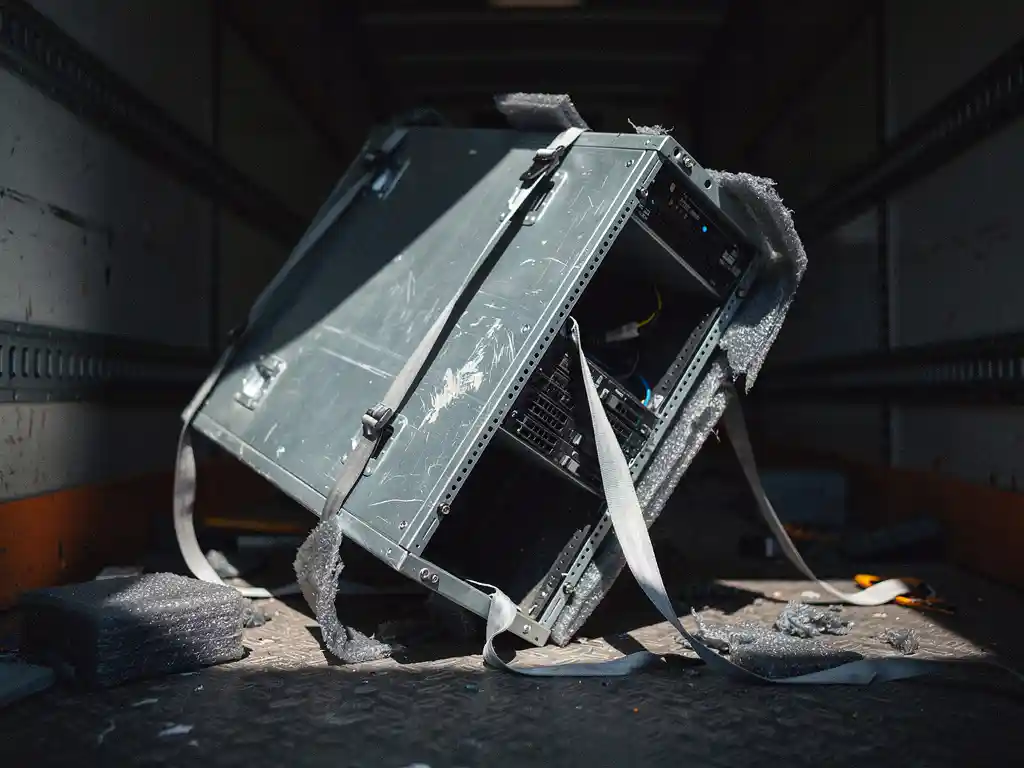
Server racks are most commonly damaged in transit by a combination of physical shock, vibration, improper packaging, and environmental exposure. These are precision-engineered systems carrying sensitive components, and even moderate mishandling during loading, transport, or unloading can cause failures that are not immediately visible but surface only after installation. The sections below break down each risk factor in detail.
What types of physical stress occur during server rack transport?
Server racks in transit are exposed to three primary forms of physical stress: impact shock, sustained vibration, and compression. Impact shock occurs during loading and unloading when racks are dropped, jolted, or set down abruptly. Vibration builds continuously across road surfaces. Compression results from stacking or improper restraint inside a vehicle.
Each of these stress types acts differently on the equipment. A single impact event can crack mounting rails, dislodge drive bays, or break solder joints on circuit boards. Sustained vibration, even at low intensity, causes cumulative fatigue in connectors and cable terminations over the course of a long journey. Compression from poor load securing can warp rack frames or damage front-panel components.
Road transport introduces the broadest range of physical stress because vehicles encounter varying road quality, braking events, and cornering forces throughout a single journey. Air freight introduces different dynamics, including turbulence and rapid pressure changes during ascent and descent. Sea freight exposes racks to prolonged rolling motion, which is particularly problematic for rack-mounted drives with spinning platters. Understanding which type of stress is most likely for a given route is the starting point for designing appropriate protection.
Why are server racks particularly vulnerable to vibration damage?
Server racks are especially vulnerable to vibration because they contain multiple components with different resonant frequencies. When vibration from a vehicle matches the natural resonant frequency of a component, that component absorbs and amplifies the energy rather than simply passing it through. This can cause mechanical fatigue, connector loosening, and drive failures far more quickly than the vibration level alone would suggest.
Hard disk drives are among the most vibration-sensitive components in a server rack. Spinning platters operate with read and write heads positioned at microscopic distances from the disk surface. Even minor vibration can cause read/write errors or head crashes. Solid-state drives are more resilient but are not immune, particularly when housed in poorly secured caddies that allow movement within the rack.
Beyond drives, vibration affects PCIe cards, RAM modules, and power supply connections. These components rely on firm contact between connectors. Vibration introduces micro-movement that gradually loosens connections, leading to intermittent faults that are difficult to diagnose after the fact. Cable management within the rack also plays a role: unsecured cables act as pendulums, transferring vibration energy directly to the ports and cards they connect to.
How does improper packaging cause server rack damage?
Improper packaging causes server rack damage by failing to absorb or redirect the physical forces the rack encounters during transit. When packaging does not match the weight, dimensions, and fragility profile of the rack, the rack itself becomes the shock absorber, which means its components bear the full force of every impact and vibration event.
Common packaging failures include using generic foam that compresses too quickly and bottoms out on impact, leaving no protective buffer. Thin cardboard corners and edge protectors that are sized for lighter equipment offer little structural support for a fully loaded rack weighing several hundred kilograms. Pallets that are too small or not rated for the load allow the rack to shift during transport, creating lateral stresses the packaging was never designed to handle.
Internal packaging is equally important. Rack-mounted components that are not individually secured within the rack can move freely inside the chassis. Drives, cards, and cable assemblies that shift during transit can damage neighboring components or disconnect entirely. Professional packaging for server racks typically involves custom crating, vibration-dampening mounts, moisture barrier wrapping, and internal bracing that immobilizes components relative to the chassis. Without these measures, even a well-driven journey carries meaningful risk.
What role do humidity and temperature play in transit damage?
Humidity and temperature fluctuations during transit can damage server racks by causing condensation on circuit boards, accelerating corrosion of metal contacts, and inducing thermal expansion and contraction in components. These effects are invisible during transit but create failures that emerge during or after installation.
Condensation is the most immediate risk. When a server rack moves from a cold storage environment or a refrigerated vehicle into a warm warehouse or loading dock, moisture in the air condenses on cold metal and circuit board surfaces. If the rack is powered on before it has fully equalized to ambient temperature, that moisture can cause short circuits. This is a well-understood risk in data center commissioning, but it is equally relevant during transit when temperature transitions happen repeatedly and without the controlled conditions of a data center.
Longer-term humidity exposure causes corrosion on connector pins, PCB traces, and chassis components. Even modest humidity above recommended storage thresholds, sustained over a multi-day sea freight journey, can degrade contact quality in ways that produce intermittent faults months after installation. Temperature extremes compound this: very low temperatures make plastics brittle and can cause thermal cracking in solder joints, while very high temperatures can damage battery backup units and thermally sensitive capacitors. Effective transit packaging includes moisture barrier wrapping, desiccant packs, and, for high-value shipments, temperature-monitored containers.
Which handling mistakes most commonly damage server racks?
The handling mistakes that most commonly result in a server rack being damaged during transport include tilting the rack beyond its rated angle, using inadequate lifting equipment, failing to secure the load inside the vehicle, and rushing the loading and unloading process. Each of these errors introduces forces that packaging alone cannot compensate for.
Tilting a rack beyond its design limits shifts the center of gravity and places lateral stress on the frame. Many racks are designed to be transported only in an upright or horizontal position, and deviating from this can cause internal components to shift, drives to misalign in their bays, or the frame itself to flex. Using a forklift with forks that are too narrow concentrates load on a small area of the pallet, creating pressure points that can crack the pallet and destabilize the rack above it.
Inside the vehicle, failure to use appropriate load restraints is a frequent cause of damage. A rack that is not strapped, blocked, or braced against the vehicle wall can move freely during braking and cornering. The forces involved in a standard emergency stop are significant enough to topple an unsecured rack entirely. Rushing during loading and unloading reduces the care applied to each movement and increases the likelihood of impacts at doorways, ramps, and loading bays. These are the moments when most physical damage occurs, and they are entirely preventable with the right personnel, equipment, and time allocation.
How can specialist logistics reduce the risk of server rack damage?
Specialist logistics reduces the risk of server rack damage during transport by combining purpose-built infrastructure, trained personnel, and tailored handling protocols that address each of the risks described above. A general cargo carrier applies standard procedures; a specialist applies procedures designed specifically for high-value, fragile technical equipment.
We handle exactly this type of complex, high-stakes logistics. Our project logistics team has direct experience assembling and transporting server cabinets, including work carried out in a dust-free clean room environment within our warehouse. This kind of controlled environment matters because contamination and environmental exposure are risks that begin before a rack ever reaches a vehicle.
The practical advantages of specialist logistics for server rack transport include:
- Custom packaging and crating matched to the specific dimensions and weight of the rack
- Vibration-dampening solutions applied at both the packaging and vehicle level
- Trained two-person handling teams who understand the correct orientation, lift points, and movement protocols for technical equipment
- Temperature and humidity monitoring during transit for sensitive shipments
- Dedicated project coordination that manages every handoff point in the chain, reducing the number of uncontrolled transfers
- Clean room facilities for pre-shipment inspection and post-delivery installation
Beyond the physical handling, specialist logistics providers apply just-in-time planning to minimize the time equipment spends in transit and in intermediate storage, both of which reduce cumulative exposure to risk. Every additional handoff in a logistics chain is an additional opportunity for damage; reducing those handoffs through direct, coordinated routing is itself a protective measure.
If you are planning a server rack relocation or international IT equipment shipment, contact our team to discuss a solution built around your specific requirements. You can also learn more about who we are and the standards we apply across every logistics engagement.