


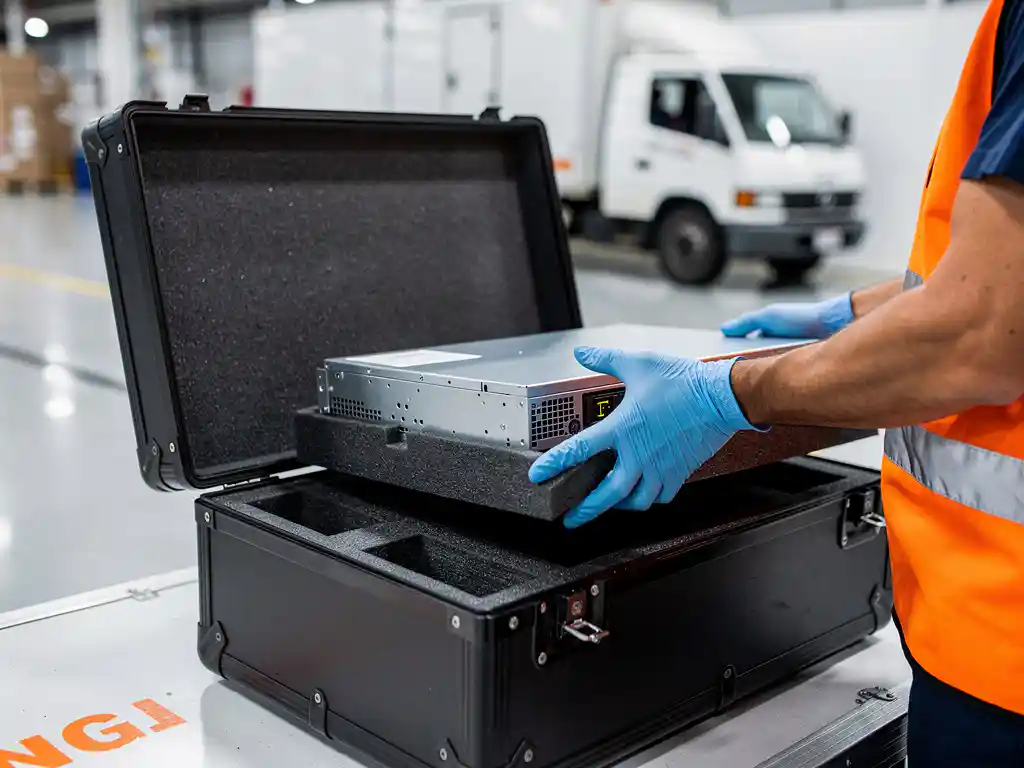
The safest way to ship sensitive IT equipment is to combine purpose-built protective packaging with a specialist logistics provider who understands the unique vulnerabilities of electronics. Standard freight handling is rarely adequate for servers, networking hardware, or precision devices. The sections below answer the most important questions about how to transport sensitive equipment safely, from packaging choices to documentation and real-time tracking.
What types of damage can occur when shipping IT equipment?
Sensitive IT equipment can be damaged by physical shock, vibration, electrostatic discharge, moisture, and temperature extremes during transit. Each of these risks is distinct, and a shipment that avoids one can still fall victim to another. Understanding the full range of threats is the first step toward preventing them.
Physical and mechanical damage
Impacts from drops, rough handling, and road vibration are the most common causes of damage during transport. Hard drives are particularly vulnerable because their read/write heads float nanometres above spinning platters. Even a moderate jolt can cause a head crash. Circuit boards can crack, solder joints can fracture, and connectors can shear under repeated vibration over long distances.
Electrostatic discharge and environmental damage
Electrostatic discharge (ESD) is invisible but destructive. A static charge that a person would barely notice can permanently damage a processor, memory module, or graphics card. Alongside ESD, condensation caused by temperature swings can deposit moisture on circuit boards, leading to short circuits when the equipment is powered on. Dust ingress is a secondary concern, particularly for optical drives and precision cooling systems.
What packaging materials are best for shipping sensitive electronics?
The best packaging for sensitive electronics combines anti-static protection, multi-layer cushioning, and rigid outer containment. Anti-static bags or ESD-shielding pouches should enclose individual components first. These are then surrounded by foam inserts, either custom-cut foam or high-density foam-in-place, inside a double-walled corrugated box or a purpose-built flight case.
For high-value or fragile equipment such as servers, rack units, or medical-grade IT hardware, reusable custom crates with internal suspension systems offer the highest level of protection. Suspension packaging holds the item away from all six walls of the container, meaning the outer crate can absorb a significant impact without transmitting it to the contents. Desiccant sachets placed inside the packaging absorb moisture during transit, reducing the risk of condensation damage. ShockWatch indicators and tilt sensors can be attached to the outside of the package to flag rough handling during the journey.
How do temperature and humidity affect IT equipment during transport?
Temperature and humidity directly affect the physical integrity of IT components. Extreme cold makes plastics brittle and can cause solder joints to contract and crack. Extreme heat softens adhesives, warps circuit boards, and degrades battery cells. Humidity introduces moisture that corrodes metal contacts and causes short circuits when equipment is powered on after delivery.
The most dangerous scenario is a rapid temperature change, for example moving equipment from a cold cargo hold into a warm warehouse. This causes condensation to form on internal surfaces. Industry guidance consistently recommends allowing equipment to acclimatise to ambient temperature before powering it on, typically for several hours after a significant temperature transition. For shipments crossing climate zones or travelling by sea freight, temperature-controlled containers or climate-monitored vehicles significantly reduce this risk. When planning how to transport sensitive equipment safely across long distances or international routes, requesting temperature and humidity logging throughout the journey provides verifiable proof that conditions remained within acceptable limits.
Should you use a general freight carrier or a specialist IT logistics provider?
For sensitive IT equipment, a specialist logistics provider is strongly preferable to a general freight carrier. General carriers optimise for volume and speed, and their handling procedures are designed for standard palletised goods. Specialist providers, by contrast, train their staff specifically in the care requirements of electronics, use appropriate equipment, and build their processes around damage prevention rather than throughput.
The practical differences are significant. A specialist provider will offer clean-room handling environments for components that cannot tolerate dust, ESD-safe procedures throughout the chain, and staff who understand why certain equipment cannot be stacked or tilted. We at Jan Krediet, for instance, assemble server cabinets in a dedicated dust-free clean room within our warehouse, and our teams are trained to handle high-value technology hardware with the same attention to detail we apply to premium furniture and kitchen logistics. Our project logistics solutions cover the full chain from warehousing to on-site installation, which is particularly relevant for large IT rollouts across multiple locations.
General freight carriers can be appropriate for robust, well-packaged commodity goods, but for servers, networking equipment, or any hardware where a single transit incident could result in data loss or significant replacement costs, the risk calculus favours a specialist every time.
What documentation and insurance do you need when shipping IT equipment?
When shipping sensitive IT equipment, you need accurate commercial invoices, packing lists, and in most cases a certificate of origin for international shipments. For cross-border movements, customs documentation including the correct HS tariff codes for electronic equipment is essential to avoid delays at borders. Inadequate or incorrect paperwork is one of the leading causes of shipment holds, which can expose equipment to uncontrolled storage conditions.
Insurance deserves careful attention. Standard carrier liability is almost always insufficient for IT equipment, as it is typically calculated by weight rather than value. A server rack weighing 80 kilograms may have a replacement value many times what standard liability would cover. Specialist all-risk cargo insurance, which covers the actual declared value of the goods against damage, theft, and loss, is the appropriate level of cover for high-value electronics. When working with a logistics partner, confirm in writing what their liability covers and where your own insurance obligation begins. Retaining photographs of the equipment and its packaging before handover provides a baseline record if a claim becomes necessary.
For businesses managing IT equipment internationally, customs clearance expertise matters as much as the paperwork itself. We handle the complete administrative process on behalf of our clients, including customs advisory, which removes both the logistical and administrative burden from the shipper. You can learn more about how we approach this through our company overview.
How can you track and verify the safe delivery of IT equipment?
Tracking and verifying the safe delivery of IT equipment requires a combination of real-time shipment visibility, physical condition monitoring, and a structured delivery confirmation process. Real-time tracking gives you location data throughout the journey, while condition monitoring tools such as shock sensors, temperature loggers, and humidity indicators tell you whether the equipment was handled correctly along the way.
At the point of delivery, a trained professional should conduct a visual inspection of the outer packaging before the recipient signs for the goods. If any packaging shows signs of impact, moisture, or tampering, this should be noted on the delivery record before the carrier leaves. Opening and inspecting the equipment itself at delivery, rather than days later, preserves your ability to make a timely damage claim if needed.
For large-scale IT deployments across multiple sites, a logistics partner who provides online tracking and a single dedicated contact person throughout the process adds significant value. It removes the need to chase multiple parties for updates and ensures that any issue is escalated and resolved quickly. We provide clients with continuous visibility and direct communication at every step, so that both the shipper and the end recipient always know where their equipment is and what condition it is in. If you would like to discuss a specific IT logistics challenge, our team is ready to help via our contact page.