


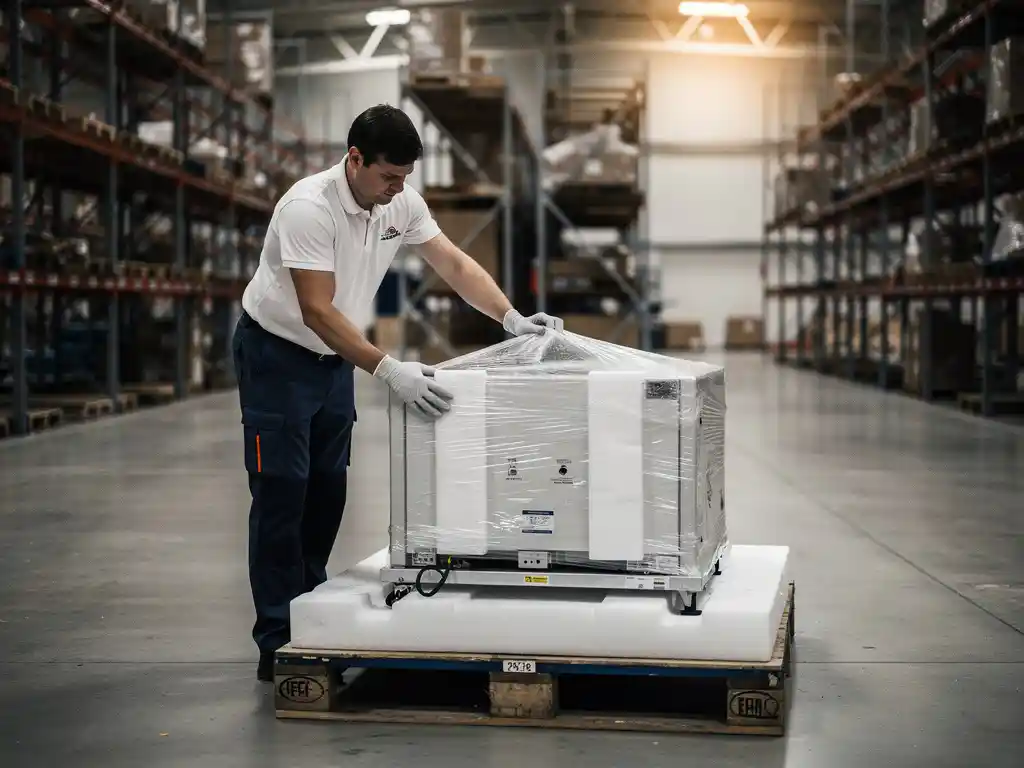
Companies that specialize in transporting sensitive equipment are dedicated logistics providers with trained personnel, purpose-built vehicles, and tailored handling procedures designed to protect high-value or fragile goods throughout the entire supply chain. Not every carrier is equipped for this work. Specialist providers combine technical knowledge, appropriate infrastructure, and a structured approach to risk that standard freight services simply cannot match. Below, we answer the most important questions about sensitive equipment transport so you can make an informed decision about your logistics partner.
What types of equipment are considered sensitive in logistics?
Sensitive equipment in logistics refers to any goods that require special handling conditions, controlled environments, or heightened care to prevent damage during transport, storage, or installation. This includes items that are fragile, high in value, technically complex, or vulnerable to environmental factors such as vibration, moisture, or temperature changes.
The category is broader than most people expect. Common examples include:
- High-end furniture and kitchens – premium pieces with delicate finishes, precision-fitted components, and surfaces that scratch or dent easily
- Server cabinets and IT infrastructure – equipment that requires dust-free environments and careful assembly, often in clean-room conditions
- Works of art – paintings, sculptures, and installations that demand climate-controlled handling and specialist packing
- Medical and laboratory equipment – precision instruments sensitive to shock, vibration, or contamination
- Event and exhibition installations – large-format displays, modular structures, and bespoke fittings that must arrive intact and ready for immediate setup
What unites all of these categories is that a standard freight approach, where speed and volume efficiency take priority, creates unacceptable risk. The cost of damage to sensitive goods almost always exceeds the cost of specialist transport. That is why identifying whether your cargo qualifies as sensitive is the first and most important step in planning any shipment.
What services does a sensitive equipment specialist provide?
A sensitive equipment specialist provides end-to-end logistics services designed around the specific vulnerabilities of the goods being moved. This goes well beyond transport alone and typically includes pre-shipment inspection, specialist packing, controlled storage, white-glove delivery, on-site assembly, and installation, all coordinated by a dedicated project team.
We at Jan Krediet offer a full-service model that covers every stage of this process. Our project logistics approach means that a dedicated team is built around the specific needs and goals of each client, covering planning, coordination, and execution so that no detail is left unmanaged.
Key services a specialist provider should offer include:
- Pre-departure inspection – trained professionals check goods before loading to identify and document any pre-existing condition
- Purpose-built vehicle configurations – such as swap bodies with double loading floors that increase capacity while reducing the physical stress of loading and unloading
- Two-person delivery teams – essential for heavy, fragile, or complex items that cannot safely be handled by a single driver
- Clean-room assembly – for technology equipment requiring a controlled, dust-free environment
- White-glove installation – on-site assembly and placement at the final destination, whether a private home, office, or commercial venue
- Customs clearance and documentation – handling the full administrative process for international shipments
- Real-time tracking and client communication – keeping all parties informed at every stage
How does specialist transport differ from standard freight?
Specialist transport differs from standard freight in three fundamental ways: the people involved are trained specifically for the goods they handle, the vehicles and equipment are configured for protection rather than volume alone, and the service model is built around the individual shipment rather than a standardized process applied to all cargo equally.
In standard freight, efficiency is the primary driver. Goods are consolidated, routed through hubs, and handled by generalist staff whose focus is throughput. This works well for durable, non-sensitive cargo. For sensitive equipment, however, each additional handling point and each moment of rough treatment represents a risk of damage or loss.
Specialist transport addresses this in several practical ways:
- Trained personnel: Staff are educated in the specific characteristics of the goods they carry. We train our own people in-house, combining on-the-job learning with deep product knowledge, whether that involves premium furniture transport or technically complex installations.
- Vehicle configuration: Specialist carriers use vehicles adapted to the cargo, including double loading floors, climate control, and load-securing systems that reduce movement during transit.
- Fewer handling points: Where possible, specialist providers move goods directly from origin to destination, reducing the number of times items are loaded, unloaded, and repositioned.
- Accountability structures: A single dedicated contact manages the entire shipment, providing a clear point of responsibility that does not exist in standard freight networks.
The difference in outcome is significant. For goods where the cost of damage is high, whether financially or reputationally, specialist transport is not a premium option. It is the appropriate baseline.
What qualifications should a sensitive equipment carrier have?
A sensitive equipment carrier should hold relevant industry certifications, demonstrate a track record with comparable goods, operate purpose-built vehicles, employ trained and vetted personnel, and be able to provide a structured, documented approach to risk management throughout the logistics chain.
When evaluating a carrier, look for the following qualifications and indicators:
- Environmental and quality certifications – ISO 14001 certification, for example, signals that a provider manages its operations to an internationally recognized standard, which reflects broader operational discipline
- Sector-specific experience – a carrier that has handled your type of goods for years, ideally decades, brings knowledge that cannot be replicated by a generalist
- In-house training programmes – providers who train their own staff rather than relying solely on external hires demonstrate a genuine commitment to handling standards
- Modern, maintained vehicle fleet – vehicles meeting current emissions and safety standards, such as EURO 6, indicate investment in operational quality
- Global partner network – for international shipments, the carrier should work with verified partners who operate to the same standards, not whoever is available locally
- Demonstrated project capability – ask for evidence of completed projects of similar complexity, including multi-site, multi-country, or technically demanding installations
Our standards and values reflect more than a century of experience in specialist logistics, including recognition as one of the top logistics providers in the Netherlands. Qualifications matter, but so does the culture behind them.
When should you use a specialist logistics provider instead of a courier?
You should use a specialist logistics provider instead of a courier when the goods require trained handling, when damage would carry significant financial or reputational consequences, when the delivery involves assembly or installation at the destination, or when the shipment crosses international borders and requires customs expertise.
Couriers are optimized for speed and simplicity. They work well for documents, small parcels, and durable goods that can withstand standard handling. The moment your shipment requires anything beyond basic pick-up and drop-off, a courier’s model creates risk rather than reducing it.
Specific situations that call for a specialist provider include:
- Delivering directly from a factory to a consumer’s home, including unpacking and room placement
- Furnishing an entire office, hotel, school, or coworking space across multiple locations
- Transporting and installing server infrastructure in a controlled environment
- Managing high-volume B2C distribution of premium goods where end-customer satisfaction directly affects your brand reputation
- Handling short lead times where goods produced today must reach their destination the following day, without compromising care
- Coordinating international shipments that involve sea freight, air freight, customs clearance, and last-mile delivery as a single managed process
The commercial logic is straightforward. If a damaged or delayed delivery costs more than the price difference between a courier and a specialist, the specialist is the more economical choice, not just the safer one. For anyone working with sensitive equipment, that calculation almost always favours a provider built specifically for the task. You can explore the full range of industries we serve to see whether your sector falls within our area of expertise, or get in touch to discuss your specific logistics challenge directly.