


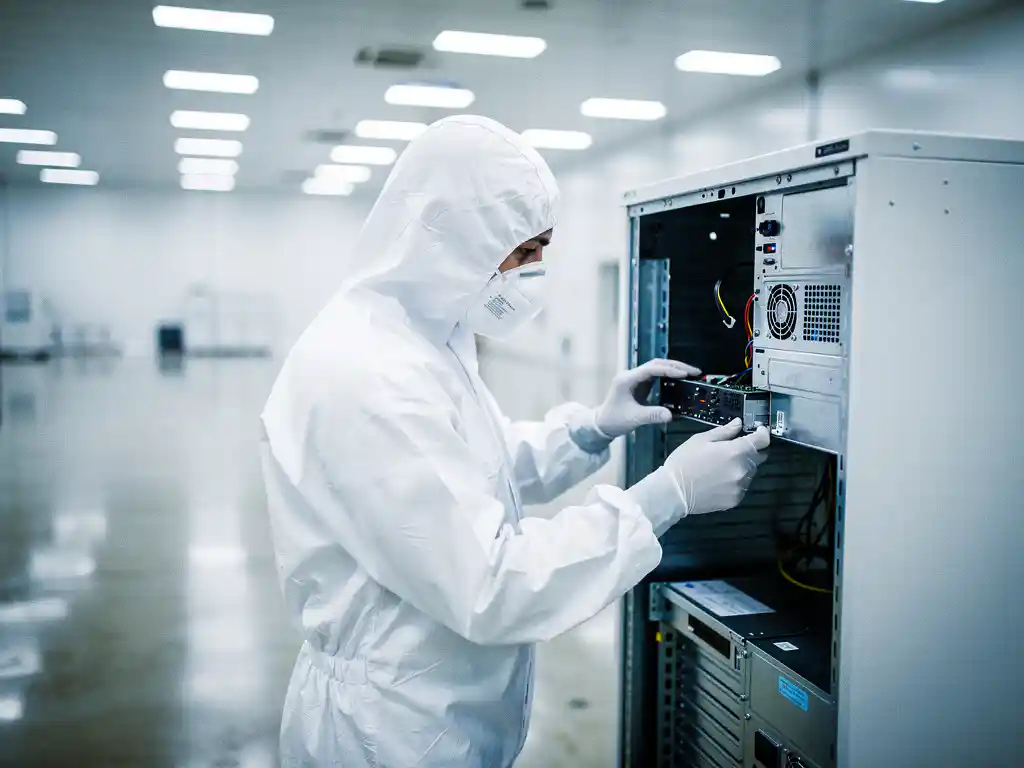
Server equipment can be assembled in a dust-free environment inside a dedicated cleanroom facility, either at a specialist data center, a certified IT integrator, or a logistics provider that operates a cleanroom within its warehouse. The most practical option depends on project scale, delivery complexity, and whether the assembly needs to be combined with storage and worldwide distribution.
Dust contamination is one of the leading causes of premature hardware failure, making the choice of assembly environment a critical decision for any organization deploying server infrastructure. This article works through the key questions surrounding dust-free server assembly, from facility types and cleanroom standards to transport requirements and the risks of getting it wrong.
What types of facilities offer dust-free server assembly?
Dust-free server assembly is carried out in cleanrooms, which are controlled environments designed to limit airborne particles, humidity, and static electricity. The main facility types that offer this capability are dedicated IT integration centers, data center staging areas, and specialist logistics warehouses equipped with cleanroom infrastructure. Each option suits different project needs.
Dedicated IT integration centers are purpose-built for hardware assembly, racking, and configuration. These facilities are designed from the ground up to meet strict particle control requirements and are typically used by large-scale IT solution providers or system integrators deploying server infrastructure at volume.
Data center staging areas serve a similar function but are physically located within or adjacent to the data center where the equipment will ultimately operate. Assembly in a staging area reduces the number of transport steps between build and deployment, which lowers the risk of contamination or physical damage during transit.
Logistics providers with cleanroom warehouse facilities offer a compelling alternative, particularly when assembly needs to be combined with storage, inventory management, and international distribution. We operate exactly this type of facility, assembling server cabinets in a dust-free cleanroom within our warehouse for a major business IT solutions provider, and combining that service with warehousing, refurbishment, and worldwide distribution from a single location. You can learn more about how we approach these complex engagements on our project logistics solutions page.
What cleanroom standards apply to server equipment assembly?
Cleanroom standards for server equipment assembly are defined by ISO 14644-1, which classifies cleanrooms by the concentration of airborne particles per cubic meter. For most server assembly work, an ISO Class 7 or ISO Class 8 environment is considered appropriate, though highly sensitive components such as storage media or optical hardware may require stricter conditions.
ISO Class 8 permits up to 3,520,000 particles of 0.5 microns or larger per cubic meter of air. This is the minimum level most IT professionals consider acceptable for general server rack assembly and cable management. ISO Class 7 is ten times cleaner and is used when assembling more sensitive components or when the risk of static discharge needs to be more tightly managed.
Beyond particle counts, a properly certified cleanroom for server assembly also controls:
- Relative humidity, typically maintained between 40% and 60% to reduce static electricity buildup
- Temperature stability, which protects sensitive components during handling
- Electrostatic discharge (ESD) protection through anti-static flooring, wrist straps, and grounded workstations
- Air pressure differentials, which prevent unfiltered air from entering the controlled space
- Personnel protocols, including gowning requirements and restricted access
When evaluating a facility, it is worth requesting documentation of its ISO classification and asking how frequently air quality is tested and verified. A facility that cannot provide this documentation should not be trusted for sensitive server assembly work.
Can logistics providers perform dust-free server assembly?
Yes, specialist logistics providers can and do perform dust-free server assembly, provided they have invested in cleanroom infrastructure within their warehouse operations. This capability is not universal across the logistics industry, but it exists among full-service providers that have expanded into high-tech and IT logistics as a dedicated service line.
The advantage of using a logistics provider for server assembly is integration. When a single partner handles goods reception, cleanroom assembly, quality inspection, storage, and outbound distribution, the number of handoffs in the supply chain is reduced. Fewer handoffs mean fewer opportunities for damage, contamination, or administrative error.
We are a practical example of this model. Our team assembles server cabinets in a dust-free cleanroom environment for a major IT solutions provider, and we combine that assembly work with warehousing and refurbishment services, as well as worldwide distribution. This means the client receives a fully managed service from the moment goods arrive at our facility to the moment they reach their destination anywhere in the world.
For organizations evaluating this route, the key questions to ask a logistics provider are whether their cleanroom meets a documented ISO classification, whether their staff are trained in ESD protocols, and whether they can demonstrate experience with comparable IT hardware projects. Our warehousing capabilities and track record across technology and project logistics reflect the depth of infrastructure and expertise we bring to this work.
What are the risks of assembling servers outside a dust-free environment?
Assembling servers outside a dust-free environment exposes hardware to airborne particles that can settle on circuit boards, cooling fans, and connectors, leading to overheating, electrical short circuits, and accelerated component degradation. The consequences range from reduced hardware lifespan to immediate failure, with significant financial and operational implications for the organization deploying the equipment.
Dust is particularly damaging because it acts as an insulator on components that need to dissipate heat. Processors, memory modules, and power supply units all generate heat during operation. When dust accumulates on these components or blocks airflow through the chassis, operating temperatures rise, triggering thermal throttling or, in more serious cases, permanent damage.
Static electricity is an equally serious concern. Standard warehouse or office environments generate significant electrostatic discharge through ordinary human movement. A single uncontrolled discharge of a few hundred volts, invisible and unfelt by a person, can permanently destroy a memory module or processor. Cleanroom environments control this through ESD-safe flooring, grounded work surfaces, and personal protective equipment.
There are also long-term reliability risks that are harder to detect immediately. Hardware assembled in a contaminated environment may pass initial testing but fail earlier than expected once deployed, creating warranty complications and unplanned downtime for the end user. For enterprise clients deploying server infrastructure at scale, these risks translate directly into support costs and reputational exposure.
How should server equipment be transported to an assembly site?
Server equipment should be transported in its original manufacturer packaging or in custom anti-static, shock-absorbing packaging, using vehicles that are clean, temperature-controlled where required, and operated by personnel trained in handling sensitive IT hardware. The transport environment should be treated as an extension of the cleanroom, not as a separate concern.
The key principles for transporting server equipment safely are:
- Use appropriate packaging: Anti-static bags, foam inserts, and rigid outer cases protect components from both electrostatic discharge and physical shock during loading, transit, and unloading.
- Control the vehicle environment: Extreme temperature fluctuations can cause condensation inside sealed equipment. Where possible, use temperature-stable transport, and allow equipment to acclimatize before opening packaging at the destination.
- Minimize handling steps: Every additional handoff between origin and assembly site is an opportunity for damage. Consolidating transport and assembly with a single provider reduces this risk significantly.
- Train the handling team: Drivers and handlers working with IT hardware should understand ESD risks and proper lifting and loading techniques for rack-mounted equipment.
- Maintain chain of custody documentation: For high-value server hardware, tracking the condition of goods from origin to assembly site provides accountability and supports warranty claims if damage occurs.
We apply these principles across our general cargo transport operations and extend them specifically to high-tech logistics projects. When transport is coordinated by the same team managing cleanroom assembly and warehousing, the entire chain operates under consistent quality standards, which is the most reliable way to protect sensitive server equipment from origin to final deployment.