


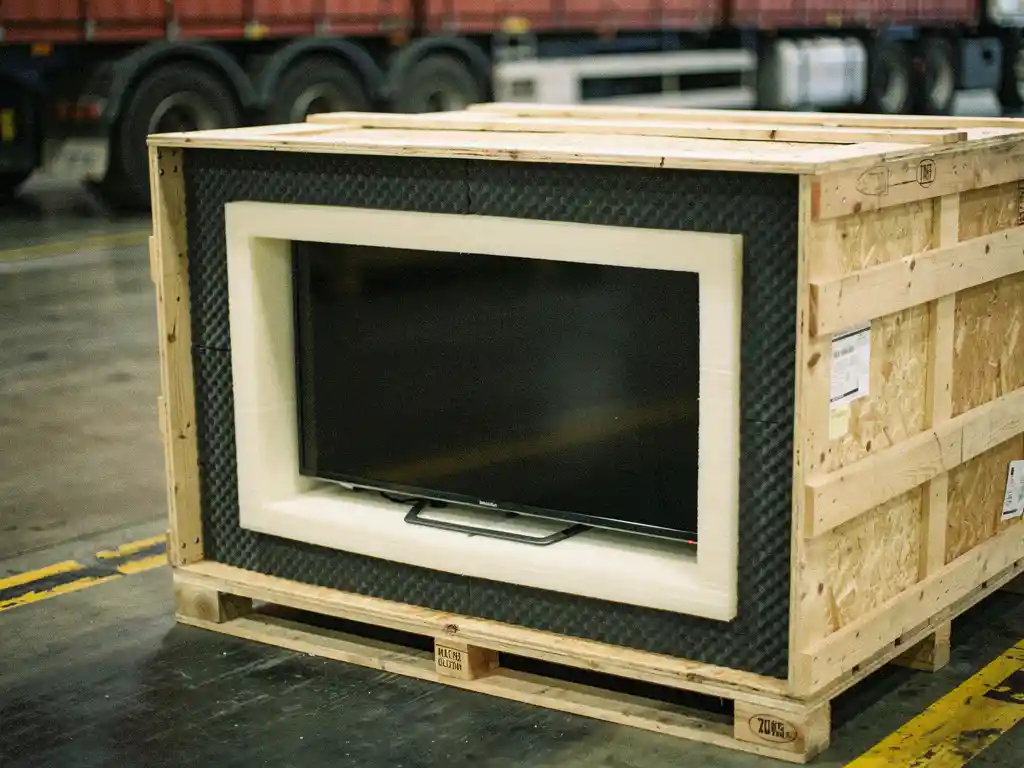
Electronics destined for transport need shock protection rated to absorb impacts of at least 50 G for most consumer devices, with fragile components like hard drives and circuit boards requiring even greater cushioning. The right level of protection depends on the product’s fragility, the transport mode, and the distance involved. This article unpacks the most common damage risks, the best materials, and how professional logistics providers keep sensitive electronics safe in transit.
What types of damage occur during electronics transport?
The most common types of damage during electronics transport are physical impact damage, vibration-induced component failure, electrostatic discharge, and moisture ingress. Each of these damage mechanisms works differently and requires a different protective response, which is why effective shock protection for electronics transport must address all of them together.
Physical impact damage is the most visible category. It occurs when a package is dropped, knocked against another object, or compressed under heavy loads during stacking. The result can range from cracked screens and bent casings to broken solder joints inside the device that are invisible until the product is powered on.
Vibration damage is subtler but equally destructive. During road, rail, or sea freight, constant low-frequency vibrations cause components to work loose, solder connections to fatigue, and sensitive read/write heads in hard drives to wear prematurely. Over a long journey, cumulative vibration stress can degrade a product that arrived without a single visible dent.
Electrostatic discharge (ESD) is a serious risk for bare circuit boards, memory modules, and processors. Even a small static charge transferred through inadequate packaging can permanently damage microelectronics without leaving any physical mark. Moisture ingress, meanwhile, is a particular concern for sea freight and cold-chain transitions, where condensation forms when temperature differentials are large.
What packaging materials provide the best shock protection?
The best shock protection materials for electronics transport are expanded polyethylene (EPE) foam, polyurethane foam, and air cushion systems, each chosen based on the fragility and weight of the product. For extremely sensitive components, anti-static foam and ESD shielding bags must be added to address electrostatic risks alongside physical impact.
Foam-based cushioning
EPE foam is the industry workhorse for electronics packaging. It is lightweight, moisture-resistant, and available in a wide range of densities, making it easy to match the cushioning grade to the specific G-force threshold of the product being shipped. Polyurethane foam offers a softer, more conforming alternative that works well for irregularly shaped items like monitors or audio equipment.
Molded foam inserts are the premium option. They are cut or cast to the exact dimensions of the product, distributing impact energy evenly across the entire surface rather than concentrating stress at contact points. This is the standard used by most premium consumer electronics manufacturers for their retail packaging, and it translates directly into better protection during freight transport.
Air-based and suspension systems
Air cushion packaging and suspension packaging, where the product is held in place by stretched film or inflatable bags without touching the box walls, are increasingly popular for high-value electronics. These systems excel at absorbing sharp, sudden impacts because the air or film acts as a buffer zone. They also reduce package weight compared to foam, which matters for air freight where weight directly affects cost.
For outer packaging, double-walled corrugated cardboard remains the standard secondary layer. The corrugated structure absorbs compression loads and provides a rigid outer shell that prevents the inner cushioning from being overwhelmed by stacking pressure in a warehouse or freight container.
How does vibration during freight transport affect electronic components?
Vibration during freight transport affects electronic components by inducing fatigue in solder joints, loosening mechanical connections, and causing resonance in sensitive parts like hard drive platters and optical assemblies. The damage accumulates progressively, meaning a product can pass a single-drop test but still arrive functionally compromised after a long road or sea journey.
Different transport modes produce different vibration profiles. Road transport generates irregular, broadband vibrations from road surface irregularities and engine operation. Rail freight produces lower-amplitude but more rhythmic vibrations. Sea freight introduces slow, rolling motion combined with higher-frequency vibrations from the ship’s engines. Each profile stresses components differently, which is why packaging engineers use transport simulation testing to expose prototype packaging to representative vibration sequences before approving it for use.
The components most vulnerable to vibration are mechanical hard drives, whose read/write heads can be damaged by lateral movement, and connectors or socketed components that can work loose over time. Solid-state drives and fully integrated circuit boards are more resilient to vibration, but their solder joints are still vulnerable to the fatigue that builds up over extended high-vibration journeys. Using vibration-damping materials, such as gel pads or viscoelastic foam, between the product and its packaging significantly reduces the energy transmitted to these sensitive elements.
What are the industry standards for electronics shock protection?
The primary industry standards for electronics shock protection in transport are ASTM D4169, ISTA (International Safe Transit Association) test protocols, and IEC 60068-2 for environmental testing. These standards define the test conditions that packaging must survive to be considered adequate for a given distribution environment.
ASTM D4169 is widely used in North America and sets out a performance sequence that simulates a full distribution cycle, including drops, vibration, compression, and atmospheric exposure. Packaging is graded against different assurance levels depending on the risk tolerance of the shipper. ISTA protocols, particularly ISTA 2A and ISTA 3A, are similarly comprehensive and are often required by major retailers and e-commerce platforms before they will accept a product for distribution through their networks.
IEC 60068-2 is the international standard most commonly referenced in European and global supply chains. It covers mechanical shock testing (IEC 60068-2-27) and vibration testing (IEC 60068-2-6) separately, allowing manufacturers to certify their products and packaging against specific shock and vibration thresholds relevant to their intended transport routes.
In practice, compliance with these standards means packaging has been physically tested in a laboratory under conditions that replicate real-world transport stress. For high-value or fragile electronics, specifying packaging that meets ISTA or ASTM standards is a straightforward way to reduce damage claims and protect the end-customer experience.
When should you use custom packaging versus standard protective packaging?
Custom packaging is the right choice when a product has an irregular shape, a high unit value, or fragility ratings that standard off-the-shelf solutions cannot reliably protect. Standard protective packaging is appropriate for products with regular dimensions, moderate fragility, and lower unit values where the cost of custom tooling is not justified by the risk reduction.
The decision comes down to three factors: product geometry, fragility threshold, and volume. A standard foam-in-box solution works well for rectangular consumer electronics with a moderate drop rating. But a curved monitor, a precision scientific instrument, or a server blade with exposed connectors will not fit securely in a generic insert, and any movement inside the package during transit creates impact and abrasion risk.
High-value products also shift the calculation quickly. When the cost of a single damaged unit exceeds the amortized cost of a custom mold or die-cut insert, custom packaging pays for itself within a relatively small shipment volume. For businesses shipping consistently large quantities of the same SKU, custom packaging also tends to reduce material waste and pack time, which offsets some of the upfront tooling cost.
A useful rule of thumb is to start with standard packaging for initial shipments and track damage rates carefully. If damage claims exceed one to two percent of units shipped, that is a strong signal that the protective solution needs to be upgraded, and custom packaging should be evaluated as part of that review.
How do professional logistics providers handle shock-sensitive electronics?
Professional logistics providers handle shock-sensitive electronics through a combination of trained handling procedures, purpose-built vehicle configurations, controlled warehousing environments, and end-to-end shipment monitoring. The difference between a specialist provider and a general freight carrier is most visible in the details: how goods are loaded, how vehicles are routed, and how exceptions are managed when something unexpected happens.
At the handling level, trained staff follow specific procedures for lifting, stacking, and securing fragile freight. This includes using appropriate clamp force settings on forklift attachments, maintaining correct stack heights, and ensuring that electronics are never placed under heavier cargo. Vehicles used for sensitive freight are often fitted with air suspension systems that reduce road vibration transmission to the cargo, and load securing equipment is selected to prevent any movement during transit.
Warehousing plays an equally important role. Specialist warehousing for electronics maintains controlled temperature and humidity levels to prevent condensation and ESD risk, with clearly designated zones for fragile goods and strict protocols for how products are received, stored, and picked. Real-time inventory tracking ensures that products are not left in transit zones longer than necessary.
We at Jan Krediet handle high-tech logistics, including the assembly and distribution of server cabinets in a dedicated clean-room environment within our warehouse. This kind of infrastructure reflects what genuine specialist handling looks like in practice: not just careful hands, but purpose-built facilities and trained teams who understand the specific vulnerabilities of the products they are moving. Our general cargo transport operations apply the same principle of matching the logistics solution to the product’s actual requirements, rather than applying a one-size-fits-all approach.
For businesses shipping electronics regularly, the most important question to ask a logistics provider is not simply whether they handle fragile goods, but how they handle them. Specific answers about vehicle specifications, staff training, warehouse conditions, and damage tracking are the markers that separate a provider with genuine capability from one that simply accepts the shipment category on paper.