


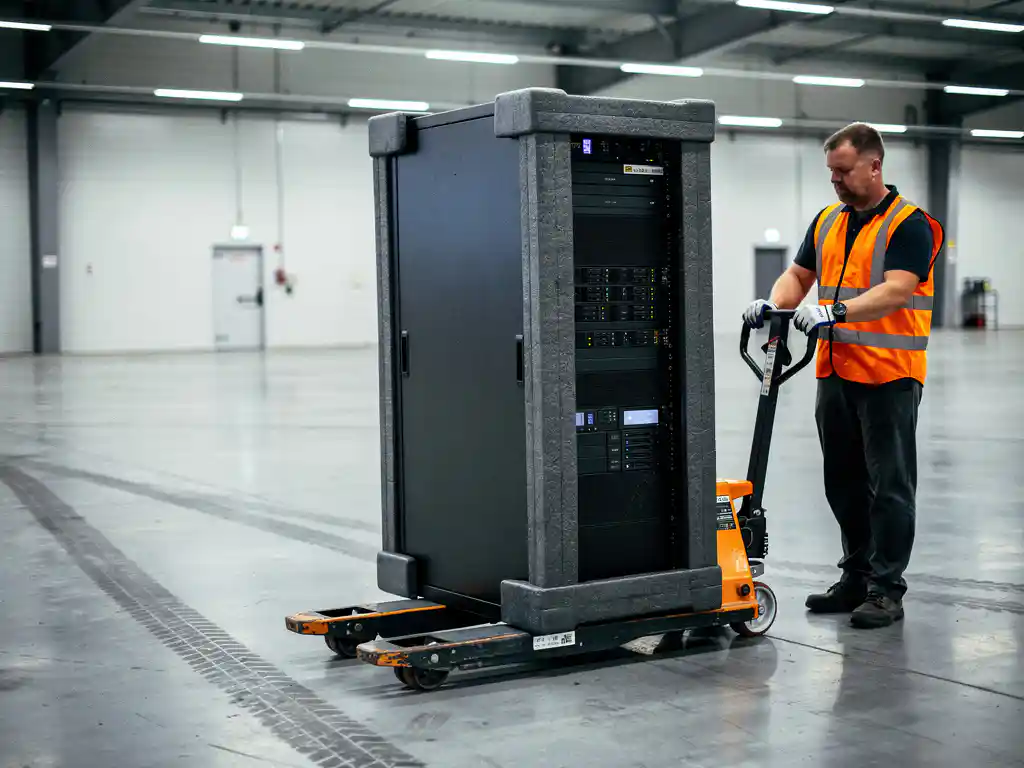
To move server racks correctly, you need a combination of specialized lifting equipment, secure fastening tools, anti-static protective gear, and a carefully planned transport setup. Server racks are heavy, fragile, and sensitive to vibration, which means standard moving equipment simply does not cut it. This article walks through the key questions surrounding safe server rack relocation, from the risks of getting it wrong to whether you should bring in specialist help.
What types of damage can occur when moving server racks without the right equipment?
Moving server racks without the correct equipment exposes hardware to physical impact, electrostatic discharge, vibration damage, and tipping hazards. Even a single drop or sharp jolt can destroy hard drives, damage circuit boards, or dislodge critical cable connections. The consequences range from costly hardware replacement to extended downtime and permanent data loss.
Physical impact is the most obvious risk. Server racks are tall, top-heavy structures that can tip if handled without proper stabilization. Without the right lifting tools, movers may be forced to tilt or drag the unit, putting uneven stress on the chassis and internal components.
Vibration is a less visible but equally serious threat. Hard disk drives, in particular, are sensitive to sustained vibration during transport. Even short journeys without vibration damping can cause read/write head crashes, leading to irretrievable data loss. Solid-state drives are more resilient but are still vulnerable to physical shock.
Electrostatic discharge (ESD) is another risk that is easy to overlook. Without anti-static precautions, static electricity generated during handling can silently damage or destroy sensitive components. This type of damage is often invisible at the time and only becomes apparent when the system is powered back on.
Finally, environmental exposure during transit, such as moisture, dust, or temperature extremes, can degrade components if servers are not properly protected. This is especially relevant for longer transport routes or moves involving loading docks exposed to the elements.
What equipment is used to lift and move heavy server racks?
The core equipment used to lift and move heavy server racks includes server rack lift tools, four-wheel dollies or server transport carts, pallet jacks, and, for larger deployments, forklifts or mechanical lift platforms. The correct choice depends on the rack’s weight, the distance of the move, and the building environment.
Server rack lift tools and transport carts
Dedicated server rack lift tools are designed to raise and lower racks safely without manual lifting. These tools clamp securely to the rack frame and use a mechanical or hydraulic mechanism to elevate the unit, reducing the risk of injury and hardware damage. They are particularly useful when repositioning racks within a data center or loading them onto a vehicle.
Four-wheel server transport carts are the standard solution for moving racks across flat surfaces. They distribute the rack’s weight evenly, provide stability on smooth floors, and allow a single operator to maneuver a fully loaded rack with control. Many carts include locking casters to prevent unintended movement during loading and unloading.
Pallet jacks and forklifts
For racks that have been placed on pallets or skids, a manual or electric pallet jack offers a practical and widely available lifting option. Electric pallet jacks are preferred for heavier configurations. When moving multiple racks across a warehouse or loading area, a counterbalance forklift provides the lifting capacity needed, provided the operator is trained and the rack is properly secured to the forks with straps or a custom cradle.
How do you safely secure a server rack during transport?
To safely secure a server rack during transport, the rack must be anchored upright using ratchet straps or load bars, padded to prevent surface contact with the vehicle walls, and ideally placed on a vibration-damping platform. Internal components should be removed or secured before the rack is moved.
The first step before transport begins is to prepare the rack itself. Servers, UPS units, and other heavy components should be removed from the rack if possible and transported separately in anti-static packaging. This reduces the total weight of the rack and eliminates the risk of internal components shifting during transit.
Once the rack is loaded into the transport vehicle, it should be positioned upright rather than on its side. Laying a rack flat changes the stress distribution on the frame and increases the risk of damage to mounted equipment. The rack should then be secured with heavy-duty ratchet straps anchored to the vehicle’s load rails at multiple points.
Foam padding or moving blankets should be placed between the rack and any adjacent surfaces to prevent scratching and absorb minor vibrations. For high-value or sensitive equipment, purpose-built transport crates with integrated foam lining offer the best protection. Some specialist logistics providers, including us at Jan Krediet, assemble and handle server cabinets in controlled environments specifically to maintain the integrity of the hardware throughout the process.
For longer transport routes, vibration-isolating mounts or air-ride suspension vehicles provide an additional layer of protection, particularly for racks that cannot be fully stripped of their components before the move.
What personal protective equipment do movers need for server rack relocation?
Movers relocating server racks need anti-static wrist straps or gloves, steel-toed safety boots, back support belts for manual handling, and cut-resistant gloves when working with rack edges and cable management components. ESD protection is essential whenever movers come into direct contact with exposed hardware.
Anti-static equipment is the most specialized requirement in server rack relocation. Standard work gloves do not protect against electrostatic discharge. ESD-safe gloves or wrist straps that ground the wearer are necessary whenever components are handled directly. This is especially important if servers are removed from the rack during the move.
Steel-toed safety boots protect against the most common injury risk: a heavy rack or component falling during loading or unloading. Given that a fully loaded server rack can weigh several hundred kilograms, foot protection is non-negotiable.
Back support belts and proper manual handling technique matter even when mechanical aids are used. Movers often need to guide, steady, or reposition equipment by hand, and the awkward dimensions of server racks make poor posture a genuine injury risk. Teams should always work in pairs as a minimum when handling large rack units manually.
High-visibility vests are also recommended in warehouse or loading dock environments where forklift traffic is present, ensuring that moving team members remain visible to vehicle operators at all times.
Should you hire specialist logistics providers to move server racks?
Yes, hiring a specialist logistics provider is strongly recommended for moving server racks, particularly for large deployments, sensitive hardware, or moves that involve transport over significant distances. The correct way to move server racks at scale requires trained personnel, the right equipment, and a controlled environment, all of which specialist providers are equipped to deliver.
The case for specialist involvement becomes clear when you consider what is at stake. A data center relocation or even a single rack move involving live production systems carries significant business risk. Downtime, data loss, or hardware failure can have financial and operational consequences that far outweigh the cost of professional handling.
We at Jan Krediet have direct experience in this area. As part of our project logistics services, we assemble server cabinets in a dust-free clean room within our warehouse, and we provide warehousing, refurbishment, and worldwide distribution for high-tech clients. This kind of controlled, specialist environment is exactly what sensitive IT equipment demands.
Specialist providers also bring project management capability. A complex server rack relocation typically involves coordination between IT teams, facilities managers, transport crews, and receiving site personnel. A logistics partner with experience in technology deployments can manage this coordination, apply just-in-time planning, and ensure that every phase of the move is executed without gaps.
For organizations considering whether to manage a server rack move in-house or bring in external expertise, the deciding factors are usually the volume of equipment, the sensitivity of the hardware, the distance involved, and the acceptable level of risk. When any of those factors point toward complexity, professional logistics support is the more reliable choice. You can explore our full range of capabilities on our contract logistics page or get in touch to discuss your specific requirements.