


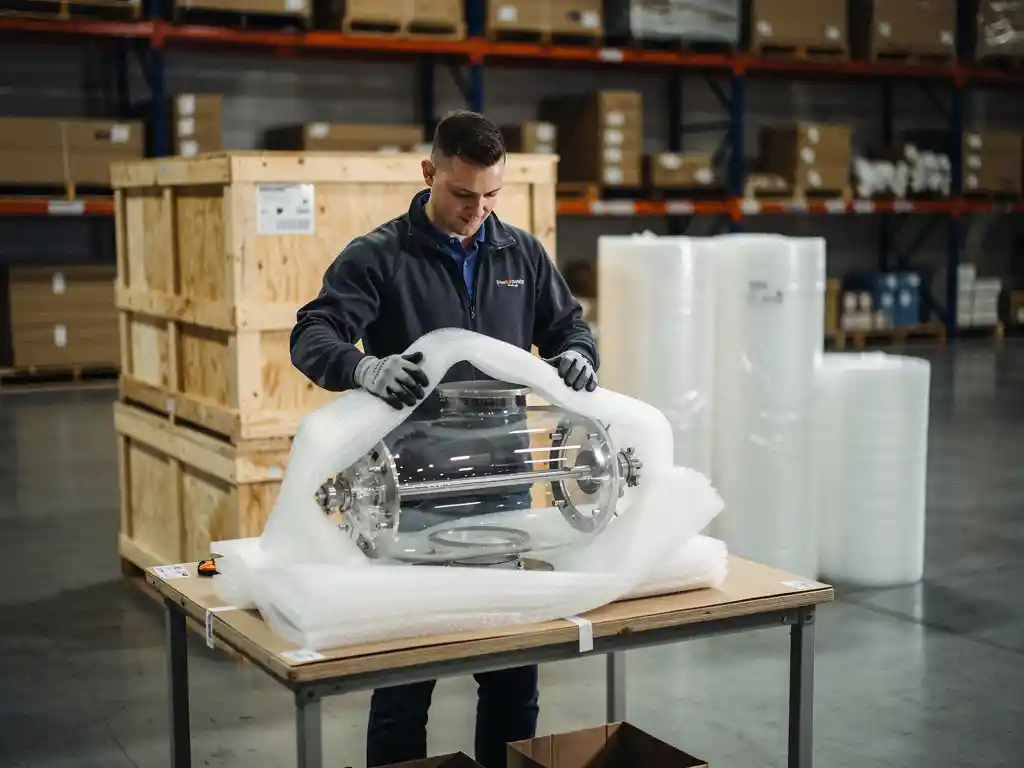
Moving fragile equipment without damage requires specialist packaging, trained handlers, and careful route planning working together as a system. No single measure is enough on its own. The right combination of protective materials, professional technique, and logistics expertise dramatically reduces the risk of breakage, scratches, or mechanical failure during transit. Below, we answer the most important questions about protecting sensitive equipment throughout the entire journey.
What types of equipment are considered fragile during transport?
Fragile equipment includes any item that is vulnerable to impact, vibration, pressure, moisture, or temperature changes during transit. This covers a wide range of goods: precision electronics, server cabinets, medical devices, works of art, premium furniture, high-end kitchen units, glass panels, and delicate instruments. What these items share is a low tolerance for the stresses that standard freight routinely experiences.
The key factor is not always physical delicacy. An item can be structurally robust but still fragile in a logistics sense if its surfaces scratch easily, its components misalign under pressure, or its value makes even minor cosmetic damage commercially unacceptable. Premium furniture and designer kitchens, for example, are physically sturdy but require the same level of care as laboratory equipment because any visible mark represents a significant problem for the end customer.
Other categories worth noting include:
- High-value electronics and server infrastructure
- Artworks, sculptures, and museum pieces
- Premium upholstered furniture and cabinetry
- Assembled kitchen units with lacquered or stone surfaces
- Medical and laboratory equipment
- Glass and ceramic architectural elements
Understanding which category your equipment falls into is the starting point for choosing the right protective approach.
What packaging materials best protect fragile equipment?
The best packaging materials for fragile equipment are those matched to the specific vulnerability of the item: foam inserts and custom crating for impact protection, furniture blankets for surface preservation, and sealed moisture barriers for electronics. Generic bubble wrap or standard cardboard boxes are rarely sufficient for genuinely fragile or high-value goods.
For premium furniture transport, furniture blankets are a highly effective and sustainable alternative to single-use packaging. They conform to irregular shapes, prevent surface contact between items, and can be reused across many shipments. For server cabinets and precision electronics, anti-static foam combined with rigid outer crating provides the layered protection needed to absorb road vibration and handling shocks.
Custom crating deserves particular attention for irregularly shaped or extremely high-value items. A crate built to the exact dimensions of the item eliminates internal movement entirely, which is one of the most common causes of transit damage. When combined with internal cushioning, custom crating is the closest thing to a guaranteed safe arrival that packaging alone can offer.
Sustainable packaging choices are increasingly important. Transporting goods loosely packed in reusable furniture blankets, or assembling components at the destination rather than shipping them pre-assembled, reduces both packaging waste and transport volume simultaneously.
How does professional handling differ from standard freight?
Professional handling of fragile equipment differs from standard freight in three fundamental ways: trained personnel, purpose-built equipment, and a culture of accountability at every touchpoint. In standard freight, goods are treated as units to be moved efficiently. In professional handling, each item is treated as a responsibility that reflects directly on the service provider.
Trained handlers understand how to lift, position, and secure items without creating stress points. For fragile goods, this means knowing which surfaces to avoid, how to use straps without applying pressure to vulnerable areas, and how to load a vehicle so that weight distribution does not shift during transit. This knowledge is not intuitive. It comes from experience and structured training.
We train our own staff internally, combining hands-on learning with a genuine respect for the products we handle. This is especially important in furniture and kitchen logistics, where a single scratch on a lacquered surface can result in a rejected delivery. Every kitchen delivery, for instance, is carried out by two trained professionals who conduct a final inspection before departure, ensuring that nothing leaves our hands in less than perfect condition.
Purpose-built equipment also plays a role. Swap bodies fitted with a double loading floor increase transport capacity while reducing the number of loading and unloading cycles each item goes through. Fewer handling touchpoints mean fewer opportunities for damage.
What role does route planning play in preventing damage?
Route planning plays a direct role in preventing damage by minimizing the number of handling events, reducing transit time, and avoiding road conditions that increase vibration and impact risk. Every additional stop, transfer point, or loading cycle introduces a new opportunity for something to go wrong. Shorter, more direct routes with fewer intermediary steps are inherently safer for fragile goods.
Smart route planning also considers timing. Delivering during off-peak hours reduces the risk of rushed handling at busy loading docks. Just-in-time coordination ensures that fragile items are not sitting in intermediate storage facilities where they may be moved multiple times before reaching their destination.
For complex or international shipments, our planning teams use route optimization tools combined with cross-docking techniques to minimize unnecessary kilometres and handling events. This is not only a sustainability measure but a damage-prevention strategy. Every kilometre avoided and every unnecessary transfer eliminated reduces the cumulative stress placed on fragile goods during their journey.
Load optimization is equally important. A poorly loaded vehicle where items can shift, lean, or vibrate against each other during transit is a significant damage risk regardless of how well the goods were packaged. Professional route planning and load planning work together as a single system.
Should you use a specialist logistics provider for fragile equipment?
Yes, using a specialist logistics provider for fragile equipment is strongly advisable, and in many cases essential. A general freight carrier is optimized for volume and speed. A specialist is optimized for care, precision, and accountability. For equipment where damage means financial loss, customer complaints, or project delays, the cost of specialist handling is almost always lower than the cost of a single damaged shipment.
The practical advantages of working with a specialist include trained personnel who understand your product category, packaging solutions designed for your specific goods, and a logistics chain built around minimizing handling events rather than maximizing throughput. Specialists also carry the right insurance coverage and have established processes for documenting the condition of goods at each stage of the journey.
Our project logistics solutions cover the full range of complex, fragile, and high-value transport challenges, from wiring and installing server cabinets in dust-free environments to delivering and installing complete office interiors in high-rise buildings across multiple countries. With nearly a century of experience and a global partner network, we approach every fragile shipment as a project that demands a tailored solution rather than a standard process.
When evaluating a specialist provider, look for evidence of sector-specific experience, in-house trained staff, purpose-built transport infrastructure, and a clear accountability structure with a single point of contact throughout the shipment. These are the markers that distinguish a genuine specialist from a general carrier offering a premium label.