


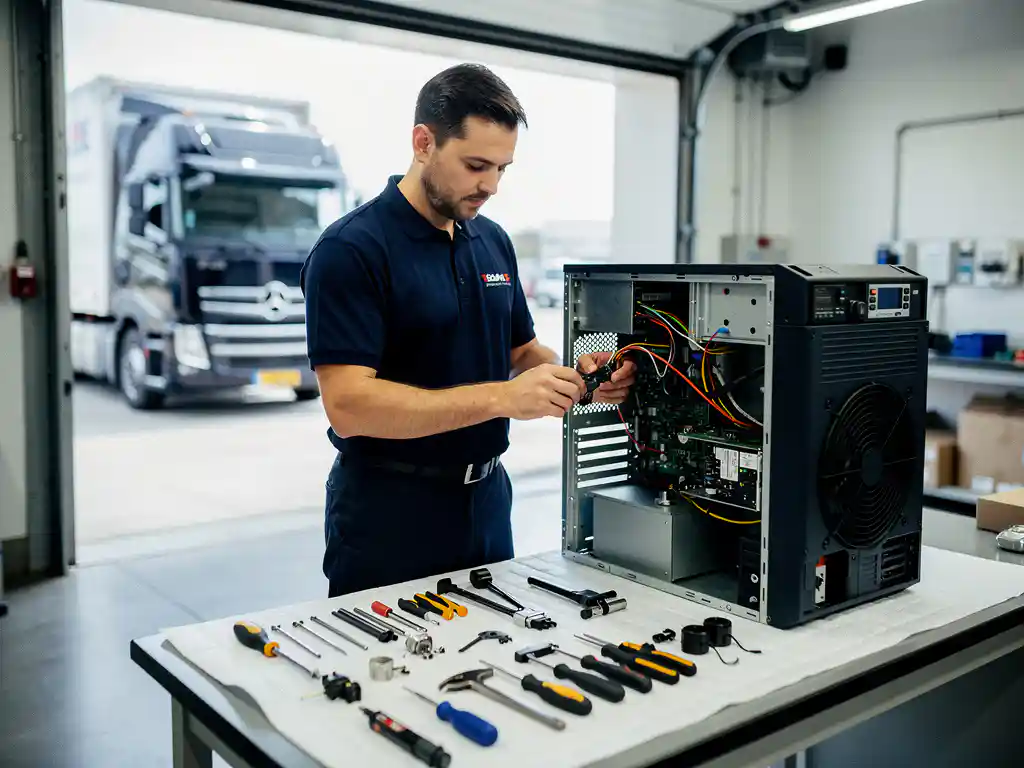
Yes, high-tech equipment can be assembled on-site by professionals, and in most cases this is the preferred approach. Specialist logistics and assembly teams are trained to handle complex, sensitive equipment in real-world environments, from server cabinets and IT infrastructure to premium kitchen systems and bespoke office installations. The questions below unpack exactly how this works, who does it, and when it makes sense to bring in a logistics partner rather than relying on the manufacturer.
What types of high-tech equipment can professionals assemble on-site?
Professional on-site assembly covers a wide range of high-tech equipment, including server cabinets and IT rack systems, integrated kitchen installations, modular office furniture with built-in technology, medical and laboratory equipment, and audio-visual infrastructure. The defining characteristic is not the product category itself but the level of precision, coordination, and specialist handling the installation demands.
In practice, the scope of professional assembly of high-tech equipment is broader than most people expect. Consider server cabinet installation: this involves not just physical placement but precise cabling, dust-free handling conditions, and correct rack mounting, all of which require trained technicians working in controlled environments. We handle exactly this type of work for a major business IT solutions provider, assembling server cabinets in a dedicated clean room within our warehouse before worldwide distribution and on-site installation.
At the other end of the spectrum, premium kitchen systems represent a different but equally demanding category. Modern integrated kitchens combine precision-engineered cabinetry, built-in appliances, and complex plumbing and electrical connections. Delivering and assembling these systems correctly requires product-specific knowledge that goes well beyond general installation skills.
Other high-tech categories that regularly require professional on-site assembly include:
- Coworking and flexible office environments with integrated power and connectivity infrastructure
- Home office setups delivered and installed on a turnkey basis, including equipment connection
- Event and exhibition installations requiring rapid, precise setup under time pressure
- High-rise office fit-outs involving complex coordination across multiple floors and trades
How does professional on-site assembly actually work?
Professional on-site assembly follows a structured process that begins well before anyone arrives at the installation site. It typically starts with planning and pre-assembly in a controlled environment, continues through coordinated transport to the site, and concludes with installation, connection, and a quality check. Each phase is managed by a dedicated team with defined responsibilities.
The planning phase is where complexity is resolved before it becomes a problem on-site. Project managers map out access routes, delivery windows, installation sequences, and the specific tools or conditions required. For large-scale projects, this can involve coordinating dozens of parties across multiple locations simultaneously.
Pre-assembly and warehouse preparation
Many high-tech installations benefit from partial assembly in a warehouse before transport. Server cabinets, for example, can be racked, cabled, and tested in a dust-free clean room environment where conditions are controlled. This reduces the time spent on-site and minimises the risk of errors in a live environment. Our warehousing facilities include dedicated space for exactly this kind of pre-assembly work.
On-site execution and final installation
Once equipment arrives at the destination, trained assembly professionals take over. For sensitive products, deliveries are carried out by two specialists rather than one, which allows for a final inspection before installation begins and ensures that heavy or fragile components are handled safely. After installation, the team verifies that everything functions as specified and that the site is left clean and ready for use. Clients and end customers are kept informed throughout via online tracking and direct communication.
What qualifications do on-site assembly professionals need?
On-site assembly professionals working with high-tech equipment need a combination of product-specific technical knowledge, physical handling skills, and problem-solving ability. Formal qualifications vary by equipment type, but practical experience, in-house training, and familiarity with the specific product category are consistently more important than generic certifications alone.
For server and IT infrastructure, technicians typically need grounding in rack systems, cable management, and basic network hardware. Clean room protocols and electrostatic discharge awareness are also essential when handling sensitive components. For kitchen and built-in appliance installation, professionals need knowledge of plumbing connections, electrical safety standards, and the specific assembly sequences required by the manufacturer.
What distinguishes genuinely qualified assembly professionals from general handymen is depth of product knowledge. We train our own personnel in-house through our JK Academy, combining on-the-job learning with structured development. This approach ensures that the person assembling a premium kitchen or installing a server rack understands the product, not just the generic process. That distinction matters enormously when something unexpected happens on-site and a judgement call is required.
Beyond technical skills, effective on-site assembly professionals also need:
- Strong communication skills to coordinate with clients, building managers, and other trades
- The ability to work methodically under time pressure without cutting corners
- Awareness of health and safety requirements specific to the installation environment
- Flexibility to adapt plans when site conditions differ from what was expected
You can learn more about the people behind our operations on our team page.
When should you use a logistics provider for assembly instead of the manufacturer?
You should use a logistics provider for on-site assembly when the installation involves coordination across multiple locations, tight delivery windows, or a volume of equipment that exceeds what a manufacturer’s own service team can efficiently handle. Logistics providers are also the better choice when the project requires warehousing, customs clearance, and assembly to be managed under a single point of responsibility.
Manufacturers excel at producing equipment and documenting how it should be installed. What they are rarely structured to do is manage last-mile delivery logistics, coordinate access with building facilities teams, absorb volume fluctuations, and guarantee next-day installation across multiple cities simultaneously. A specialist logistics partner bridges that gap.
Consider a company equipping a network of coworking spaces across Berlin, Cape Town, and Paris. The manufacturer can supply the furniture, wall decorations, and technical fit-out components, but coordinating delivery and installation across 150 locations worldwide is a logistics challenge, not a manufacturing one. Our project logistics teams handle exactly this type of assignment, managing every phase from warehouse to finished interior.
The case for using a logistics provider is strongest when:
- The project spans multiple sites or countries with different regulatory requirements
- Products need to be stored, pre-assembled, or refurbished before final delivery
- End-customer satisfaction is directly tied to the quality of the installation experience
- The client wants a single accountable partner rather than managing a chain of separate suppliers
What can go wrong with on-site assembly and how is it prevented?
The most common problems in professional on-site assembly of high-tech equipment are product damage during transport, incorrect installation sequences, site access failures, and missing components. Each of these is preventable through structured planning, pre-departure inspections, and clear communication between all parties involved in the project.
Product damage is the risk that concerns most clients, and rightly so. High-tech equipment is often expensive, fragile, and difficult to replace quickly. Prevention starts with packaging choices, transport vehicle specification, and the training of the people doing the loading and unloading. We use swap bodies fitted with a double loading floor to increase transport stability while reducing loading and unloading time, and every delivery of sensitive products is carried out by two trained professionals who conduct a final inspection before departure.
Incorrect installation is a subtler risk. It often happens not because technicians lack skill but because they lack product-specific knowledge. A generic installer may follow the general steps correctly but miss a manufacturer-specific requirement that only becomes apparent when the system is tested. This is why in-house training focused on specific product categories produces better outcomes than relying on generalist contractors.
Site access failures are a planning problem. If a delivery vehicle cannot reach the installation floor, or if building management has not been informed of the arrival window, the entire schedule collapses. Experienced project managers anticipate these scenarios and confirm access arrangements well in advance, with contingency plans in place for high-rise buildings, restricted urban areas, or sites with limited loading dock availability.
Missing components are prevented through systematic pre-delivery checks and inventory management. When goods are held in a dedicated warehouse before dispatch, every item can be verified against the installation specification before the team leaves. Our client cases reflect how this structured approach consistently delivers complete, damage-free installations even on complex, multi-location projects.