


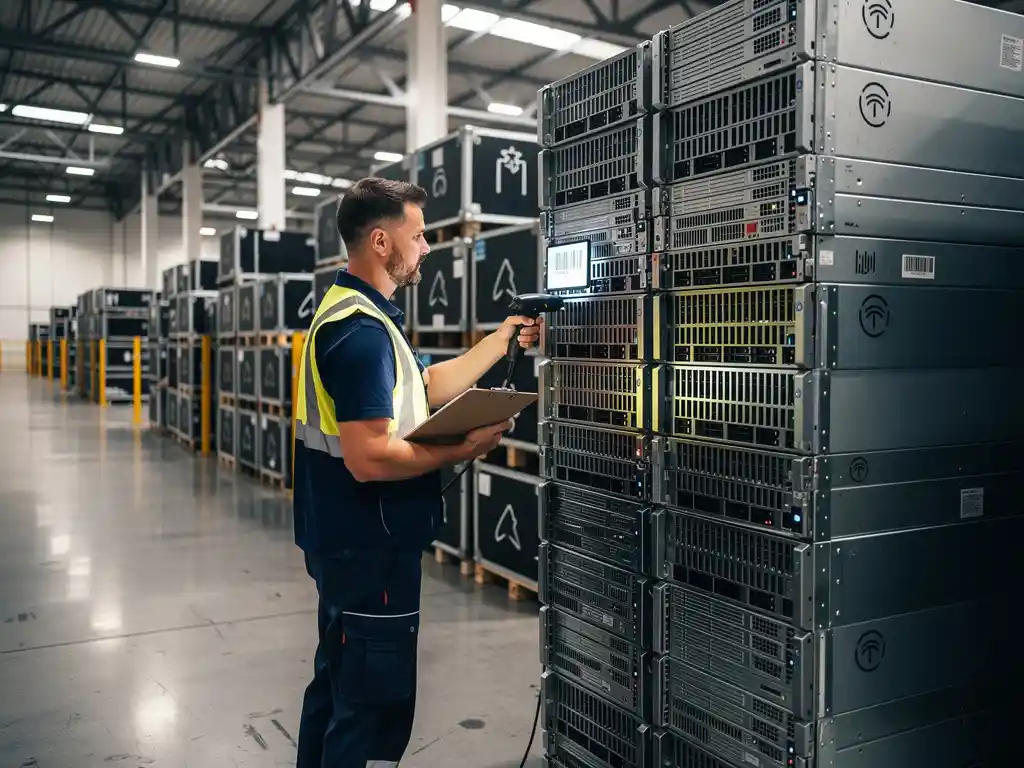
Data center asset tracking is best accomplished through a combination of methods: barcode scanning for initial inventory, RFID tags for automated identification, and DCIM (Data Center Infrastructure Management) software to centralize and visualize all asset data in real time. Most organizations use these tools together rather than relying on any single approach.
The right mix depends on the scale of your data center, your budget, and how frequently assets move or change. A small facility might manage well with barcodes and a spreadsheet, while a large enterprise environment almost always benefits from RFID integration paired with dedicated DCIM software. The sections below break down each method, tool, and best practice in detail.
What methods are used to track data center assets?
The most widely used methods for tracking data center assets are barcode scanning, RFID tagging, DCIM software, and manual auditing. Most effective asset tracking programs combine at least two of these approaches, using barcodes or RFID for physical identification and DCIM software as the central repository where all asset data is stored, updated, and analyzed.
Each method serves a different function within the overall tracking strategy:
- Barcode scanning: A cost-effective starting point. Each asset receives a printed label with a unique barcode. Technicians scan assets manually during audits or moves. It is reliable and inexpensive but requires someone to be physically present and actively scanning.
- RFID tagging: Tags emit a radio signal that readers can detect automatically, even without line of sight. This makes RFID significantly faster and less labor-intensive than barcodes for large inventories.
- DCIM software: A centralized platform that records asset details, tracks locations, monitors capacity, and integrates with other systems such as network management tools. DCIM turns raw scan data into actionable visibility.
- Manual auditing: A periodic physical walkthrough to verify that the recorded inventory matches what is actually installed. Even facilities using RFID and DCIM still conduct manual audits to catch discrepancies.
- GPS and IoT sensors: Less common in static data center environments but useful for tracking mobile assets such as laptops, portable storage units, or equipment moving between facilities.
The most resilient approach treats these methods as layers. Physical tags (barcode or RFID) identify individual assets. DCIM software maintains the living record. Manual audits validate the data at regular intervals. Together, they reduce the risk of shadow IT, lost equipment, and compliance gaps.
What is RFID asset tracking and how does it work in data centers?
RFID (Radio Frequency Identification) asset tracking uses small electronic tags attached to equipment that communicate wirelessly with RFID readers. In a data center, each server, switch, or storage unit receives an RFID tag encoded with a unique identifier. Fixed readers mounted in aisles or on rack doors, or handheld readers carried by technicians, detect these tags and automatically log asset locations without requiring manual scanning of each item individually.
There are two core components in any RFID system:
- The tag: A small chip and antenna attached to the asset. It stores a unique ID and, depending on the tag type, may also store additional data such as asset specifications or maintenance history.
- The reader: A device that emits radio waves and captures the signal returned by nearby tags. Readers can be fixed (installed permanently in a location) or handheld (used by staff during audits or moves).
When a reader detects a tag, it passes the asset’s unique ID to the asset management system, which then updates the asset’s recorded location and status. This happens in near real time, which means that when a technician moves a server from one rack to another, the system reflects that change almost immediately rather than waiting for the next scheduled audit.
In data center environments specifically, RFID is valuable because racks are densely packed and manually scanning hundreds of barcodes is time-consuming and error-prone. RFID dramatically reduces the time needed for a full inventory check and improves accuracy by eliminating the human element from the identification step. The technology does have limitations: metal surfaces and dense cabling can interfere with radio signals, so installation and tag placement require careful planning.
How does DCIM software improve asset visibility?
DCIM (Data Center Infrastructure Management) software improves asset visibility by creating a single, continuously updated record of every asset in the facility, including its physical location, configuration, capacity usage, and operational status. Instead of maintaining separate spreadsheets or disconnected databases, teams work from one source of truth that reflects the current state of the data center at any given moment.
The visibility improvements DCIM delivers fall into several practical categories:
- Location tracking: DCIM maps assets to specific racks, rows, and rooms. When an asset moves, the system records the new location. This eliminates the common problem of equipment appearing on paper but being physically unlocatable on the floor.
- Capacity planning: By recording power draw, cooling load, and rack space for each asset, DCIM gives operations teams a clear picture of available capacity before they deploy new equipment. This prevents overloading circuits or cooling zones.
- Lifecycle management: DCIM records purchase dates, warranty expiry, and maintenance history for each asset. Teams receive alerts before warranties lapse or equipment reaches end of life, enabling proactive replacement rather than reactive firefighting.
- Change management: When assets are added, moved, or decommissioned, DCIM logs the change, who made it, and when. This audit trail is essential for compliance reporting and root cause analysis after incidents.
- Integration with other systems: Most modern DCIM platforms connect with network management systems, ticketing tools, and monitoring platforms. This means an alert generated by a failing server can be automatically linked to that server’s full asset record, giving the responding technician immediate context.
The practical result is that operations teams spend less time hunting for information and more time acting on it. In environments where downtime is costly, the speed and accuracy that DCIM provides translate directly into faster incident response and fewer configuration errors.
What’s the difference between active and passive asset tracking?
The key difference between active and passive asset tracking is whether the tracking tag has its own power source. Active tags have an internal battery and continuously broadcast their signal, enabling real-time location updates. Passive tags have no battery and only respond when energized by a reader’s radio signal, making them lower-cost but dependent on reader proximity to detect the asset.
Active asset tracking
Active tags transmit a signal at regular intervals without needing a reader to prompt them. Fixed readers throughout the facility pick up these signals and update the asset’s location continuously. This makes active tracking well suited to environments where assets move frequently or where real-time location awareness is operationally critical. The trade-off is cost: active tags are significantly more expensive than passive ones, and the infrastructure of fixed readers adds to the investment. Battery life is also a maintenance consideration, typically ranging from two to five years depending on transmission frequency.
Passive asset tracking
Passive tags contain no battery. They harvest the energy from a reader’s radio frequency field to power their response signal. A technician carrying a handheld reader, or a fixed reader installed at a chokepoint such as a door or aisle entrance, activates the tag when it comes within range. Passive RFID tags are inexpensive, have no battery to replace, and can last the lifetime of the asset they are attached to. The limitation is that they cannot report their location independently. Someone or something must bring a reader close enough to detect them.
For most data centers, passive RFID strikes the right balance between cost and capability, particularly when combined with DCIM software that maintains a logical record of where assets were last seen. Active tracking becomes worthwhile in very large facilities, multi-building campuses, or environments where assets are frequently transported between locations and real-time location data has direct operational value.
What data should be recorded for each data center asset?
For each data center asset, you should record its unique identifier, make and model, serial number, physical location (facility, room, rack, and rack unit position), installation date, warranty expiry, power consumption, network configuration details, and current operational status. This core dataset enables lifecycle management, capacity planning, and compliance reporting from a single record.
Beyond the essentials, a well-structured asset record typically includes:
- Asset category and type: Server, switch, storage array, UPS, patch panel, and so on. Categorization makes filtering and reporting far more practical.
- Owner and assigned team: Which business unit or team is responsible for the asset. This is particularly important in multi-tenant or shared data center environments.
- Procurement details: Purchase date, vendor, purchase order number, and cost. Useful for budgeting, depreciation tracking, and vendor management.
- Maintenance history: Dates and descriptions of all maintenance activities, firmware updates, and repairs. This history supports troubleshooting and demonstrates due diligence during audits.
- Connectivity details: Which ports are connected, to which devices, and via which cables. Accurate connectivity records are essential for safe change management.
- End-of-life and decommission status: A flag indicating whether an asset is active, in storage, scheduled for decommissioning, or already removed. Keeping decommissioned assets in the record (marked appropriately) preserves the audit trail.
The discipline of recording complete data at the point of installation, rather than backfilling it later, is what separates a useful asset database from one that becomes unreliable over time. Incomplete records are one of the most common reasons asset tracking programs fail to deliver their intended value.
How often should data center asset audits be conducted?
Data center asset audits should be conducted at minimum once per year, with quarterly audits recommended for high-change environments. Organizations subject to regulatory compliance frameworks such as ISO 27001, SOC 2, or PCI DSS often require more frequent verification. In practice, the right frequency depends on how rapidly your asset inventory changes and how much risk an inaccurate record creates for your operations.
A useful way to think about audit frequency is by risk tier:
- High-change environments: Facilities where assets are regularly added, moved, or decommissioned benefit from quarterly or even monthly spot audits. The longer the gap between audits, the more discrepancies accumulate and the longer they take to resolve.
- Stable environments: Facilities with low asset turnover can often manage with a thorough annual audit supplemented by change-log reviews throughout the year.
- Compliance-driven environments: If your data center falls under a regulatory framework, audit frequency may be defined by that standard. Review the specific requirements of your applicable framework and treat those as a floor, not a ceiling.
It is also worth distinguishing between a full audit and a targeted verification. A full audit involves physically checking every asset against the recorded inventory. A targeted verification focuses on a specific zone, rack row, or asset category. Many teams find that conducting full annual audits combined with targeted monthly verifications of high-activity zones keeps their records accurate without the disruption of a facility-wide walkthrough every few months.
Regardless of frequency, every audit should result in a documented reconciliation report that records what was found, what discrepancies existed, and what corrective actions were taken. This documentation is what transforms an audit from a one-time exercise into a continuous improvement process for your inventory and asset management practices.