


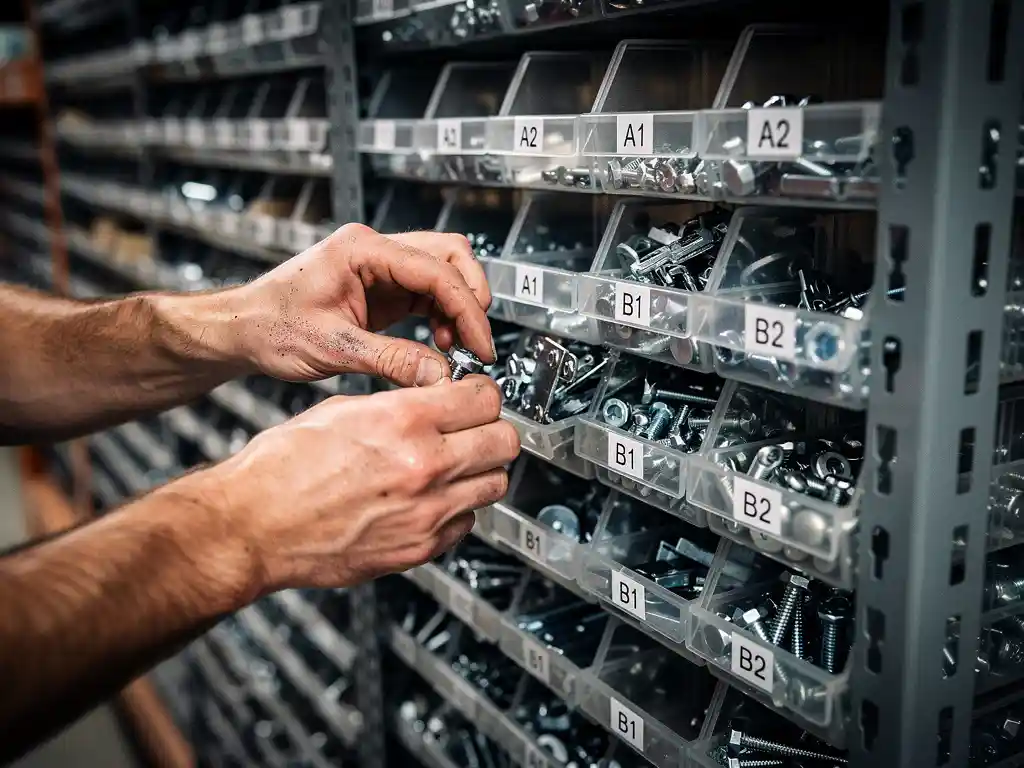
Keeping an overview of loose hardware components comes down to one core principle: every small part needs a defined place, a clear label, and a system that tracks it from the moment it enters your warehouse to the moment it leaves. Without that structure, screws, bolts, brackets, and fixings disappear into the chaos of daily operations. The sections below walk through the most common pitfalls and the most effective solutions, from physical organisation methods to digital tracking and smart packaging choices.
Why do loose hardware components get lost so easily?
Loose hardware components get lost easily because they are small, numerous, and visually similar to one another. Unlike a sofa or a kitchen cabinet, a bag of M6 bolts carries no obvious identity on its own. When multiple product lines share a warehouse, components from different orders quickly become mixed, misplaced, or simply overlooked during picking and packing.
Several factors compound the problem. First, hardware is often received in bulk and stored without immediate sorting, meaning the disorganisation begins at the point of goods reception. Second, high-turnover environments create pressure to move quickly, and speed works against careful handling of small parts. Third, loose components are lightweight and easy to knock off shelves, tip out of trays, or accidentally sweep into a bin.
There is also a human factor. When a team member cannot immediately identify what a component belongs to, the path of least resistance is to set it aside. That “set aside” location is rarely consistent, and the component effectively vanishes from the active inventory. Addressing these root causes is the starting point for any reliable overview of loose hardware components.
What are the best methods for organising loose hardware in a warehouse?
The most effective methods for organising loose hardware in a warehouse combine physical zoning, dedicated storage systems, and consistent labelling. Bin storage systems with clearly marked compartments, product-specific trays, and fixed picking locations reduce the chance of components ending up in the wrong place. Every component type should have one assigned home and one only.
Dedicated bin and tray systems
Modular bin systems allow warehouses to create compartmentalised storage at a granular level. Each bin is assigned to a specific component type, product, or client. Colour coding adds a visual layer of organisation that speeds up picking and reduces errors. When a bin is empty, the gap is immediately visible, which prompts restocking before a shortage causes a problem.
Fixed locations and visual management
Assigning a fixed shelf location to every component type, and labelling both the shelf and the bin, creates what warehouse professionals call a “fixed location” system. Visual management tools such as shadow boards, floor markings, and printed location maps help staff navigate quickly and return items to the right place without thinking twice. This is especially valuable in busy environments where multiple team members share the same storage area.
Our warehousing solutions are built around exactly this kind of structured approach, ensuring that even complex, multi-component product lines stay organised across more than 60,000 square metres of warehouse space.
How does barcode or RFID tracking help with small parts?
Barcode and RFID tracking help with small parts by giving each component a unique digital identity that can be scanned, logged, and traced at every stage of the logistics process. Instead of relying on visual identification or memory, warehouse staff scan a label and the system instantly confirms what the part is, where it belongs, and whether it has been picked correctly.
Barcodes are the more established option and work well for components that are handled individually or in labelled bags. A barcode label on a sealed hardware pack links that pack to a specific order, product, or client record in the warehouse management system. Every time the pack moves, a scan updates its location. This creates an auditable trail that makes it straightforward to identify where a component was last recorded if it goes missing.
RFID takes this further by allowing multiple items to be read simultaneously without line-of-sight scanning. In a high-volume warehouse where hardware packs move in and out of storage areas frequently, RFID readers can log dozens of components passing through a gate in seconds. This is particularly useful for managing loose hardware at a kit level, where all the fixings for a single product are grouped together and tracked as one unit.
Both technologies reduce reliance on manual counting and visual checks, which are the two weakest points in any small-parts tracking system. The investment in labelling infrastructure pays back quickly in reduced picking errors, fewer missing components, and faster resolution when discrepancies do occur.
What role does packaging play in keeping hardware components together?
Packaging plays a critical role in keeping hardware components together by acting as the physical boundary that prevents mixing, loss, and damage. The right packaging groups all the fixings for a single product into one sealed unit, making it impossible to accidentally separate a bolt from the bracket it belongs with.
The most reliable approach is to pack hardware components at the product level rather than the component level. This means all screws, bolts, and fixings for one specific item are sealed together in a labelled bag or box before they ever enter the warehouse. When a picker selects that product, the hardware comes with it automatically. There is no separate picking step for small parts, which eliminates one of the most common sources of missing components.
Tamper-evident seals add another layer of reliability. If a seal is broken, it is immediately clear that the contents may be incomplete, which triggers a check before the product reaches the customer. For premium products, where a missing fixing can delay installation entirely, this kind of quality control built into the packaging itself is worth the additional cost.
Packaging also protects components during transport. Loose hardware rattling around inside a larger carton can scratch surfaces, puncture packaging, or simply work its way into corners where it is overlooked at delivery. Sealed, product-specific hardware packs prevent all of these outcomes. For companies delivering directly to end consumers, this matters even more, since the customer experience at the point of unpacking reflects directly on the brand.
How can a logistics partner help manage hardware component oversight?
A logistics partner can help manage hardware component oversight by taking responsibility for the entire process from goods reception to final delivery, including the storage, tracking, kitting, and quality checking of loose components. Rather than managing small parts in-house, companies hand that complexity to a specialist who has the systems, the space, and the trained staff to handle it reliably.
We have been doing exactly this for a century, working with manufacturers and dealers of high-end furniture and kitchens who cannot afford missing components at the point of installation. Our team receives goods, checks hardware against packing lists, organises components by product and client, and ensures that every delivery leaves our warehouse complete. Clients have full visibility through online tracking, so they always know the status of their orders without needing to chase individual shipments.
A strong logistics partner also brings process discipline that is difficult to replicate internally. Fixed storage locations, warehouse management systems, trained picking staff, and quality control checkpoints are the infrastructure that keeps loose hardware components accounted for at scale. For businesses growing their product range or expanding into new markets, outsourcing this complexity to a partner with proven contract logistics expertise is often the most practical and cost-effective route to reliable oversight.
Beyond storage and transport, a logistics partner can also handle kitting and assembly services, grouping hardware components with the products they belong to before dispatch. This removes the risk of components becoming separated during the outbound journey and ensures that the end customer receives everything they need in one complete package, every time.