


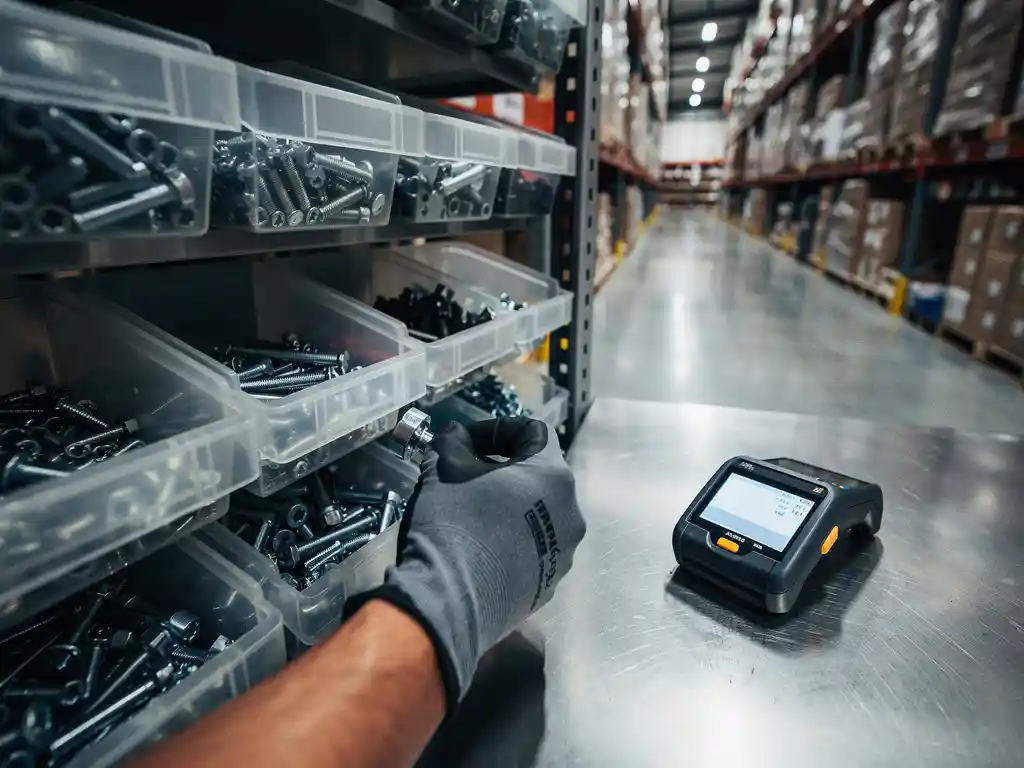
Loose hardware components are stored in dedicated, clearly labelled bin locations within a warehouse, organised by component type, size, and the product or project they belong to. Each component receives a unique location code that connects it to a specific order, product line, or delivery job. This article walks through the systems, processes, and common pitfalls involved in managing a complete overview of loose hardware components throughout the supply chain.
How are loose hardware components organised in a warehouse?
Loose hardware components are organised in a warehouse using a structured bin or slot system, where each component type is assigned a fixed or dynamic location based on size, frequency of use, and the product family it belongs to. Labels, barcodes, or QR codes on each bin allow warehouse staff to locate and retrieve the right component quickly and accurately.
In practice, this means hinges, screws, handles, brackets, and similar small parts are stored in clearly marked compartments, often in a dedicated hardware zone separate from bulkier goods. Components that belong together, such as the fixings for a specific kitchen cabinet model, are frequently grouped in a single kit tray or bag so that pickers can collect everything for one order in a single movement.
Larger warehousing operations also apply an ABC classification to hardware storage. High-turnover components are placed closest to packing stations, while slower-moving items sit further back. This layout reduces walking time and picking errors, both of which become costly at scale. Our warehousing solutions are built around exactly this kind of structured, product-specific approach, ensuring that even the smallest component is where it needs to be when it is needed.
What systems are used to track hardware components in logistics?
Hardware components in logistics are tracked using Warehouse Management Systems (WMS), barcode scanning, and, in some operations, RFID technology. These systems record every movement a component makes, from the moment it enters the warehouse to the moment it leaves with a shipment, creating a full audit trail for every item.
A WMS is the backbone of component tracking. When a delivery of hardware arrives, each component type is scanned and logged against a purchase order. The system assigns a bin location and updates stock levels in real time. When a picker retrieves components for an outbound order, another scan confirms the correct item has been taken and reduces inventory accordingly.
Barcode scanning remains the most widely used method because it is reliable, low-cost, and fast. RFID offers a hands-free alternative that is particularly useful when components are very small or when speed is critical, though implementation costs are higher. For high-value or complex project work, some operations also use digital picking lists on handheld devices that guide warehouse staff step by step through a pick, reducing the chance of selecting the wrong component entirely.
What happens to hardware components when a shipment arrives?
When a shipment containing loose hardware components arrives at a warehouse, the goods go through a structured goods-in process: the delivery is checked against the purchase order, components are counted and inspected for damage, and each item is scanned into the WMS before being assigned to a storage location. Nothing enters the warehouse stock without being formally received and recorded.
The inspection stage is more important for hardware than it might seem. A missing bag of screws or a wrong hinge size discovered at goods-in is straightforward to resolve. The same problem discovered at the point of delivery to an end customer, or mid-installation at a project site, causes delays, complaints, and additional transport costs. Catching discrepancies early is one of the most effective ways to protect delivery reliability.
Once checked and scanned, components are either put away into their assigned bin locations or, in the case of cross-docking operations, moved directly to an outbound staging area if they are already allocated to an imminent shipment. Cross-docking is especially relevant in fast-moving supply chains where components are manufactured one day and need to reach the next stage of the chain the following day.
How are hardware components linked to specific orders or projects?
Hardware components are linked to specific orders or projects through order references assigned in the WMS at the point of goods receipt or during kitting. Every component picked for an order is scanned against that order’s unique reference number, creating a direct, traceable connection between the physical item and the job it belongs to.
In project logistics, where a single installation might involve hundreds of individual components destined for a specific room or floor of a building, this linking process becomes critical. Project managers typically work from a detailed bill of materials that lists every component required for each phase of the installation. The WMS matches incoming stock against this list and flags any shortfalls before the delivery window opens.
Kitting is the most practical expression of this linking process. Rather than storing hardware generically and picking it at the last moment, kitting involves assembling all components for a specific order into a single labelled package well in advance. This approach dramatically reduces picking errors and makes it immediately visible if anything is missing. For complex projects involving multiple delivery locations, kitted packages can also be pre-labelled by destination, so that the right components reach the right site without additional sorting at the point of delivery.
Our project logistics team applies this kind of meticulous component management across installations at more than 150 locations worldwide, ensuring that every fitting, bracket, and fixing arrives exactly where it is needed.
What causes hardware components to go missing in a warehouse?
Hardware components go missing in a warehouse primarily due to picking errors, inadequate labelling, informal storage habits, and gaps in scanning discipline. Small, visually similar components are especially vulnerable because staff may place or retrieve them from the wrong bin without realising it, and the error only becomes apparent when an order is short at the point of packing or delivery.
Several specific causes account for the majority of losses:
- Unlabelled or poorly labelled bins that allow components to be placed in the wrong location during put-away
- Skipped scans during busy periods, which leave the WMS with an inaccurate picture of stock levels and locations
- Ad hoc storage where staff place components on a nearby shelf rather than in their assigned location, intending to move them later
- Damaged packaging on inbound deliveries that causes components to be separated from their product or order reference
- Insufficient cycle counting, meaning discrepancies between physical stock and system records go undetected for extended periods
Regular cycle counts, clear bin labelling, and consistent scanning discipline address most of these causes. The discipline to scan every movement, even under time pressure, is the single most effective habit a warehouse team can build to maintain an accurate overview of loose hardware components.
When should loose hardware be stored separately from main products?
Loose hardware should be stored separately from main products when there is a meaningful risk of the components becoming mixed up, lost, or damaged if stored together, or when the hardware belongs to multiple different product lines or orders. Separate storage also makes sense when components have a different turnover rate or handling requirement than the main goods they accompany.
For furniture and kitchen logistics in particular, storing loose hardware alongside assembled or packaged units creates practical problems. A box of cabinet hinges placed inside a flat-pack carton can shift during transport and damage the product. Hardware stored loosely in a shared location becomes difficult to allocate accurately when multiple orders are being processed simultaneously.
Dedicated hardware storage also supports faster and more accurate kitting. When all components for a product range are held in a single, organised hardware zone, the kitting team can work systematically through a pick list without navigating the broader warehouse. This is especially valuable in operations with short lead times, where the time between a delivery arriving and needing to leave again is measured in hours rather than days.
There are situations where storing hardware with the main product is the right approach, specifically when a single product always ships with the same fixed set of components and the risk of mixing is low. In these cases, pre-assembling the hardware kit into the product packaging at goods-in simplifies the entire outbound process. The decision should always be driven by the specific characteristics of the product, the order volumes involved, and the complexity of the picking operation.
For anyone managing a supply chain that includes high-value or complex goods, getting the overview of loose hardware components right is not a minor administrative detail. It is a direct driver of delivery accuracy, customer satisfaction, and operational efficiency. If you want to understand how we approach this challenge across furniture, kitchen, and project logistics, our contract logistics services page gives a clear picture of how we structure these operations end to end.