


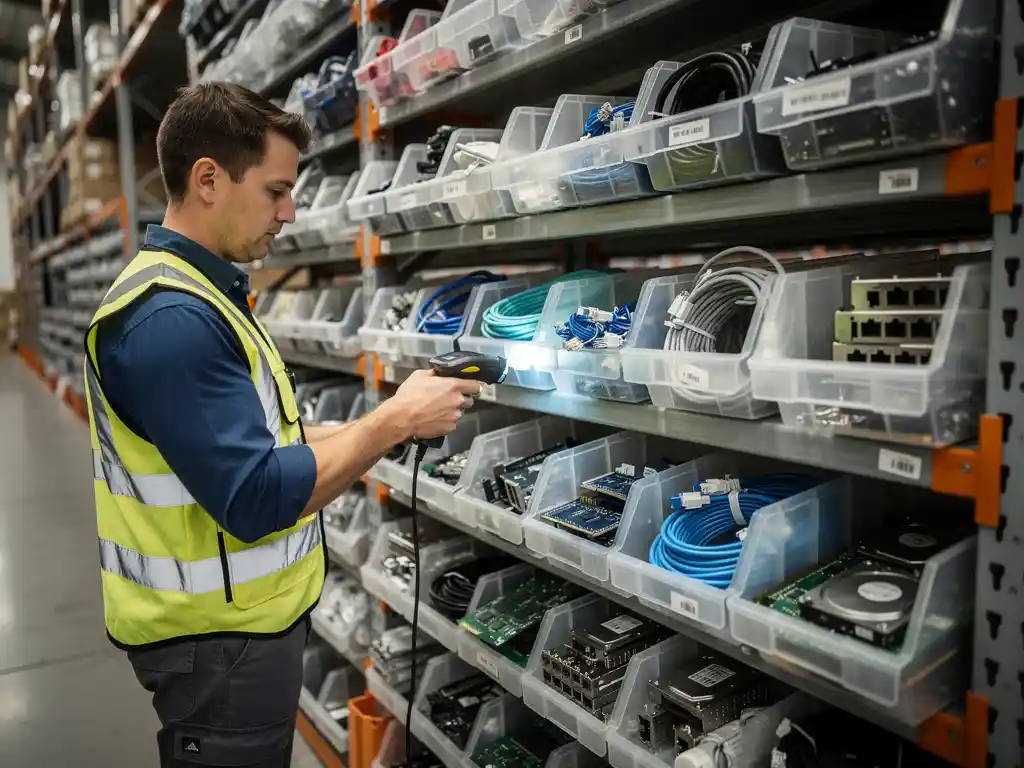
Loose IT components can be managed efficiently through a combination of structured labeling systems, dedicated storage solutions, a warehouse management system (WMS) for real-time tracking, and clearly defined handling procedures. The core challenge is that individual parts, from cables and adapters to spare drives and network cards, are easy to misplace, mislabel, or lose track of entirely without a deliberate system in place. This article walks through the most common pain points and the practical answers to each one.
What types of loose IT components are hardest to track?
The loose IT components that are hardest to track are small, interchangeable, and high-volume items. These include patch cables, SFP modules, RAM sticks, power adapters, hard drives, and network interface cards. Because they look similar across brands and models, and because they move frequently between locations, they are disproportionately likely to be misidentified, misplaced, or lost entirely during handling.
A useful way to think about this is by combining physical size with frequency of movement. A large server chassis rarely goes missing because it is difficult to move and easy to notice. A bag of mounting screws or a stack of identical SSDs, on the other hand, can be separated from their documentation within minutes of arriving at a warehouse or staging area.
The components that consistently cause the most tracking problems share a few characteristics:
- They are small enough to be stored in bulk without individual packaging
- They are interchangeable across multiple product lines or clients
- They are handled by multiple people at different stages of the process
- They lack a visible serial number or asset tag on the component itself
Understanding which parts in your specific inventory fall into these categories is the starting point for any effective tracking strategy. An overview of loose hardware components by risk category, built at the start of a new project or contract, gives your team a clear picture of where attention is most needed.
How does poor IT component management affect business operations?
Poor management of loose IT components causes delays, cost overruns, and damaged client relationships. When a component cannot be located at the moment it is needed, a deployment stalls. When parts are mixed up between clients or orders, errors multiply downstream. Over time, untracked inventory also creates financial losses through shrinkage, duplicate purchasing, and write-offs that could have been avoided.
The operational impact goes beyond the immediate inconvenience of a missing part. In high-tech logistics environments, where server cabinets need to be assembled and shipped on tight schedules, a single unlocated component can delay an entire installation. The downstream effects then include rescheduled engineer visits, extended project timelines, and penalty clauses in service agreements.
There is also a compliance dimension. Certain IT components, particularly those containing storage media, must be tracked for data security and regulatory reasons. If a hard drive or memory module cannot be accounted for, the question of where it ended up becomes a legal and reputational concern, not just a logistics one.
Finally, poor component management erodes trust. Clients who rely on a logistics partner to handle their IT hardware expect accurate inventory counts and reliable status updates. When those expectations are not met consistently, the relationship deteriorates regardless of how competitive the pricing is.
What storage and labeling systems work best for loose IT parts?
The most effective storage and labeling systems for loose IT components combine physical organization with machine-readable identification. Bin-based storage with clearly defined locations, combined with barcode or QR labels on individual components or their packaging, gives warehouse staff a reliable way to locate, pick, and return parts without relying on memory or informal conventions.
Physical storage principles
Dedicated shelving zones by component type reduce the chance of parts being stored in the wrong location. Within each zone, standardized bins or trays with fixed dimensions make it easier to spot when something is missing. Anti-static trays and ESD-safe containers are essential for sensitive electronics and should be treated as a baseline requirement rather than an optional upgrade.
Color coding by client, project, or component category adds a visual layer that speeds up picking and reduces errors during busy periods. The key is consistency: a system that is applied in some areas but not others quickly loses its value.
Labeling approaches
Labels should be applied at the smallest logical unit. For components that arrive in bulk, that means labeling individual items or their smallest packaging unit, not just the outer carton. Barcodes are reliable for high-volume environments. QR codes offer more data capacity and are increasingly practical given how widely smartphones are used on warehouse floors. RFID tags provide the most automation potential but require a higher upfront investment in readers and infrastructure.
Whatever system is chosen, the label must survive the handling environment. IT components often move through temperature-controlled clean rooms, standard warehouse areas, and transit packaging in the same life cycle. Labels that peel, fade, or become unreadable at any point in that journey create gaps in the tracking record.
How can a warehouse management system track individual IT components?
A warehouse management system tracks individual IT components by assigning each item a unique identifier linked to a digital record that updates in real time as the component moves through the facility. When a part is received, picked, moved, assembled into a larger unit, or shipped, a scan event updates the system. At any moment, the WMS can report where a component is, who last handled it, and what its current status is.
For loose hardware components specifically, the WMS needs to be configured to handle serial number tracking at the item level, not just at the carton or pallet level. This distinction matters because a pallet of SSDs may arrive as a single inbound record, but each drive needs its own identity once it enters the system. Setting up this granularity at intake, rather than trying to retrofit it later, is critical.
Modern WMS platforms also support lot tracking, which groups components by batch or production run. This is particularly useful for recall management: if a specific batch of components is identified as faulty, the system can immediately show which orders included parts from that batch and where those orders were shipped.
Integration between the WMS and the client’s own enterprise systems, such as an ERP or asset management platform, closes the loop further. Rather than reconciling two separate records at the end of a project, both parties work from a shared data source throughout.
Our warehousing solutions are built around this kind of structured, technology-supported inventory control, including clean-room assembly and serialized tracking for high-tech components.
When should IT component logistics be outsourced to a specialist?
IT component logistics should be outsourced to a specialist when the volume, complexity, or compliance requirements of handling those components exceed what an internal team can manage reliably. Specific triggers include rapid growth in component volumes, the need for clean-room handling, international distribution, serialized tracking requirements, or the management of returns and refurbishment alongside outbound distribution.
A useful benchmark is whether your current process consistently produces accurate inventory counts and on-time fulfillment without requiring significant manual intervention. If reconciling stock takes more time than the actual handling, or if errors are being caught after dispatch rather than before, the system has outgrown its capacity.
Outsourcing to a specialist also makes sense when the logistics function is not a core competency of the business. A company whose primary value is developing IT solutions should not be allocating significant management attention to warehouse layout, carrier negotiation, or customs documentation. A specialist logistics partner handles those elements as their core daily activity, which typically produces better outcomes at lower total cost.
The decision is also shaped by risk. Components that carry data security obligations, high unit values, or fragility requirements demand handling expertise that takes time and investment to build internally. A partner with established infrastructure and trained personnel reduces that risk from day one.
We work with leading IT solutions providers on exactly this basis, handling warehousing, clean-room assembly, refurbishment, and worldwide distribution as an integrated service. You can explore our contract logistics offering for more detail on how that model works in practice.
What are the best practices for IT component returns and reverse logistics?
The best practices for IT component returns and reverse logistics are a clearly defined returns process with documented intake steps, condition assessment at the point of receipt, immediate re-labeling and system registration of returned items, and a structured decision tree for determining whether a component is refurbished, redeployed, or disposed of. Without these steps, returned components become an uncontrolled inventory that undermines the accuracy of the broader system.
Returns are often treated as an afterthought in IT component logistics, but they represent a significant source of both cost and opportunity. Components returned in good condition can be refurbished and redeployed, reducing procurement costs and supporting sustainability goals. Components that are damaged or end-of-life need to follow a compliant disposal or recycling path, particularly when they contain storage media or hazardous materials.
The intake process is the most important step. Every returned item should be scanned, assessed, and assigned a status before it enters any storage area. Mixing uninspected returns with serviceable stock is one of the most common causes of inventory inaccuracies in IT warehouses.
Communication between the logistics team and the client is equally important. Clients need visibility into the status of their returned components, including condition reports and disposition decisions. A WMS that supports reverse logistics workflows, with separate queues and status fields for returned items, makes this transparency straightforward rather than dependent on manual reporting.
For organizations managing large volumes of IT hardware across multiple locations, reverse logistics is also an area where specialist support adds clear value. Coordinating collection, transport, assessment, and either refurbishment or disposal across an international footprint requires the same level of planning discipline as outbound distribution. Our project logistics teams are experienced in managing exactly these kinds of multi-site, multi-phase operations for technology clients.