




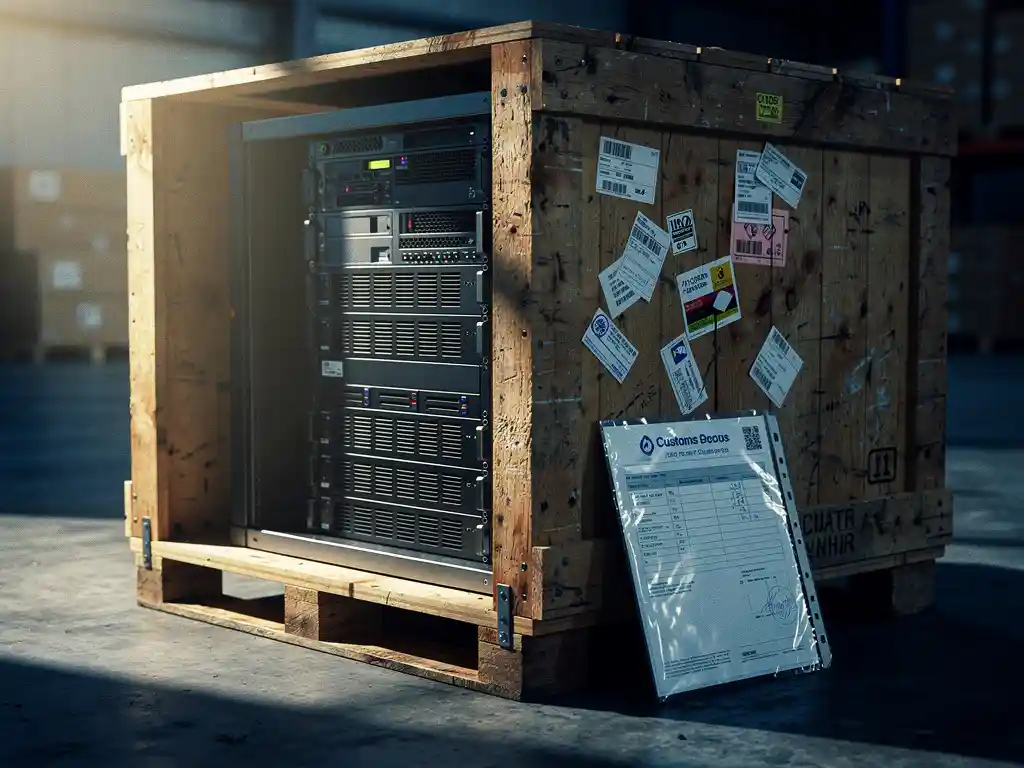
International server relocations are subject to customs rules that vary by country but consistently require accurate commercial documentation, correct tariff classification, and compliance with any applicable export controls. The core principle is that servers are treated as commercial goods the moment they cross an international border, regardless of whether they are being permanently imported or temporarily moved. The sections below address the most common questions businesses face when relocating servers across borders.
What customs documents are required for moving servers internationally?
Moving servers internationally requires a commercial invoice, a packing list, a bill of lading or air waybill, and a certificate of origin. For permanent relocations, an import declaration is also required in the destination country. If the equipment contains licensed software or encryption technology, additional export documentation may be needed before the shipment can legally leave its country of origin.
Each document serves a specific function in the customs process. The commercial invoice establishes the declared value of the equipment and is used by customs authorities to calculate applicable duties and taxes. The packing list provides a detailed breakdown of individual items, their weights, and their dimensions. The certificate of origin confirms where the equipment was manufactured, which determines whether preferential trade agreements or tariff reductions apply.
For air freight shipments, the air waybill acts as both the transport contract and a key customs document. For sea freight, the bill of lading fulfills the same role. When relocating servers to another country as part of a broader IT infrastructure project, it is also advisable to prepare a detailed technical specification sheet for each server unit. Customs authorities in many countries request this to verify the equipment’s classification under the Harmonized System (HS) code, which directly affects the duty rate applied.
Do servers qualify as controlled or restricted goods under export law?
Servers can qualify as controlled goods under export law, particularly when they contain high-performance processors, advanced encryption capabilities, or technology with potential dual-use applications. In such cases, an export license may be required before the equipment can legally be shipped to certain countries. This applies under frameworks such as the EU Dual-Use Regulation and the US Export Administration Regulations (EAR).
The classification of a server as a controlled item depends on its technical specifications rather than its intended use. Authorities evaluate factors such as processing speed, memory capacity, and the nature of any embedded software. Servers used for standard business operations typically fall below the thresholds that trigger export license requirements, but high-performance computing systems, particularly those used in data centers, are more likely to be flagged.
Businesses relocating servers to another country should conduct an export classification review before shipping. This involves identifying the correct Export Control Classification Number (ECCN) for each unit and checking whether the destination country appears on any restricted or embargoed lists maintained by the relevant national authority. Failing to obtain a required export license can result in significant fines, shipment seizure, and reputational consequences.
How does an ATA Carnet work for temporary server relocations?
An ATA Carnet is an international customs document that allows goods to be temporarily imported into a participating country without paying import duties or taxes. For server relocations that are temporary in nature, such as moving equipment for a short-term project or a trade event, an ATA Carnet eliminates the need to pay duties upfront and reclaim them upon re-export. The carnet must be obtained before departure and is valid for up to one year.
The ATA Carnet system operates across more than 80 countries and territories. When a shipment enters a participating country, customs officials stamp the carnet counterfoil. The same process applies when the equipment leaves. As long as the goods are re-exported within the validity period and the counterfoils are correctly stamped at each border crossing, no duties are charged.
For businesses relocating servers temporarily, such as setting up infrastructure at a remote site before returning the equipment to a central facility, the ATA Carnet is a practical and cost-effective solution. However, it requires careful management. If equipment is not re-exported on time or the documentation is incomplete, the issuing chamber of commerce in the country of origin becomes liable for the duties that would otherwise have been charged. It is therefore essential to track all carnet counterfoils and return deadlines throughout the relocation process.
What import duties and taxes apply when relocating servers to a new country?
Import duties on servers vary by country and are calculated based on the equipment’s customs value, which includes the purchase price, freight costs, and insurance. In the European Union, servers typically attract a customs duty rate of zero percent under the Information Technology Agreement (ITA), a multilateral trade agreement that eliminates tariffs on a broad range of IT products. VAT or local consumption taxes still apply on top of this.
Outside the EU, duty rates differ considerably. Countries that are signatories to the ITA, including the United States, Japan, South Korea, and many others, also apply zero or reduced tariffs on qualifying IT equipment. However, countries that have not signed the ITA may apply standard tariff rates, which can range from a few percent to over twenty percent of the declared customs value depending on the jurisdiction.
Beyond import duty, businesses should account for value-added tax or goods and services tax at the point of import. In many countries, this tax is recoverable by VAT-registered businesses, but the cash flow impact of paying it upfront can be significant for large server shipments. Some countries also apply additional levies on electronic goods, so it is important to research the full tax profile of the destination country before finalizing the relocation budget.
Which countries have the strictest customs rules for IT equipment imports?
Countries with the strictest customs rules for IT equipment imports include China, Russia, India, Brazil, and several countries in the Middle East and Africa. These jurisdictions commonly require pre-import approvals, technical certifications, or mandatory registration of IT equipment with national telecommunications or cybersecurity authorities before customs clearance can be granted.
China requires that certain categories of IT equipment, including servers used in sensitive sectors, comply with national cybersecurity standards and may be subject to inspection before release. Russia has historically required encryption-capable equipment to be certified by the Federal Security Service (FSB) before import. India applies detailed technical standards through the Bureau of Indian Standards (BIS), and non-compliant equipment can be detained at the port of entry.
Brazil is known for its complex import licensing system, which involves multiple government agencies and can significantly extend clearance timelines. In several Gulf Cooperation Council countries, IT equipment containing encryption must be registered with national telecommunications regulators prior to import. For businesses relocating servers to another country in any of these regions, engaging a logistics partner with local customs expertise is not optional but essential to avoid costly delays and compliance failures.
How can a logistics partner simplify customs clearance for server moves?
A logistics partner with customs expertise simplifies server relocations by managing documentation preparation, tariff classification, duty calculation, and direct communication with customs authorities on your behalf. This removes the administrative burden from your internal team and reduces the risk of errors that cause shipment delays or financial penalties. An experienced partner also identifies opportunities to reduce duty costs through trade agreements or temporary import schemes.
At Jan Krediet, we handle the complete customs clearance process as part of our project logistics services, including server relocations. Our team manages export documentation in the country of origin, coordinates import declarations at the destination, and advises on the most appropriate customs regime for each shipment, whether that is permanent import, temporary admission, or an ATA Carnet arrangement.
Beyond documentation, a capable logistics partner adds value through proactive planning. Customs regulations change, and what applied to a server shipment two years ago may not apply today. We stay current with regulatory developments across the countries we serve, which means your relocation is handled in compliance with the rules as they stand in 2026, not as they were written in a previous year. Our warehousing capabilities also allow equipment to be held in a bonded environment while customs formalities are completed, preventing unnecessary delays to your project timeline.
If you are planning an international server relocation and want to understand the customs requirements specific to your origin and destination countries, reach out to our team for tailored guidance.