


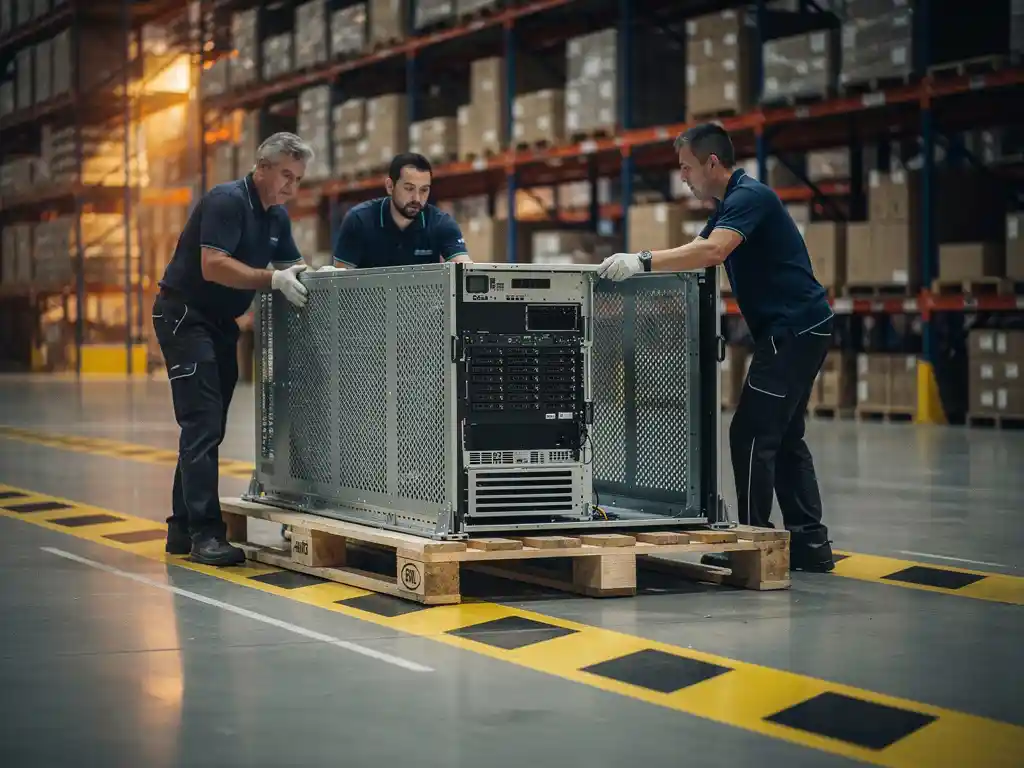
A data center relocation can be managed by a combination of IT relocation specialists, logistics providers, and internal IT teams working together under a coordinated plan. The right lead party depends on the scale and complexity of the move, but in most cases a specialist logistics provider with experience in high-tech equipment takes on the physical coordination role. Below, we answer the most important questions about who does what and how to choose the right partner.
What does a data center relocation actually involve?
Relocating a data center to another site involves physically moving servers, networking equipment, storage systems, power infrastructure, and cabling from one facility to another while maintaining data integrity and minimizing downtime. It is not simply a transport job. A successful move requires detailed asset inventories, decommissioning procedures, chain-of-custody documentation, and a precise reinstallation plan at the destination.
The process typically unfolds in several phases. First, a full audit of existing equipment is completed so every rack, cable, and component is catalogued before anything is touched. Then a migration plan is developed that sequences which systems move first to reduce service disruption. Physical packing and transport follow, with equipment protected against vibration, static, and temperature fluctuations. Finally, equipment is reinstalled, reconnected, and tested at the new site before the move is declared complete.
The complexity grows significantly with scale. Moving a handful of server cabinets is a very different challenge from relocating an entire enterprise data hall. Large-scale moves often involve parallel operations, phased cutovers, and coordination across multiple stakeholders, including facilities management, network engineers, and external logistics teams.
Who are the key parties responsible for a data center move?
Responsibility for a data center move is shared across several parties: the internal IT team, a specialist IT relocation firm or logistics provider, and often the management teams of both the origin and destination facilities. No single party can handle every dimension alone, which makes clear role definition essential from the outset.
The internal IT team typically owns the technical side. They understand the architecture, manage system dependencies, and make decisions about sequencing and acceptable downtime windows. They are also responsible for data backup verification before the physical move begins.
The logistics or relocation partner takes responsibility for the physical movement. This includes packing, transport, chain-of-custody tracking, and safe delivery to the new site. In more complex projects, a dedicated project manager from the logistics side coordinates all moving parts and serves as the single point of contact across all phases.
Facility managers at both ends handle access, power, cooling, and loading dock coordination. Without their involvement, even the best-planned move can stall on the day of execution. When the relocation crosses borders, customs and compliance expertise become an additional responsibility, often handled by the logistics provider.
What’s the difference between an IT relocation firm and a logistics provider?
An IT relocation firm specializes specifically in decommissioning, transporting, and reinstalling technology infrastructure. A logistics provider specializes in the physical movement, warehousing, and supply chain coordination of goods. The key distinction is depth of IT expertise versus breadth of logistics capability, and the best data center moves often require both.
IT relocation firms typically employ engineers who can disconnect and reconnect server cabinets, label cabling systems, and verify that equipment arrives in working condition. They understand the technical risks specific to server hardware, such as shock sensitivity, electrostatic discharge, and thermal exposure during transit.
Logistics providers bring different strengths. They operate established transport networks, manage complex project coordination across multiple locations, handle customs clearance for cross-border moves, and often provide warehousing if equipment needs temporary storage between decommissioning and reinstallation. For large-scale or international relocations, a logistics provider’s infrastructure and project management capability can be the deciding factor in whether a move runs on schedule.
In practice, the two models increasingly overlap. Logistics companies with high-tech specialisms, such as our project logistics offering, build dedicated teams capable of handling technically sensitive equipment, including server cabinets, combining physical logistics expertise with the precision required for IT infrastructure.
Should you hire a general mover or a specialist for data center equipment?
You should always hire a specialist for data center equipment. General movers are equipped for furniture and household goods, not for sensitive electronics that require anti-static packaging, vibration-dampened transport, and strict chain-of-custody documentation. Using a general mover for server hardware introduces serious risks of equipment damage, data loss, and compliance exposure.
The difference in approach is substantial. A specialist provider uses purpose-built transport crates, monitors environmental conditions during transit, and assigns trained personnel who understand how to handle rack-mounted equipment safely. Every item is logged, tracked, and accounted for throughout the move.
General movers lack this infrastructure. They may treat a server rack the same way they treat a filing cabinet, which is a costly mistake. Even minor physical shocks during transit can damage hard drives, loosen connections, or void manufacturer warranties. For equipment that holds sensitive business or customer data, the stakes are even higher.
The cost difference between a general mover and a specialist is real, but it is small relative to the cost of equipment failure, data recovery, or unplanned downtime. Specialist providers also carry appropriate liability coverage for high-value technology assets, which general movers typically do not.
How do logistics providers ensure data security during a move?
Logistics providers ensure data security during a data center relocation through chain-of-custody documentation, sealed and tamper-evident packaging, GPS-tracked transport, and controlled access at every stage of the move. These measures ensure that no equipment is left unaccounted for and that access to sensitive hardware is restricted to authorized personnel only.
Before any equipment leaves the origin site, a full asset manifest is created and signed off. Each item is individually labeled and matched to its manifest entry. Sealed containers or locked transport cages are used so that any tampering is immediately visible upon arrival at the destination.
Transport vehicles are tracked in real time, and handover between parties is documented at each transition point. This creates a clear, auditable record of where every piece of equipment was at every moment during the move. For organizations subject to data protection regulations, this documentation is not optional. It forms part of the compliance evidence required to demonstrate that sensitive data was handled responsibly throughout the relocation process.
Some logistics providers go further by offering secure staging areas or clean-room environments for equipment inspection and preparation. We operate a dust-free clean room within our warehouse specifically for handling server cabinets and related high-tech equipment, which reflects the level of environmental control that sensitive IT hardware demands.
What should you look for when choosing a data center relocation partner?
When choosing a partner for relocating a data center to another site, look for demonstrated experience with high-tech equipment, a structured project management approach, chain-of-custody protocols, the ability to handle customs for cross-border moves, and a single point of contact who owns the process from start to finish.
Experience is the first filter. Ask whether the provider has handled server cabinets, networking equipment, and sensitive electronics before. Request references or case examples from comparable projects. A provider with a track record in high-tech logistics will have the right equipment, trained personnel, and documented procedures already in place.
Project management capability matters as much as physical logistics. A data center move involves multiple stakeholders, tight timelines, and significant consequences for delays. Your partner should assign a dedicated project manager who coordinates every phase, communicates proactively, and escalates issues before they become problems.
For international relocations, customs expertise is non-negotiable. Equipment crossing borders must be correctly classified, documented, and cleared without delays that leave your infrastructure stranded in transit. Verify that your logistics partner handles this in-house rather than outsourcing it to an unknown third party.
Finally, assess how the provider approaches accountability. Clear chain-of-custody documentation, real-time tracking, and liability coverage for high-value assets are baseline requirements. A partner who cannot demonstrate these controls clearly is not equipped for the responsibility a data center move represents. You can learn more about how we approach complex logistics projects on our about us page, or get in touch directly to discuss your specific requirements.