


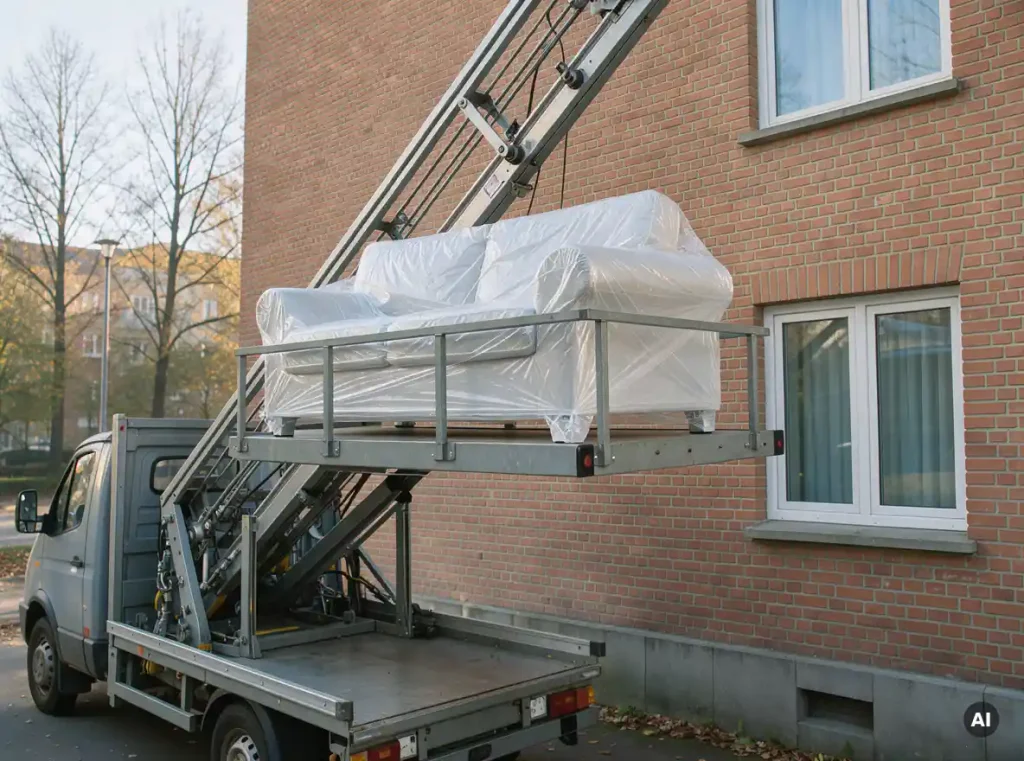
An external lift is usually the better choice for furniture delivery when the load is large, heavy or awkward, and the building has no suitable goods lift. A goods lift wins when one is already installed, fits the items and can be reserved. The right pick depends on access, item size, timing and cost.
In practice, most deliveries to upper floors come down to a few simple checks. The sections below explain which factors matter most, when each option makes sense and what to arrange before the truck arrives.
What factors decide which lift works best?
Four factors decide it: the dimensions and weight of the furniture, the floor you are delivering to, the access around the building, and whether a suitable goods lift actually exists and is available. If the furniture fits through the stairwell and goods lift comfortably, the goods lift usually wins. If not, an external lift is the safer route.
Look at each factor in turn:
- Item size and weight: Large sofas, wardrobes, dining tables and stone worktops often exceed the internal size or weight limit of a standard passenger or goods lift.
- Floor height: Most external furniture lifts work well up to a certain building height, so very tall buildings may rule them out.
- Street and site access: An external lift needs a stable, level spot for the truck and the lift. Narrow streets, overhead cables, trees and parking restrictions can all get in the way.
- Window or balcony opening: The furniture must physically fit through the opening, and the surrounding area must be clear.
- Building rules: Some apartment complexes restrict delivery times, require protective floor covering or limit which lifts can be used.
Weather also plays a role. Strong wind can pause an external lift operation, so it is worth having a backup plan for outdoor work.
When is an external lift the better choice?
An external lift is the better choice when furniture is too big for the stairs or internal lift, when the building has no goods lift, or when you want to avoid carrying heavy pieces through shared corridors. It lifts items straight to a window or balcony, keeping them away from tight turns and narrow doorways.
This makes it a strong fit for furniture lifts for apartments in older buildings, where stairwells are steep and narrow and a lift may not exist at all. It also protects furniture. Fewer hands, fewer corners and fewer carrying steps mean less chance of scratches, dents or damaged walls and floors.
An external lift is particularly useful in these situations:
- Delivering heavy furniture upstairs when the stairwell is too tight for a safe carry.
- Moving oversized items such as large sofas, wardrobes or glass tables.
- Delivering to a building without any working goods lift.
- Keeping shared hallways clear and reducing disturbance to neighbours.
The main limits are access and weather. If the truck cannot park close enough to the facade, or the window opening is too small, the external lift is not an option.
When does a goods lift make more sense?
A goods lift makes more sense when the building already has one that fits the furniture, when outdoor access is difficult, or when the weather is poor. It is also the practical choice for a high volume of items, such as an office fit-out, where carts can run continuously inside the building.
A goods lift works inside the building’s own protected environment. There is no dependency on wind, street parking or window size. For commercial properties, hotels and large apartment blocks that were designed with deliveries in mind, it is often the faster and calmer option.
Keep these points in mind before choosing it:
- Check the internal dimensions and load limit. A lift that looks big enough may still fail once you account for door width and the diagonal of a tall item.
- Confirm availability. Many buildings share a single goods lift between all residents, so it may need to be booked.
- Protect the interior. Lift walls, floors and hallways usually need padding or covering, and some building managers require it.
For larger projects where many pieces move in one day, we plan the sequence so the goods lift is used efficiently. Our project logistics team handles exactly that kind of coordination for offices, schools and hotels.
How do external and goods lifts compare on cost and speed?
A goods lift is usually cheaper and often faster when it is already in the building, because there is no extra equipment to hire. An external lift adds hire and operator costs, but it can save time and reduce damage risk when the alternative is a long, difficult carry upstairs.
There is no fixed price for either option, since the external furniture lift cost depends on the region, the lift type, the duration and the access situation. What you can compare is how each option behaves:
- Setup time: An external lift needs positioning and safety checks before the first item goes up. A goods lift is ready as soon as it is reserved.
- Throughput: A goods lift can carry several items on a cart per trip. An external lift typically moves one piece at a time, though each trip is quick.
- Cost drivers: For an external lift, expect equipment hire, an operator and possibly a street permit. For a goods lift, costs are usually limited to a building fee or booking charge, if any.
- Risk to the goods: Fewer carrying steps generally means lower damage risk, which can offset the extra cost of an external lift for valuable or fragile pieces.
For a single heavy item going to a high floor, the external lift often pays for itself. For many smaller items, the goods lift tends to be more economical.
What should be arranged before delivery day?
Before delivery day, confirm the furniture dimensions, measure every access point, check whether a goods lift or external lift is feasible, and arrange permits and building permissions. Clear communication with the delivery team and the building manager prevents most last-minute problems.
A short checklist helps:
- Measure everything. Record the width, depth, height and weight of each item, plus every door, stairwell turn, lift cabin and window opening on the route.
- Share photos and measurements with the delivery team. A quick visual of the entrance, street and target floor helps them choose the right method.
- Book the goods lift or request permission. Many buildings require advance notice and may limit delivery to certain hours.
- Arrange street access. For an external lift, secure parking space and any required permit, and check for overhead obstacles.
- Prepare the space. Clear the receiving room, protect floors and move fragile items out of the way.
- Plan for weather. Agree on a fallback option if wind or rain makes an outdoor lift unsafe.
Specialist furniture logistics makes this easier. Our trained crews deliver and, where needed, assemble pieces on site, drawing on long experience with furniture transport for premium brands. If your delivery is complex, you can contact us and we will help you choose the safest and most efficient route to the right floor.