


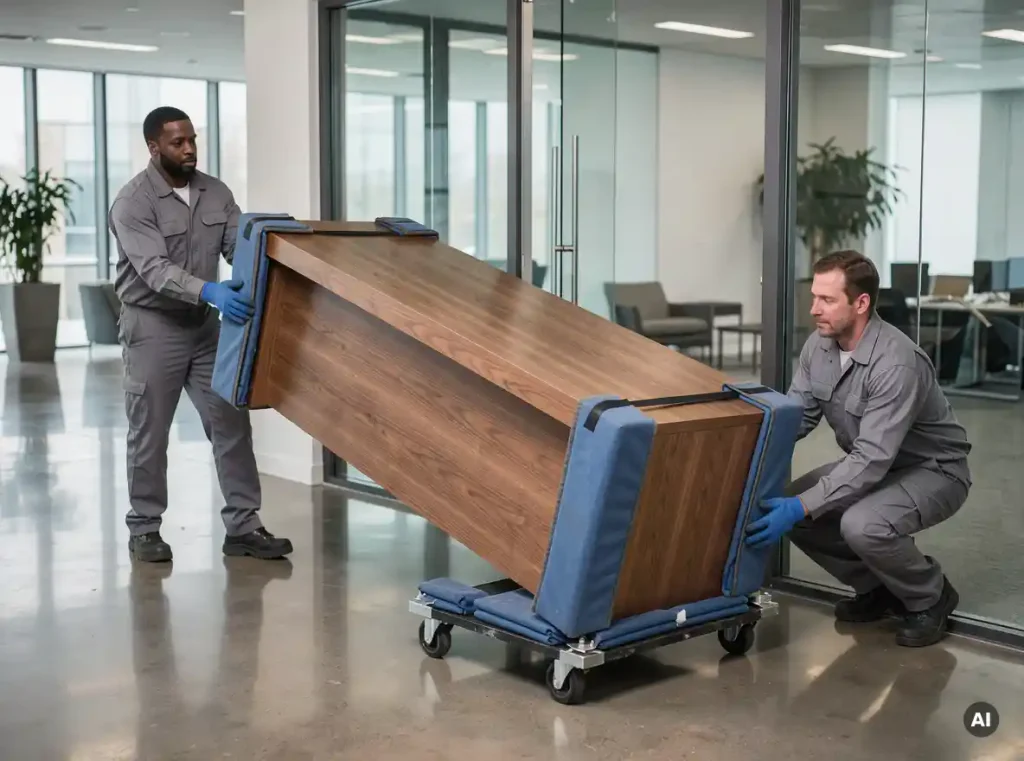
An oversized reception desk can pass through a tight entrance by being measured accurately in advance, tilted or rotated along its narrowest axis, or split into modular sections that are reassembled on site. If none of these work, hoisting through a window or opening a facade is the fallback. Success almost always comes down to planning the route before delivery day.
Most desks that “don’t fit” actually do fit once someone checks the full path, not just the front door. Below, we walk through the measurements, techniques, and equipment that make tight-entrance deliveries work.
Which measurements decide whether a desk will fit?
Four numbers decide whether a desk fits: the desk’s length, width, and height, plus its diagonal depth, compared with the narrowest clear opening along the entire route. The narrowest point is rarely the front door. Stairwells, lift cabins, corridor corners, and door frames inside the building often cause the real bottleneck.
Measure the clear opening, not the door size. Door leaves, handles, frames, and hinges all reduce usable width, so a door labelled 100 cm may offer only 90 cm in practice. Then walk the route and note every obstacle:
- Door widths and heights, with doors fully opened (or removed from their hinges)
- Corridor widths, plus any radiators, pipework, or fixtures that narrow them
- Turning space at corners and landings, which matters more than straight widths
- Lift cabin interior size and its door opening
- Ceiling height, including low beams, sprinkler lines, and lighting
Compare each of these with the desk’s dimensions, including packaging. Foam and blankets add a few centimetres that can tip a tight fit into a failed one. A short site survey or a set of photos with measurements usually settles the question before anything is loaded onto a truck.
How can a desk be tilted or rotated to pass?
A desk passes through a narrow entrance by presenting its smallest cross-section to the opening. Tilting it on its side, standing it on end, or rotating it diagonally through the doorway often reduces the effective width by tens of centimetres. The right orientation depends on the desk’s shape and where its weight sits.
The basic idea is geometry. A rectangular object can pass through an opening whose diagonal is larger than the object’s smaller cross-section. In practice, installers work through a few steps:
- Identify the desk’s slimmest profile, usually its depth by height.
- Choose the orientation that keeps that profile facing the opening, typically on its side or end.
- Angle the desk as it enters, then straighten it once the leading edge clears the frame.
- Rotate again at corners, using the pivot point rather than dragging the desk around the turn.
Curved or L-shaped reception desks need extra care, since their overhangs and protruding returns can snag on frames. Remove loose parts such as countertops, panels, or drawer units first. A rehearsal with the empty packaging or a cardboard template of the desk’s footprint can reveal pinch points before the real piece is at risk.
Can a reception desk be delivered in modular pieces?
Yes, many reception desks are built or can be adapted to arrive in modular sections that are assembled on site. Splitting a desk into a base, side modules, and a separate countertop reduces each piece’s size and weight, so every part can pass through narrow openings that the finished desk never could.
The best moment to decide this is at the design and ordering stage. If the entrance is known to be tight, ask the manufacturer for a modular or knock-down version with:
- Pre-fitted joints or connectors designed for tool-free or quick on-site assembly
- A countertop split into sections with discreet seams
- Numbered or labelled components to speed up reassembly
Dismantling an existing desk is possible too, but it should follow the manufacturer’s guidance. Cutting into a solid-surface or stone top without a plan can ruin the piece, and seams in premium finishes need skilled finishing. For high-end projects, we often pair delivery with assembly and installation, so the same trained team that carries the pieces in also puts them back together and checks the final result. That is part of our project logistics work, where complete interiors are installed before we leave.
What equipment helps move oversized furniture safely?
The right equipment for oversized furniture includes furniture dollies, skates, sliding sheets, lifting straps, and protective blankets, with hoists or cranes for large pieces that cannot go through the building. Using proper tools protects both the desk and the installers, and keeps walls, floors, and door frames undamaged.
Common tools for tight-entrance deliveries include:
- Furniture dollies and skates for moving heavy desks smoothly across floors
- Lifting and carrying straps that spread the load across two or more people
- Corner and edge protectors plus furniture blankets for frames and finishes
- Floor and wall protection such as boards and runners along the route
- Stair climbers or hand trucks where steps are unavoidable
For sensitive or valuable pieces, the people matter as much as the gear. Handling fragile furniture works best with two trained professionals per delivery, trained on the job to treat the product with care. Our teams are trained in-house for exactly this, and furniture transport is a craft we have refined for a century.
What if the entrance still is not wide enough?
If the entrance is still too narrow after tilting and splitting, the desk can be hoisted through a window, balcony, or loading opening, or the building can be temporarily modified, for example by removing a door, frame, or glazing panel. These are last resorts, and they require planning, permission, and the right equipment.
Before choosing this route, work through the alternatives in order:
- Remove doors from their hinges to gain extra clearance.
- Check for a secondary entrance, service door, or loading bay with a wider opening.
- Consider furniture hoisting, using an external lift or crane to bring the desk in through a window or terrace opening.
- Ask the building owner about removing a section of glazing or a frame, if permitted.
Each option brings its own considerations: street permits for cranes, insurance, weather, and building management approval. This is where early coordination pays off. The earlier the site survey, the more options remain open and the lower the cost and risk.
If you are planning a desk delivery with a tricky entrance, get in touch with our team. We treat every logistics challenge as a chance to build a tailored solution, and we would be happy to think it through with you.