


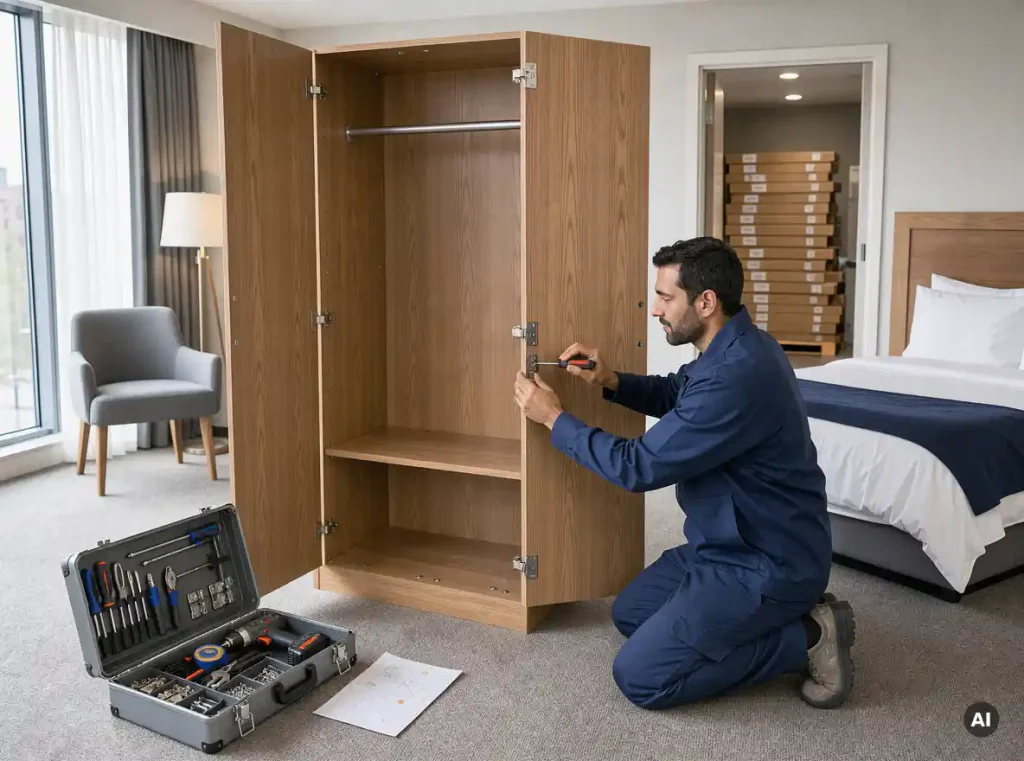
Off-site furniture assembly is usually cheaper for large, repeatable volumes because assembly happens in a controlled warehouse where labor is efficient and tools are on hand. On-site assembly is usually cheaper for small, fragile, or one-off orders where transporting bulky pre-assembled pieces would cost more than the labor itself. The right answer depends on volume, product type, and delivery distance, and the sections below break down each cost driver.
Which costs make furniture assembly more expensive?
The biggest cost drivers in furniture assembly are labor hours, transport volume, product complexity, and damage risk. Whether assembly happens in a warehouse or at the customer’s location, these four factors determine most of the final price on your invoice.
Labor is the most visible cost. Assembly time rises quickly with complex items such as modular sofas, height-adjustable desks, or fitted cabinets. Travel time for installers adds to this when assembly takes place on location, because every minute spent driving between addresses is a minute not spent assembling.
Other factors that push costs up include:
- Access limitations: narrow staircases, missing lifts, or restricted loading windows slow down any installation.
- Packaging and protection: assembled furniture needs more careful wrapping than flat-packed items.
- Rework: a missing part or a misaligned panel can mean a second visit.
- Skill requirements: premium furniture needs trained installers, not general labor.
How does transport affect off-site assembly costs?
Transport affects off-site assembly costs because pre-assembled furniture takes up far more space in a truck than flat-packed furniture. Fewer units fit per load, which raises the cost per piece, increases the number of trips, and adds handling risk. This is the main trade-off against the efficiency gains of assembling in a warehouse.
A truck carrying flat-packed items can move many more pieces per trip than one carrying fully built wardrobes or kitchen units. Assembled products also need more protection, and every extra handling step raises the chance of damage. For that reason, specialized furniture transport matters so much when assembled pieces travel any real distance.
Smart loading can soften this effect. We use swap bodies with a double loading floor, which increases capacity and shortens loading and unloading times. Combined with careful route planning, this keeps the transport penalty of pre-assembled furniture smaller than you might expect.
When is on-site furniture assembly the cheaper option?
On-site furniture assembly is cheaper when volumes are small, products are fragile or oversized, or items must be built in their final position. Skipping the extra warehouse handling and transporting compact flat-packed goods saves both transport costs and damage risk.
On-site assembly typically wins in these situations:
- Single items or small orders: setting up a warehouse assembly line for a handful of pieces rarely pays off.
- Items that cannot pass through doors: large wardrobes, kitchens, and fitted units often have to be built where they will stand.
- Short distances: when installers are already nearby, travel time is minimal.
- Installation and assembly combined: for kitchens and fitted furniture, assembly and installation are effectively one job.
For consumer deliveries, a white glove delivery service that includes assembly in the correct room avoids a second appointment and keeps the customer experience smooth. The same applies to kitchen delivery and installation, where trained two-person teams deliver and fit units in one visit.
When does off-site assembly save more money?
Off-site assembly saves more money when you handle large volumes of identical or similar products, such as office chairs, workstations, or hotel room furnishings. A warehouse offers fixed workstations, tools, and a predictable workflow, which lowers the labor cost per unit and shortens on-site installation time.
Repetition is the key. When installers assemble the same product dozens or hundreds of times, they build speed and consistency. Quality control is also easier in a warehouse, since issues can be fixed before anything reaches the customer.
Off-site assembly also helps with project timing. Large furnishing projects, such as offices, schools, and hotels, often have tight installation windows. If most of the assembly is done beforehand, the on-site team only has to place and finish items. This is where warehouse assembly pays off, especially when it is combined with storage and just-in-time delivery. As an example, we handle around 2,000 office chairs per week, which is exactly the kind of volume where centralized handling makes financial sense.
What hidden costs should be factored into the comparison?
Hidden costs in furniture assembly include damage and returns, storage fees, waiting time at delivery sites, repeat visits, packaging waste, and the administrative effort of coordinating several parties. These rarely appear in a first quote but can easily outweigh the difference between two assembly methods.
Watch for these items when comparing quotes:
- Damage and claims: assembled furniture is more exposed in transit, while on-site assembly risks damage in customers’ homes or offices.
- Storage time: warehouse assembly needs space and planning, especially when delivery dates move.
- Failed or repeated visits: missing parts or absent recipients lead to extra trips.
- Waste disposal: packaging removal is sometimes excluded from the price.
- Coordination effort: managing separate transport, assembly, and installation suppliers costs internal time.
A single partner for the whole chain reduces many of these risks. When transport, assembly, and installation sit under one roof, a single point of contact is accountable from start to finish.
How can the cheapest assembly option be chosen?
The cheapest assembly option is found by comparing the total cost per delivered and installed unit, not the assembly price alone. Calculate labor, transport, damage risk, and coordination for both methods using your real volumes, product types, and delivery locations, then choose the method with the lowest all-in figure.
A practical approach looks like this:
- Map your volumes: large repeatable batches favor off-site; small mixed orders favor on-site.
- Check product dimensions: bulky assembled items raise transport costs sharply.
- Review delivery access: tight spaces can make pre-assembled items impossible to deliver.
- Compare total cost per unit: include transport, damage allowance, and any repeat visits.
- Consider a hybrid model: pre-assemble components off-site and complete final assembly on location.
Many projects end up with a mix of both. If you want an honest comparison for your own situation, our project logistics team can help you model each scenario. You can also get in touch with us to talk through your volumes and delivery requirements.