


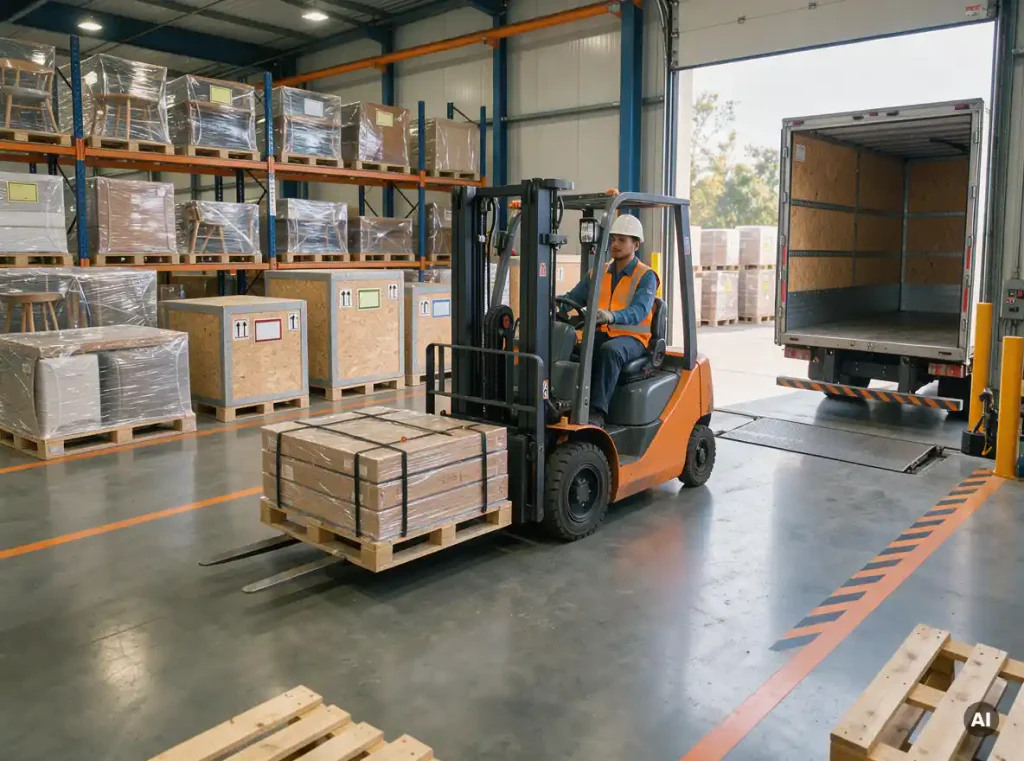
A staging warehouse reduces fit-out site congestion by receiving, checking, and holding goods off site, then releasing them in the exact sequence and quantity the installation team needs each day. Instead of dozens of trucks arriving unannounced, the site receives a few planned, ready-to-install deliveries.
This works because most congestion comes from poor timing, not poor volume. Controlling when and how goods arrive removes the clutter before it forms. Below, we answer the key questions about how staging works and when it pays off.
Anyone who has run a fit-out knows the picture: pallets in corridors, a loading bay blocked by the wrong delivery, and installers stepping around crates. Project logistics exists to prevent exactly this.
What Causes Congestion on Fit-Out Sites in the First Place?
Fit-out site congestion is caused mainly by uncoordinated deliveries, limited storage space, and goods arriving before the site is ready to receive them. When multiple suppliers ship directly to the same address with no shared schedule, trucks, pallets, and packaging pile up faster than installers can clear them.
Several factors tend to combine:
- Too many suppliers delivering independently, each with their own carrier and arrival window.
- Early or late arrivals that do not match the installation sequence, leaving goods with nowhere to go.
- Limited access, such as a single goods lift, a narrow loading bay, or restricted delivery hours in a busy building.
- Packaging waste from dozens of separate shipments that must be unpacked, sorted, and removed on site.
- Damage and rework, because goods stored in half-finished rooms get bumped, dusty, or misplaced.
The common thread is that the site becomes a storage space, a sorting area, and a waste station all at once. That is not what a fit-out site is for.
How Does a Staging Warehouse Control Deliveries to Site?
A staging warehouse controls deliveries by acting as a single consolidation point. Goods from many suppliers arrive there first, are inspected and stored, and are then dispatched to site in planned batches that match the installation schedule, so the site only receives what it can use that day.
In practice, the process usually follows a clear flow:
- Receive and check. Incoming goods are booked in, counted, and inspected for damage while there is still time to fix problems.
- Store and consolidate. Items from different suppliers are held together, organized by project, floor, or room.
- Sequence and prepare. Goods are grouped in the order they will be installed.
- Release on demand. Deliveries leave the warehouse on a fixed schedule, often as one consolidated truck instead of many separate ones.
This is a form of just-in-time delivery for construction and interiors. The warehouse absorbs the unpredictability of supplier lead times so the site does not have to. It is also why warehousing is such a natural part of any well-run fit-out plan.
Which Staging Services Take the Most Pressure Off Site?
The services that relieve the most pressure are consolidation, kitting and sequencing, pre-assembly, and packaging removal. Each one moves a task that would normally clutter the site into a controlled warehouse environment, where it can be done faster and without blocking anyone.
Kitting and Sequencing
Kitting means grouping all the items needed for one room, floor, or workstation cluster into a single labeled set. Sequencing means delivering those sets in installation order. Installers receive exactly what they need, in the right place, without hunting through pallets.
Pre-Assembly and Packaging Removal
Assembling furniture, wiring equipment, or preparing components in the warehouse means fewer tools, fewer offcuts, and far less cardboard on site. We can also strip and recycle packaging before goods leave the warehouse, or transport items loosely wrapped in furniture blankets instead of single-use packaging. That keeps corridors clear and reduces waste handling for the site team.
For premium furniture and workspace projects, these steps also protect finish quality, since goods are handled once and installed soon after arrival. Our team at Jan Krediet furniture transport works this way on projects where a single scratch matters.
When Is a Staging Warehouse Worth Using for a Fit-Out?
A staging warehouse is worth using when a project has many suppliers, tight site access, a fixed handover date, or high-value goods that need protection. The more complex the delivery picture, the more value staging adds. For very small jobs with one supplier and ample space, direct delivery may be enough.
Staging tends to pay off in situations like these:
- Multi-supplier projects such as offices, hotels, schools, and coworking spaces, where furniture, lighting, IT, and decoration all arrive from different places.
- Constrained sites, including high-rise buildings with one goods lift or city locations with limited loading windows.
- Phased or multi-site rollouts, where the same sequence repeats across floors or locations.
- International sourcing, where long lead times and uncertain arrival dates make direct-to-site delivery risky.
- Tight deadlines, where a blocked bay or a missing item can delay an entire handover.
A useful rule of thumb: if you cannot confidently say when every delivery will arrive and where it will go, staging will probably help. Our teams handle this kind of complexity across many industries, from workspaces to technology installations.
How Should Staging and Site Schedules Be Coordinated?
Staging and site schedules should be coordinated by working backward from the installation plan. Start with when each area needs goods, then set warehouse release dates, supplier arrival deadlines, and delivery slots to match, with one shared schedule and one point of contact keeping everyone aligned.
A few practices make this work smoothly:
- Build the schedule from the install sequence, not from supplier ship dates.
- Agree delivery windows with the site manager and building management, including lift bookings and access rules.
- Set a cut-off for supplier arrivals at the warehouse, leaving buffer time for inspection and kitting.
- Hold short, regular check-ins between the logistics team and the site team, especially in the final weeks.
- Keep a buffer stock of critical items in the warehouse so a late delivery does not stall installers.
A dedicated project manager makes a real difference here. When one person coordinates routes, lead times, and delivery schedules, small changes on site can be absorbed quickly instead of cascading into delays. Our team is happy to talk through how this would look for your project.
How Can You Tell Whether Staging Is Reducing Congestion?
You can tell staging is working when fewer vehicles arrive at the site, unloading times shrink, installers waste less time searching for items, and fewer goods are damaged or misplaced. The clearest sign is simple: the site looks calmer, and installation progresses without waiting on deliveries.
Useful indicators to track include:
- Number of deliveries per week compared with the original direct-delivery plan.
- Average time a delivery vehicle spends at the loading bay.
- Installer downtime caused by missing, wrong, or hard-to-find items.
- Damage and rework incidents on delivered goods.
- Volume of packaging waste removed from site.
- On-time completion of each floor or phase against the schedule.
Review these figures at the end of each phase and adjust. If one floor ran smoothly, repeat the approach; if another struggled, look at the delivery windows or kitting detail. Staging improves with each cycle, and the lessons carry over to the next project. If you would like to see how this plays out in practice, take a look at our project cases.