


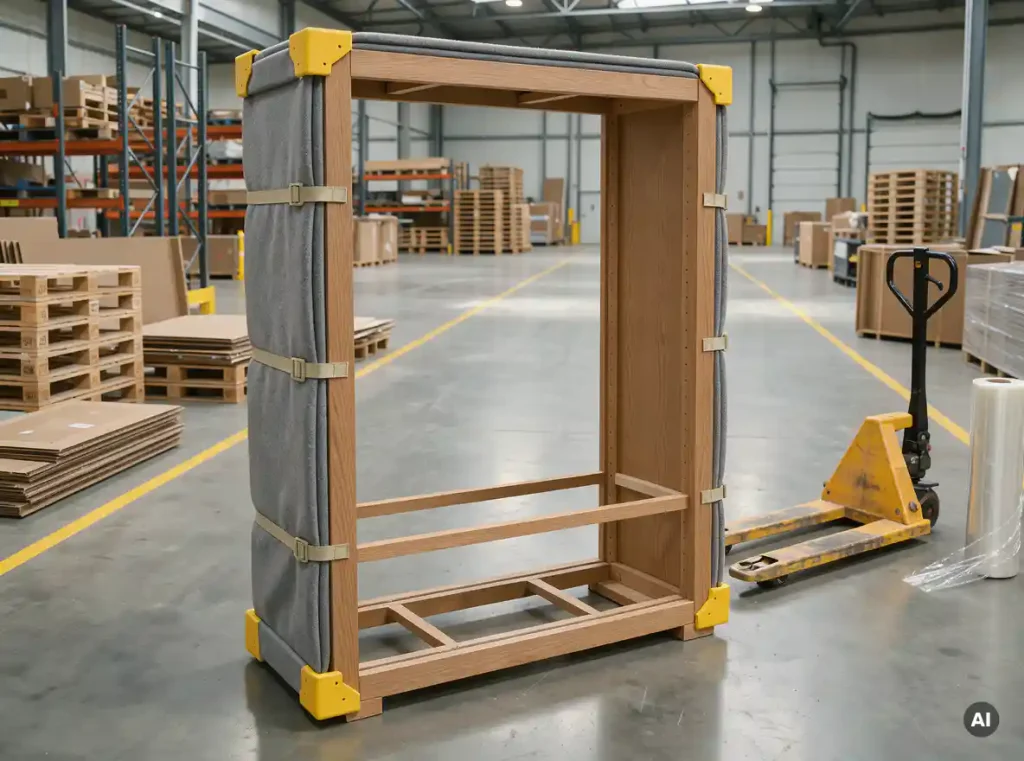
To protect part-assembled furniture between phases, wrap exposed surfaces in furniture blankets or protective film, store each unit in a clean, dry, climate-stable space, move it on padded equipment, and label every component. Damage mostly happens during handling, so protection must cover packaging, storage, transport and documentation together.
The right level of protection depends on the finish, the number of handovers and how long the pieces wait. Below, we answer the key questions we hear from manufacturers, dealers and project teams.
Where does part-assembled furniture get damaged most often?
Part-assembled furniture is damaged most often at the moments of handling: loading, unloading, moving between storage locations and staging on site. Edges, corners, glass, stone tops, veneer and painted surfaces are the most vulnerable, especially where unfinished joints, exposed hardware or protruding parts create new pressure points.
Part-assembled pieces are riskier than finished or flat-packed ones. A half-built cabinet carries open edges, loose fittings and uneven weight, and it often has no final packaging. Typical causes of damage include:
- Impact: corners and edges knocking against walls, doors, trolleys or other items.
- Abrasion: units rubbing against each other or against hard load surfaces in transit.
- Moisture and temperature swings: especially for wood, veneer and glued joints.
- Dust and debris: which settle on surfaces and scratch when wiped or covered carelessly.
- Stacking pressure: pieces placed on top of each other without proper separation.
- Mix-ups: wrong parts reaching the wrong phase, leading to forced fits and cosmetic damage.
Knowing where the weak points are lets you plan protection precisely instead of wrapping everything the same way.
What packaging best protects part-assembled furniture?
The best packaging for part-assembled furniture combines reusable furniture blankets or protective film on finished surfaces, corner and edge protectors on vulnerable points, and rigid support for fragile elements such as glass or stone. The goal is to cushion impacts and prevent abrasion without trapping moisture or leaving residue.
Match the material to the surface:
- Furniture blankets: ideal for large painted or lacquered surfaces. They are reusable and avoid single-use waste, and we often transport goods loosely packed in blankets for exactly this reason.
- Corner and edge protectors: essential for tops, doors and panels, where most impact damage starts.
- Protective film or tape-safe wrap: useful for fresh finishes, but choose low-tack products so nothing marks the surface.
- Foam or cardboard separators: keep pieces apart so they never touch directly.
- Rigid covers or crates: best for glass, stone and highly sensitive components.
Avoid sealing wood tightly in plastic for long periods, because trapped humidity can harm the finish. For longer waits, breathable covers are safer. Good furniture packaging between phases should also be easy to remove and reapply, since pieces often get unwrapped for inspection.
How should part-assembled furniture be stored between phases?
Store part-assembled furniture in a clean, dry, climate-stable warehouse, off the floor, with enough space around each unit to prevent contact and stacking pressure. Group components by project and assembly phase so the right items are easy to find, and keep fragile pieces in dedicated, low-traffic zones.
Good part-assembled furniture storage rests on a few simple principles:
- Control the environment. Avoid damp areas, direct sunlight and large temperature swings.
- Keep units off the ground. Use pallets, racks or padded supports.
- Do not stack unless the piece is designed for it. Where stacking is needed, use separators and spread the weight.
- Organize by phase and project. This reduces handling, which is the biggest source of damage.
- Restrict access. Fewer people and forklifts near delicate stock mean fewer incidents.
For multi-phase jobs, professional warehousing for furniture projects keeps components safe, organized and ready for the next phase. When a project runs over weeks or months, having storage, inventory and later assembly under one roof removes a lot of risk.
How can furniture be transported safely between assembly phases?
Furniture is transported safely between assembly phases by securing each piece on padded, purpose-built equipment, loading it in a planned sequence, and using trained handlers. Careful load planning, immobilization inside the vehicle and minimal transfers matter more than any single piece of packaging.
Several practices make the difference:
- Plan the load order. Load in reverse order of delivery and place heavier units low, with fragile items protected and separated.
- Secure everything. Straps, load bars and padding stop movement, which causes most in-transit scratches.
- Use the right vehicles. Equipment designed for furniture, such as swap bodies with a double loading floor, helps maximize capacity while keeping loading and unloading quick and controlled.
- Use trained people. Furniture logistics is a specialist job. We train our own drivers and installers in-house, with a strong focus on care and respect for the product, and fragile items are usually handled by two people.
- Limit handovers. Every extra transfer is another chance for damage, so direct routes and fewer touchpoints help.
For projects with several phases, working with a partner experienced in specialist furniture transport keeps handling consistent from one phase to the next. This matters most in complex project furniture logistics, where timing, sequencing and on-site installation all depend on each other.
How do you keep track of parts and condition between phases?
Keep track of parts and condition by labeling every component with a unique reference, recording its condition with photos at each handover, and maintaining an up-to-date inventory per project and phase. A simple, consistent check-in and check-out routine prevents lost parts and disputes about damage.
A reliable tracking routine includes:
- Clear labeling. Mark each part with project, room, item and phase so nothing gets mixed up.
- Condition checks at every handover. Inspect and photograph pieces when they arrive, leave storage and reach site.
- Parts kits. Keep fittings, screws and small components bundled and tagged with the item they belong to.
- A live inventory. Track what is stored, what is in transit and what is already installed.
- A single point of contact. One responsible person keeps communication clear across phases.
This documentation is the backbone of furniture damage prevention. It shows exactly where an issue occurred, speeds up fixes and protects the schedule. For larger jobs, dedicated project logistics teams can manage planning, inventory and installation as one connected process, so nothing slips between phases.
If you are planning a multi-phase furniture project and want a second pair of expert eyes on your approach, feel free to get in touch with our team. We are happy to think along.