


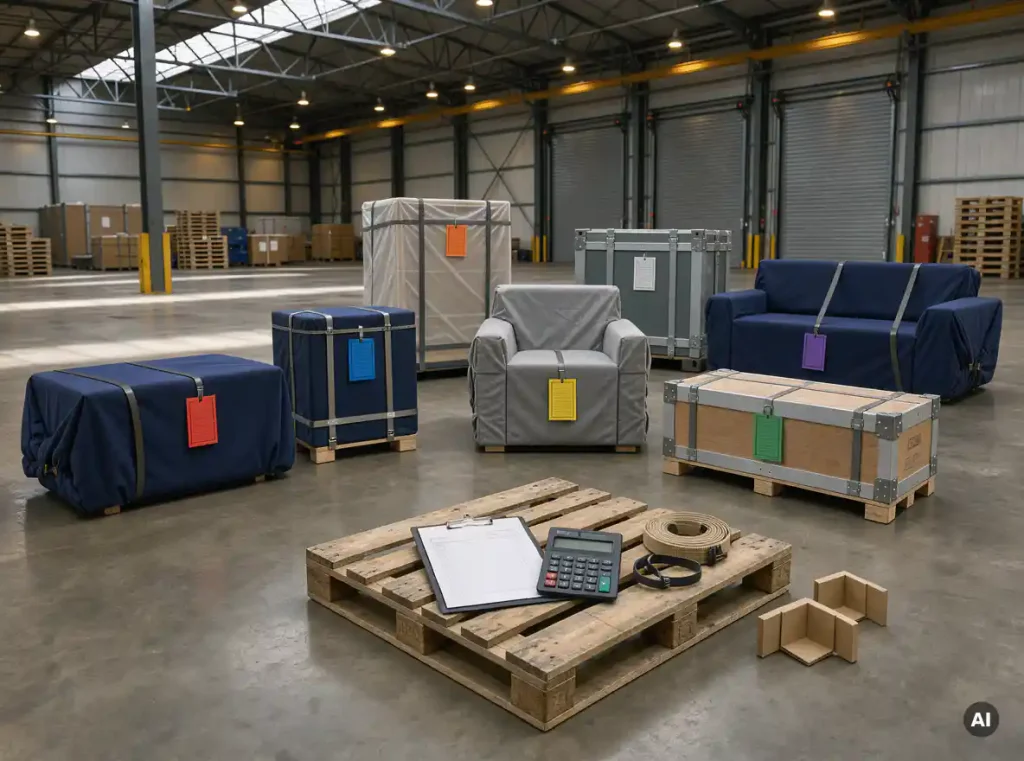
The seven costs to compare in project logistics quotes are transport, warehousing, handling and loading, assembly and installation, project management, customs and administration, and surcharges. Comparing these line by line, instead of looking at the total, shows what each quote actually covers and where the real price differences sit.
Two quotes that look similar at the bottom can hide very different scopes. Below, we answer the questions buyers ask most often when they compare project logistics costs.
Why can two project logistics quotes differ so much?
Two project logistics quotes differ because they rarely cover the same scope. One provider may include installation, waste removal and a dedicated project manager, while another prices transport only. Differences in planning assumptions, delivery windows, vehicle types and risk allowances also move the total considerably.
Project logistics is rarely a standard product. A fit-out of office floors, a hotel or a school involves many parties, strict deadlines and fragile goods. Every provider fills in the unknowns differently. Some build in a safety margin for delays, others assume everything runs perfectly and add costs later.
The way a provider is organized matters too. A project logistics partner that handles transport, warehousing and installation under one roof prices the whole chain. A provider who subcontracts parts of the work often adds coordination margins at each step. Neither approach is wrong, but you can only judge them fairly when you know which one you are looking at.
Which seven cost lines should every quote list?
Every project logistics quote should list seven cost lines: transport, warehousing, handling and loading, assembly and installation, project management, customs and administration, and surcharges. If a quote bundles several of these into one price, ask for a breakdown so you can compare it fairly with other offers.
- Transport: the cost of moving goods, split by full truck load, groupage or partial loads, and by route and delivery window.
- Warehousing: storage per pallet or square metre, inventory management and how long goods can stay before extra fees apply. Our warehousing services are one example of how this line can be structured.
- Handling and loading: loading, unloading, cross-docking, repacking and any special equipment needed for fragile or high-value items.
- Assembly and installation: the labour to unpack, assemble, place and connect goods on site, including crew size and expected duration.
- Project management: planning, coordination, a single point of contact and progress reporting. This is often hidden inside other lines.
- Customs and administration: import and export documents, duties handling and the paperwork for cross-border projects.
- Surcharges: fuel, toll, congestion and similar add-ons, which should be stated clearly rather than left open.
A quote that lists all seven, even when some are priced at zero, tells you the provider has thought through the whole project.
What hidden surcharges are easy to miss?
The hidden surcharges most often missed are waiting time, failed delivery attempts, restricted access fees, weekend or evening work, extra storage days and waste or packaging removal. These rarely appear in the headline price but can add significantly to the final invoice when a project does not run exactly as planned.
Check each quote for these common items:
- Waiting and standstill time: what happens if the building site is not ready when the truck arrives.
- Access restrictions: time slots, lift reservations, parking permits or limited loading bays in city centres.
- Re-delivery and storage: charges when a delivery has to be postponed because of site delays.
- Out-of-hours work: premiums for nights, weekends or tight deadlines.
- Damage and insurance: the liability limit and whether extra cover costs more.
- Fuel and toll clauses: whether these are fixed or adjusted at invoicing.
- Packaging and waste: removal of pallets, foil and cartons after installation.
Ask every provider the same question: “Which costs could appear on the final invoice that are not on this quote?” The answer tells you a lot about how transparent they are.
How do you compare quotes on an equal basis?
To compare project logistics quotes equally, send every provider the same brief, then place the answers in one sheet with the seven cost lines as rows. Normalize units, assumptions and delivery windows so each line describes the same work. Only then compare totals and note what each quote excludes.
A practical approach looks like this:
- Write one brief. Include volumes, locations, dates, access conditions and required services, so every provider quotes the same project.
- Build a comparison sheet. List the seven cost lines as rows and the providers as columns.
- Align assumptions. Check crew size, working hours, storage duration and delivery windows. A cheaper quote often rests on lighter assumptions.
- Mark exclusions. Add the cost of anything missing so each quote shows its estimated full price.
- Review the contract terms. Look at payment terms, liability, cancellation rules and price adjustment clauses.
This turns a stack of different documents into a fair comparison of total cost of logistics. It also gives you a clear list of questions to take back to each provider. If you want a sparring partner while building your brief, you can contact our team and we will gladly think along.
Is the cheapest project logistics quote the best choice?
The cheapest project logistics quote is not automatically the best choice. A low price can reflect a narrow scope, optimistic planning or missing services that return later as extra costs, delays or damage. The best quote balances price with reliability, transparency and a team that can handle complications on site.
Consider what a delay or a damaged item costs you. When a fit-out is part of a larger opening date, one missed delivery can affect contractors, staff and customers. In that light, experience with complex projects, trained crews and a single accountable contact often justify a slightly higher price.
That is how we approach project work. We build a dedicated project team around the client, cover planning, coordination and execution, and keep one point of contact throughout. If you want to see how this works in practice, our project cases show what a fully managed delivery looks like.
Use the cheapest quote as a reference point, not a verdict. Compare scope, risk and service level first, and the right choice usually becomes clear.