


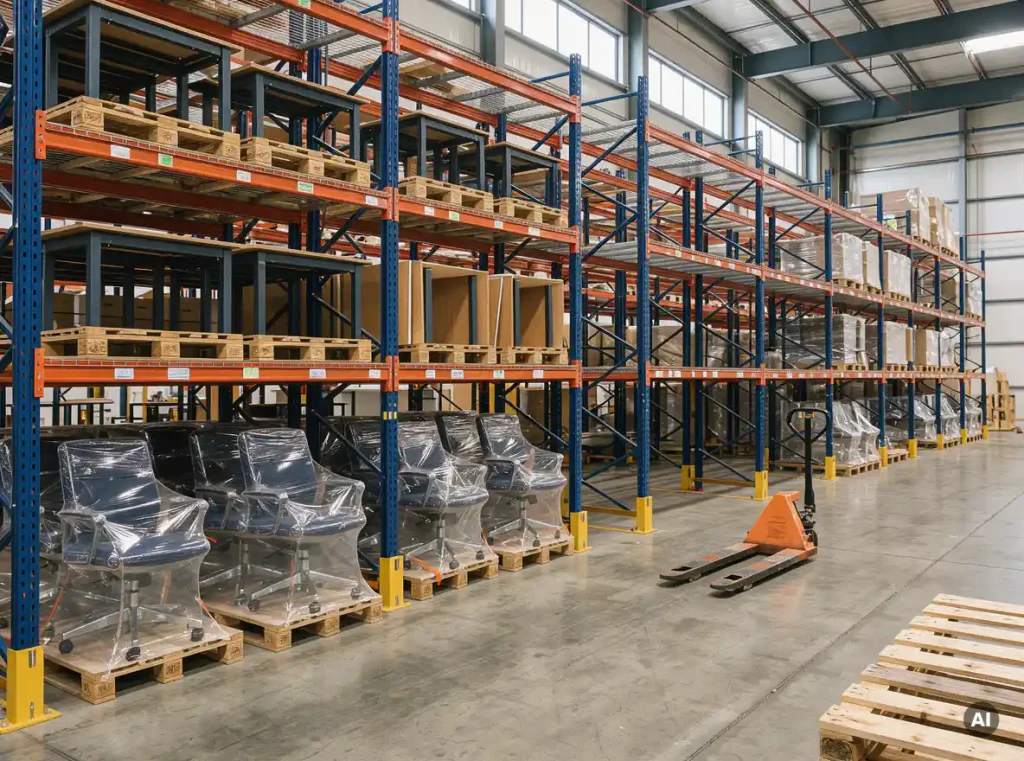
Warehousing costs during a phased office fit-out are driven mainly by how long goods are stored, how much space they occupy, how often they are handled, and how deliveries are scheduled. Furniture type, packaging, and unplanned delays then push the total up or down. Because each floor or department arrives at a different time, costs build in layers rather than as one flat fee.
Understanding these layers lets you budget realistically and avoid surprises when a floor opens late. Below, we answer the most common questions about what shapes the bill.
How is storage duration priced in a phased fit-out?
Storage duration is usually priced per pallet position or per square meter, per week or per month. The longer furniture and equipment sit in the warehouse between delivery phases, the more you pay. A phased fit-out stretches storage across months, so even small rate differences add up quickly.
Most providers offer a base rate that falls as the committed period or volume grows. In a phased project, the real question is how the stock level moves over time. At the start, the warehouse holds nearly everything. As each phase leaves for the site, the occupied space shrinks. Pricing that follows this curve, instead of billing the peak volume for the entire project, can save a meaningful amount.
It helps to agree on a storage plan early, with an expected release date for each phase. Our warehousing solutions are built around this kind of project planning, so storage can follow the actual rhythm of the fit-out.
Which handling activities add to warehousing costs?
Every touch of the goods adds cost. Receiving, inspecting, labeling, storing, picking, repacking, and loading for dispatch are each charged separately or bundled into a handling fee. The more steps your project needs, and the more often goods move, the higher the warehousing cost for office fit-out FF&E.
Typical handling activities include:
- Inbound receiving and inspection: unloading, counting, and checking goods against the packing list for transport damage.
- Labeling and zoning: tagging items by floor, room, or workstation so the right pieces ship in the right phase.
- Pre-assembly and kitting: building desks or chairs in the warehouse, or grouping parts into complete workstation sets.
- Picking and outbound loading: collecting items for each call-off and loading them in installation order.
- Waste and packaging removal: taking away cartons and protective materials so the site stays clean.
Assembling in the warehouse can look like an extra expense, yet it often cuts installation time on site and reduces transport volume. We weigh these trade-offs together with clients, since the cheapest handling line is not always the cheapest project overall.
How do delivery schedules and call-offs change the price?
Delivery schedules change the price because every call-off triggers picking, loading, and transport. A predictable, well-planned release schedule is cheaper than frequent short-notice requests. Just-in-time delivery for a fit-out reduces storage time on site but raises the number of shipments, so the balance needs to be set deliberately.
Call-off storage for office furniture works best when the schedule is realistic and shared in advance. Short lead times, partial loads, and last-minute changes tend to mean extra vehicles, overtime, and less efficient routes. Larger, consolidated call-offs lower the cost per item but require more temporary space on site.
Many fit-outs sit between two extremes: one large delivery that overwhelms the site, and constant small drops that inflate transport costs. Grouping deliveries by floor or department usually finds the middle ground. Because we manage complete project logistics, we can align warehouse releases with the installation sequence so crews are never waiting for goods.
What does the type of furniture and equipment influence?
The type of furniture and equipment influences warehousing costs through volume, fragility, weight, and handling needs. Bulky, delicate, or high-value items take up more space, need more care, and sometimes require climate control or insurance upgrades. A pallet of stackable chairs costs far less to store than the same space filled with premium desks or conference tables.
Several factors matter most:
- Size and stackability: items that cannot be stacked occupy more floor area or racking.
- Fragility and finish: glass, stone, and high-gloss surfaces need protective packing and gentler handling.
- Technical equipment: IT hardware, audiovisual gear, and server cabinets may need clean, secure, or temperature-controlled space.
- Value: expensive items raise insurance and security requirements.
Specialist knowledge pays off here. Our teams are trained to handle premium furniture with care, and we know which items need blankets, crates, or inspection before they leave for the site. See how we approach furniture transport for more detail.
What hidden costs and risks can inflate storage budgets?
Hidden costs usually come from delays, changes, and gaps in information. A postponed handover extends storage, late supplier deliveries scatter stock across multiple arrivals, and damaged or missing items trigger re-ordering and re-handling. These risks rarely appear in the first quote but can inflate a storage budget noticeably.
Watch for these common budget leaks:
- Project delays: every extra week in storage is billed, even if the delay is outside your control.
- Incomplete or mismatched deliveries: partial shipments force repeated inspections and prolonged holding of incomplete sets.
- Poor labeling from suppliers: unclear or missing labels cost time to sort and match.
- Transport damage found late: issues discovered at installation, not at receiving, lead to expensive replacements and delays.
- Minimum charges and ancillary fees: short-term changes, extra inventory reports, or after-hours releases may carry add-ons.
Reading the rate card carefully and asking what happens if the schedule slips are two of the simplest ways to protect your budget. Clear communication with a single contact person keeps these risks visible early, when they are still cheap to fix.
How can phased fit-out storage costs be reduced?
Phased fit-out storage costs fall when you plan the delivery sequence early, consolidate suppliers, and keep the schedule stable. Accurate inventory data, smart packaging choices, and a warehouse partner who understands project work also help. Small decisions at the start tend to save the most money later.
Practical ways to lower cost include:
- Share a realistic phasing plan up front so storage space and labor are booked for the right periods.
- Require consistent labeling and packing lists from suppliers to speed up receiving and picking.
- Consolidate inbound shipments to reduce the number of receiving events.
- Pre-assemble or kit in the warehouse when it shortens on-site installation and reduces transport volume.
- Build in a buffer for delays and agree on how extended storage is priced before it happens.
- Choose one partner for warehousing, transport, and installation to avoid handovers, duplicate handling, and finger-pointing.
Since 1924 we have supported complex fit-outs, so we know where phased projects tend to lose money. If you want a clearer view of your own situation, you can contact our team and we will help you map storage, handling, and delivery into one workable plan.