


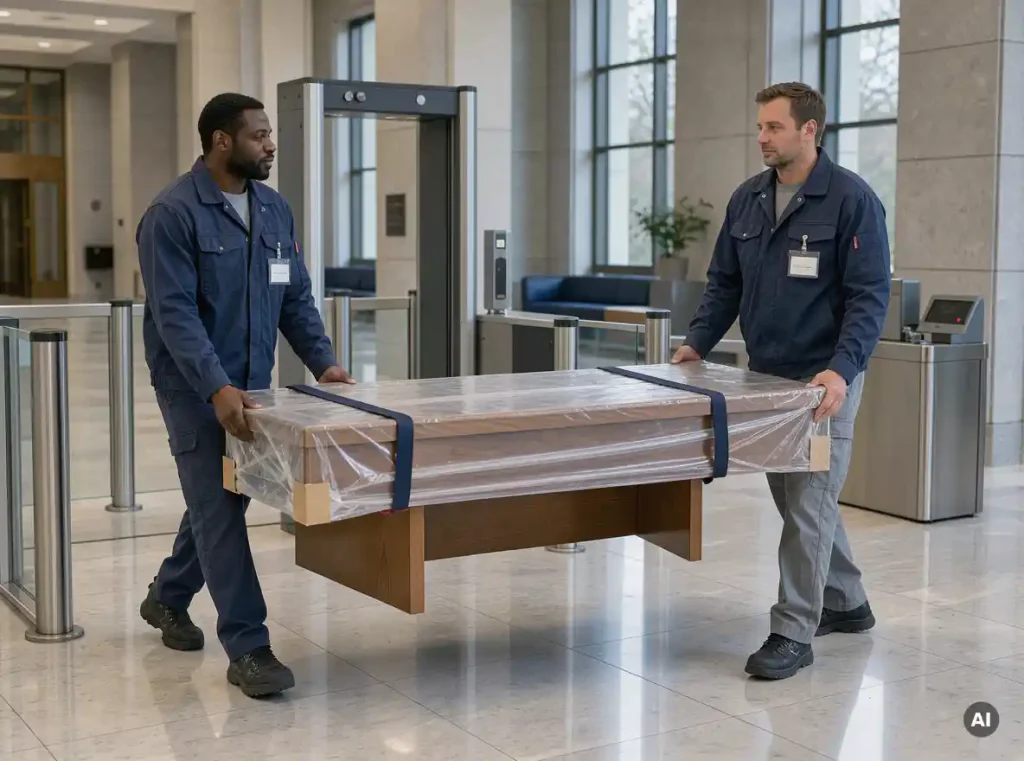
Government furniture installations typically require identity verification, background screening, pre-approved personnel lists, and escorted site access. Exact requirements vary by building, agency, and country, but installers should expect to be vetted before they ever reach the loading dock.
The level of screening depends on what the building houses, from a municipal office to a ministry or courthouse. This article answers the key questions about who gets screened, which documents are needed, how access works on the day, and how to plan around it all.
Who Gets Screened Before Entering a Government Building?
Everyone who works inside a government building on a furniture installation project gets screened. That includes installers, drivers, supervisors, and project managers. Anyone who needs unescorted access or who handles goods inside secure areas typically faces the most thorough checks.
In practice, screening intensity follows the sensitivity of the location. A public service counter in a town hall usually involves a basic visitor check. A ministry, court, or security-related facility can require full background checks on every person on the crew, completed well before the project starts.
Drivers deserve a special mention. Even if they only deliver to a loading bay, they often need to be registered in advance, and their vehicles may be inspected on arrival. We treat drivers as part of the vetted team from the start, because a single unregistered person can hold up an entire delivery.
What Documents Do Installers Need to Provide?
Installers usually need valid photo identification, proof of employment, and any security clearance or background check certificates the site requires. Many government clients also ask for a pre-submitted personnel list, so security can match every name and face against approved records on arrival.
Typical documentation includes:
- Government-issued photo ID, such as a passport or national ID card
- A certificate of good conduct or an equivalent background check, where required
- Proof of employment with the installing company
- Vehicle registration details and driver information for delivery vehicles
- Insurance and liability documents for the installing company
- Site-specific safety or induction certificates
Requirements differ by country and agency, so always confirm the exact list with the site contact. Requests for documents often arrive late in a project, which is why it pays to collect them early. Our experienced installation team keeps its paperwork up to date so submissions can go out quickly when a new project is confirmed.
How Does Site Access Work on Installation Day?
On installation day, access follows a fixed routine: arrival at a designated entrance, ID checks against the approved list, inspection of vehicles and tools, and issue of a visitor badge. Installers are often escorted while inside the building, and their movements are limited to agreed zones.
A typical sequence looks like this:
- The delivery vehicle arrives at the assigned gate or loading bay within a booked time slot.
- Security checks driver and crew IDs against the pre-approved list.
- Vehicles, cargo, and tools may be scanned or inspected.
- Each person receives a badge and, where required, an escort.
- Installation proceeds in the approved areas, often with restrictions on phones, cameras, or laptops.
- At the end of the day, badges are returned and tools are checked out again.
Expect some restrictions to feel strict. Photography is commonly prohibited, certain floors may be off limits, and deliveries may only be allowed at specific hours. Following these rules without friction builds trust with the client, which often leads to smoother access in later phases.
How Do Security Checks Affect Installation Planning?
Security checks affect installation planning by adding lead time, limiting working hours, and reducing flexibility on crew changes. Projects need extra time for vetting before day one, and schedules must account for entry procedures, escorts, and restricted zones that slow down daily progress.
Several planning factors come into play:
- Vetting lead time: Background checks can take days or weeks, so crew names must be submitted early.
- Fixed crews: Swapping in a replacement installer at the last minute is rarely possible if that person is not already approved.
- Time windows: Delivery slots are often narrow, and arriving early or late can mean being turned away.
- Escort availability: Work may only proceed when a staff member is free to accompany the crew.
- Phased delivery: Large projects are often split by floor or department to match access permissions.
This is where strong project management makes the difference. Our project logistics teams plan around these constraints from the start, with built-in buffers for screening and a clear point of contact for the client. Staging goods in a nearby facility through warehousing can also help, because deliveries can then be called off in small, precisely timed batches that fit narrow access windows.
How Can Suppliers Prepare for Government Security Requirements?
Suppliers prepare best by asking for the full security requirements at the tender stage, building a standing pool of pre-vetted installers, and keeping documents current. Early communication with the client’s security officer prevents delays and helps avoid surprises on installation day.
Practical steps include:
- Clarify requirements early. Ask which checks, forms, and clearances apply before you price and schedule the job.
- Build a vetted team. Keep a core group of installers who already hold current background checks, so you can respond quickly to new projects.
- Keep records organized. Store IDs, certificates, and insurance documents in one place, with expiry dates tracked.
- Brief the crew. Make sure everyone knows the rules on phones, photography, tools, and conduct inside the building.
- Appoint one contact. A single coordinator who talks to the client’s security team keeps information consistent.
- Plan for the unexpected. Have backup approved personnel in case someone falls ill.
Government clients value reliability and discretion as much as price. Suppliers who treat security checks as part of the service, not as an obstacle, tend to win repeat work. If you are planning a secure installation and want a logistics partner who understands the process, you can get in touch with us to talk through your requirements.