


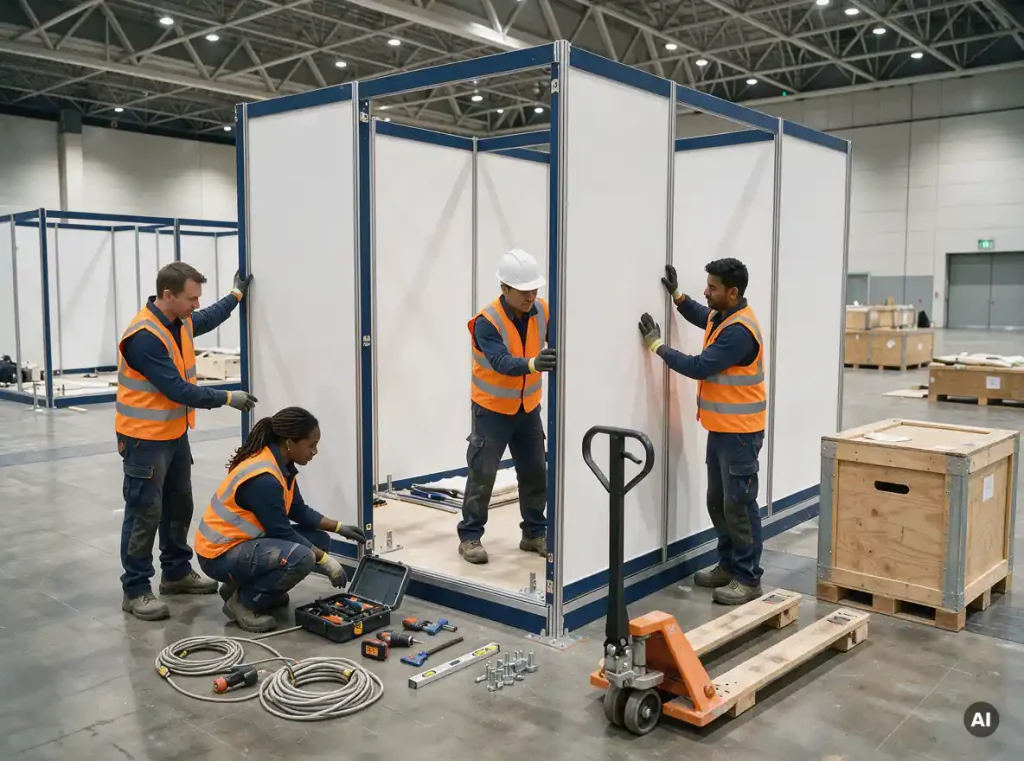
A 48-hour exhibition fit-out is planned by working backwards from the opening time. You lock in access, drawings, and deliveries first, divide the two days into build, finish, and inspection phases, and give every trade a fixed slot and a named owner. Add a fallback plan for the delays you already know are likely.
The rest of this guide answers the practical questions behind that plan, from pre-build checks to what to do when a pallet goes missing.
What Has to Be Locked In Before the Clock Starts?
Before build-up begins, you must confirm venue access times, final stand drawings, the delivery schedule, and the contact person for each trade. Anything left open at hour zero costs time later. A 48-hour exhibition fit-out leaves almost no room for decisions made on the fly.
Use this checklist as your pre-build gate:
- Venue rules: loading dock slots, floor load limits, rigging permissions, and working hours.
- Final drawings: approved layouts, power and data points, and dimensions of every large item.
- Bill of materials: a complete list of furniture, graphics, AV equipment, and consumables, with quantities.
- Delivery plan: who ships what, from where, and when it arrives on site.
- Contact sheet: mobile numbers for every supplier, driver, and installer, plus one decision maker on site.
Treat this as a hard gate. If a drawing is not signed off or a delivery has no confirmed slot, resolve it before the clock starts, not after.
How Should the 48 Hours Be Split Up?
Split the 48 hours into three phases: structure and services first, then furnishing and graphics, then finishing and inspection. A common approach is to spend roughly the first half on construction and power, the next stretch on furnishing, and keep the final hours for cleaning and fixes.
A simple build-up schedule looks like this:
- Hours 0 to 16: structure and services. Walls, flooring, rigging, electrics, and data. These tasks block others, so they go first.
- Hours 16 to 36: furnishing and graphics. Furniture, display units, lighting, AV, and signage go in once the space is clear and safe.
- Hours 36 to 44: styling and technical checks. Product placement, plants, screens, and a full test of power and equipment.
- Hours 44 to 48: finishing and sign-off. Cleaning, snagging, and a walkthrough against the original brief.
Always keep the last few hours free as a buffer. If everything is scheduled to the minute, the first delay will push into the opening time.
How Do You Time Transport and Deliveries Precisely?
Time deliveries by working backwards from when each item is needed on the stand, then add a buffer for traffic and venue queues. Stagger arrivals by phase so the loading area never clogs, and load vehicles in reverse order of installation so the first items needed come off the truck first.
Good exhibition logistics relies on a few habits:
- Book dock slots early and confirm them in writing with the organizer.
- Label every crate or pallet with the stand number, contents, and install phase.
- Use warehousing close to the venue to hold goods and release them just in time.
- Keep fragile or high-value items on dedicated vehicles with trained handlers.
Our teams handle this kind of precise sequencing every day. For projects where transport, storage, and on-site installation must line up, our project logistics team plans the full chain so deliveries match your build schedule. If you need goods staged nearby before the build opens, our warehousing solutions let us release items in the exact order they are needed.
Which Roles and Trades Need to Be Coordinated?
You need one overall project manager plus a lead for each trade: construction, electrics, flooring, graphics, furniture, AV, and cleaning. The project manager owns the schedule and resolves conflicts, while each trade lead owns their own slot, crew, and materials.
The biggest risk is trades working in each other’s way. Electricians cannot finish while carpenters are still cutting, and furniture cannot go in before the floor is protected. Prevent this with a few simple routines:
- Kick-off briefing: walk every lead through the schedule and the dependencies between trades.
- Single point of contact: all changes go through the project manager, not between trades.
- Short check-ins: a brief stand-up every few hours to confirm progress and flag blockers.
- Clear sign-off: each trade confirms completion before the next one starts.
When assembly and installation are part of the job, having one partner coordinate delivery and fitting removes a handover and a point of failure. That is the thinking behind our integrated approach to furniture transport and installation.
What Commonly Goes Wrong in a 48-Hour Build?
The most common failures are late or missing deliveries, damaged items, drawings that do not match the real space, and trades overlapping. Most of these trace back to gaps in planning rather than bad luck, which is why the pre-build checklist matters so much.
Watch for these recurring problems:
- Delivery delays: traffic, venue queues, or a supplier missing a cut-off.
- Damage in transit: poorly packed or handled items that arrive unusable.
- Measurement errors: furniture or displays that do not fit through doors or into the stand.
- Power and data surprises: sockets in the wrong place or insufficient capacity.
- Unclear ownership: nobody knows who decides when something changes.
Careful handling matters most for premium items. Specialist crews who are trained to move delicate goods reduce the risk of damage before the item ever reaches your stand.
How Do You Build a Fallback Plan for Delays?
Build a fallback plan by listing the likely delays, deciding in advance what you will do for each, and keeping time and spare materials in reserve. A good fit-out contingency plan names a trigger, an action, and an owner for every risk, so nobody debates what to do while the clock runs.
Here is a practical way to structure it:
- Identify the top risks: late delivery, damage, power failure, and missing crew.
- Set a trigger for each: for example, a truck more than two hours late.
- Decide the response: a backup supplier, a simplified layout, or reordering the build sequence.
- Assign an owner: one named person authorized to make the call.
- Hold a reserve: spare stock, a few unscheduled hours, and a nearby storage point for replacements.
Prioritize what must be perfect at opening, such as the main display and key furniture, and what can be finished after the doors open. That ranking tells you where to protect time when things slip. If you want a partner who plans for these scenarios from the start, you can get in touch with our team and we will help you build a realistic schedule.