


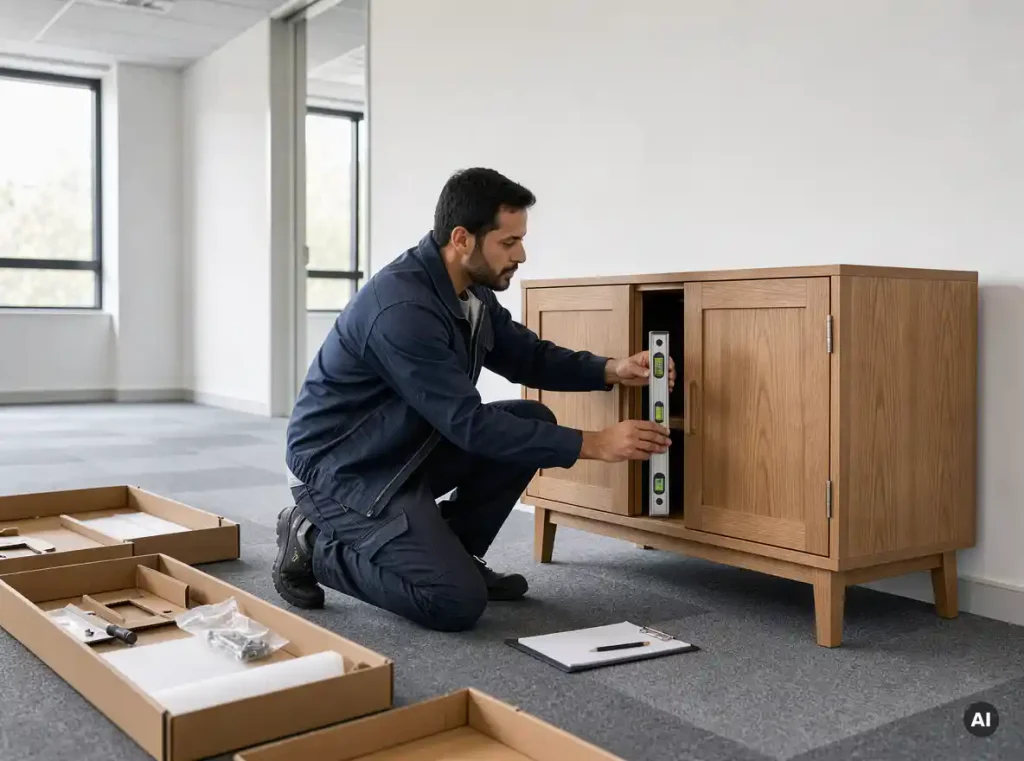
In a multi-supplier furniture installation, the client (or the client’s project manager) signs off on final quality, but only after each supplier has signed off on its own scope and the main contractor has confirmed that the combined result meets the contract. Sign-off works as a chain: each party certifies its own work, and the client accepts the whole.
That chain only holds when roles are agreed before the first pallet arrives. Below, we answer the related questions project teams ask most: where accountability splits, what a checklist should cover, who has the final say, how snags get resolved, and how a logistics partner can keep it all together.
Where does accountability split between suppliers on site?
Accountability splits along scope boundaries: each supplier is responsible for the goods it supplies, the work it performs, and any damage it causes, while the party coordinating delivery and installation is responsible for sequencing, access, and interfaces between trades. Anything that falls between two scopes needs a named owner in the contract.
In practice, the gaps cause most disputes. A desk manufacturer delivers perfectly, a flooring contractor leaves an uneven subfloor, and the installer cannot level the units. Who owns that? Without a clear interface list, everyone points elsewhere.
Typical split points include:
- Product quality: the manufacturer or supplier owns defects in materials and finish.
- Transport damage: the carrier owns damage in transit, up to the moment of agreed handover.
- Installation workmanship: the installer owns fit, alignment, and fixing.
- Site readiness: the main contractor owns access, power, floors, walls, and cleanliness.
- Interfaces: a named coordinator owns anything where two scopes meet, such as cable management or wall-mounted units.
Putting these lines in writing during project furniture logistics planning, before delivery, removes most of the guesswork later. We have seen on complex fit-out projects that a one-page responsibility matrix saves more time than any amount of on-site negotiation.
What does a furniture installation sign-off checklist include?
A furniture installation sign-off checklist confirms that every item is delivered, correctly placed, undamaged, functional, and clean, and that the right documents are handed over. It should be completed per area or room, signed by the installer, and countersigned by the client or their representative.
A solid checklist covers:
- Completeness: quantities and variants match the order and the floor plan.
- Condition: no scratches, dents, tears, or transport damage on any item.
- Placement: positions match the approved layout, with correct orientation and spacing.
- Function: doors, drawers, mechanisms, height adjustments, and connected equipment all work.
- Stability and safety: units are fixed, level, and compliant with relevant safety requirements.
- Cleanliness: packaging removed, surfaces cleaned, waste taken away.
- Documentation: care instructions, warranties, and as-built information are handed over.
Add photos with timestamps for each area. They turn a subjective argument (“it was already like that”) into a factual record, which is the backbone of any clean furniture installation handover.
Who has the final say: client, contractor, or supplier?
The client has the final say on acceptance, because the client pays for and uses the result. The main contractor or project manager typically acts on the client’s behalf to verify compliance, while suppliers certify their own work but cannot accept it for the client.
Roles usually look like this:
- Supplier or installer: declares its work complete and ready for inspection.
- Main contractor or project manager: checks the work against the specification and coordinates inspections across suppliers.
- Client or client’s representative: formally accepts, accepts with listed snags, or rejects.
The contract decides the details. If a client delegates acceptance authority to an interior designer or project manager, that delegation should be written down, including the name of the person who may sign. Otherwise a signature on the day may later be challenged as unauthorized.
A conditional acceptance is common and healthy: the client accepts the installation with a defined snag list and a deadline for fixes. That keeps the project moving without waiving any rights.
How are snags and quality disputes resolved between suppliers?
Snags are resolved by logging each defect with photos and a location, assigning it to the responsible party, setting a deadline, and re-inspecting after the fix. Disputes between suppliers about who caused a defect are settled by the contract’s responsibility matrix and the documented condition at each handover point.
A practical resolution process runs in four steps:
- Log it: record every snag in one shared list, with photo, location, and description.
- Assign it: name the responsible supplier. If ownership is unclear, the project coordinator decides provisionally so work is not blocked.
- Fix it: agree on a deadline per snag, prioritizing items that block use of the space.
- Close it: re-inspect and sign off on each item individually, not in bulk.
When two suppliers blame each other, evidence from earlier handover points decides the matter. Delivery receipts, goods-in photos, and installation-day condition reports show where the defect first appeared. If the facts still do not settle it, escalate to the client’s project manager, and only then to formal dispute mechanisms in the contract.
How can a logistics partner simplify multi-supplier quality control?
A logistics partner simplifies quality control by acting as a single point of contact and a single record keeper: consolidating deliveries, inspecting goods on receipt, coordinating installation, and documenting condition at every step. That replaces many separate handovers with one accountable flow from warehouse to finished room.
For us, this is the daily reality of project work. We run dedicated project teams that cover planning, coordination, and execution, and we handle warehousing, transport, assembly, and installation under one roof. When goods from several manufacturers arrive at our warehouse, we can check them in, flag damage before it reaches site, store them until the space is ready, and deliver them in the right sequence.
The benefits for quality control are concrete:
- One contact person: the client deals with one project manager instead of chasing five suppliers.
- Earlier detection: defects are found at goods-in, not in front of the end user.
- Consistent records: photos, receipts, and checklists follow the same format for every supplier.
- Cleaner handover: our installers complete the sign-off checklist area by area, so the client inspects a finished result.
If you are planning a multi-supplier fit-out and want fewer moving parts at handover, get in touch with our team and we will talk through how we would structure delivery, installation, and sign-off for your project.