


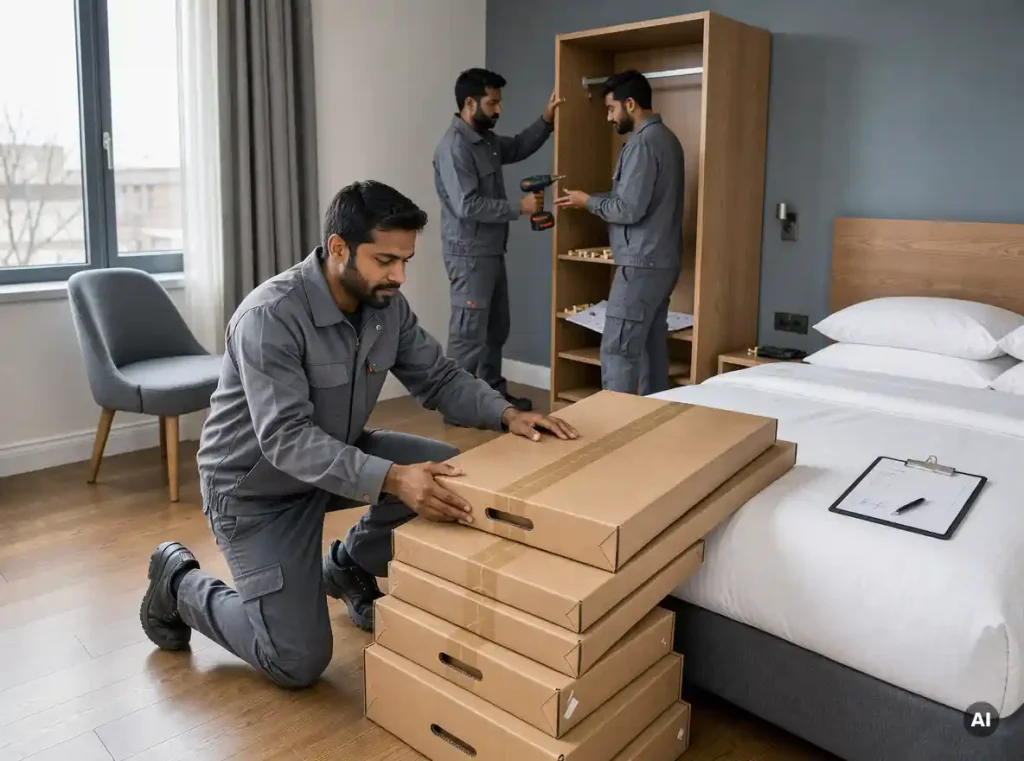
Delivery proof supports room-level installation sign-off by recording exactly which items arrived, in what condition, and in which room they were placed, so each room can be verified and approved on its own. It turns one large handover into many small, checkable ones.
This matters most on multi-room projects such as hotels, offices, schools and kitchen installations, where one missing chair or damaged panel can otherwise stall approval of an entire floor. Below, we answer the practical questions behind room-by-room delivery records and how they fit into a smooth handover.
If you are planning a larger fit-out, our project logistics team builds this kind of documentation into the workflow from day one.
What should a room-level delivery record contain?
A room-level delivery record should contain the project name, room or unit identifier, a list of delivered items with quantities, the delivery date and time, the condition of each item on arrival, and the recipient’s name and signature. Photos and notes on any deviations make the record far more useful.
The more specific the record, the less room there is for interpretation later. A strong record typically includes:
- Room reference: floor, room number or unit code that matches the project plan
- Item list: product names, article numbers and quantities, checked against the order
- Condition notes: any visible damage, packaging issues or missing parts, noted at the moment of delivery
- Photo evidence: images of the items in place and of any defects
- Time stamp and names: who delivered, who received, and when
Keep the record factual. Notes such as “scratch on left door, 5 cm” are far more helpful than “minor damage.”
How do you link delivery proof to each room?
You link delivery proof to each room by labeling every item, pallet or crate with a room code before it leaves the warehouse, then scanning or checking those codes at delivery. The code on the label must match the room code on the delivery record and the project plan.
This works best when the coding is agreed before shipping starts. In our experience, the steps that make the link reliable are:
- Agree on a room numbering scheme with the client and installer, and use it everywhere.
- Pre-label goods with the room code at the point of picking or warehousing.
- Load and unload in room sequence where possible, so goods go straight to the right place.
- Record the delivery against each room code, not just against the project as a whole.
When goods are staged in the correct room at delivery, the installer can start immediately, and the proof already points to the right place.
Who needs to sign off on delivered items?
The person who physically receives the goods signs for delivery, usually the site manager or a nominated representative of the client. For installation approval, the sign-off typically involves the installer, the project manager and the client or end user who confirms the room is complete and acceptable.
Clear roles prevent disputes. A practical setup looks like this:
- Receiving party: confirms quantity and visible condition on arrival
- Installer or assembly team: confirms the items were installed correctly and completely
- Project manager: checks the room against the plan and specification
- Client or end user: gives the final acceptance for the room
For kitchens and premium furniture, the end user often does the final check, which is why white-glove delivery and a careful final inspection before departure are so valuable. Our kitchen transport service uses two trained professionals per delivery for exactly this reason.
How does delivery proof help resolve damage and missing-item disputes?
Delivery proof helps resolve disputes by giving everyone the same factual record of what was delivered and in what condition at a specific time. If damage or a shortage is noted at handover, responsibility is clear. If it is not noted, the record shows the goods were accepted as complete.
Here is how it works in practice:
- Damage claims: time-stamped photos and condition notes show whether an item was damaged in transit or later on site
- Missing items: the item list checked against the order shows exactly what was and was not delivered
- Partial deliveries: room-level records show which rooms are ready for installation and which are waiting on stock
- Faster replacements: precise records let you reorder only the affected item for the affected room
Without room-level detail, a shortage is often discovered only at installation, when it is harder to trace and more expensive to fix. Recording issues at the door keeps small problems small.
What is the difference between proof of delivery and installation sign-off?
Proof of delivery confirms that goods arrived at the right location, in the right quantity and condition. Installation sign-off confirms that those goods were assembled, placed and connected correctly and that the room meets the agreed specification. The first closes the transport stage; the second closes the installation stage.
The key differences are:
- What it proves: delivery proof covers arrival, while installation sign-off covers finished work
- Who signs: the receiver signs for delivery, while the client or end user typically approves the installation
- When it happens: delivery proof comes at unloading, and sign-off comes after assembly and checks
- What it triggers: delivery proof releases transport invoicing and starts installation, while sign-off releases final payment and handover
The two documents work as a chain. A clean delivery record makes the installation sign-off easier, because any defect found later can be traced back to either the delivery stage or the installation stage. Our furniture transport and installation work follows this same two-step logic.
How can digital proof of delivery speed up project handover?
Digital proof of delivery speeds up handover by capturing signatures, photos and notes on a mobile device and making them instantly available to everyone involved. Project managers see room status in real time, so approvals, invoicing and follow-up work no longer wait for paper to travel.
The main benefits are:
- Instant visibility: clients and installers see which rooms are delivered and ready
- Fewer lost documents: records are stored centrally and searchable by room
- Faster issue handling: photos and notes are shared the moment a problem is logged
- Cleaner audit trail: every step is time-stamped for later reference
- Quicker closing: a complete set of room records can be compiled into a handover file almost automatically
Online tracking also keeps clients informed without extra phone calls. If you would like to discuss how to set this up for your next fit-out, you can get in touch with us, and we will help you design a room-by-room process that fits your project.