


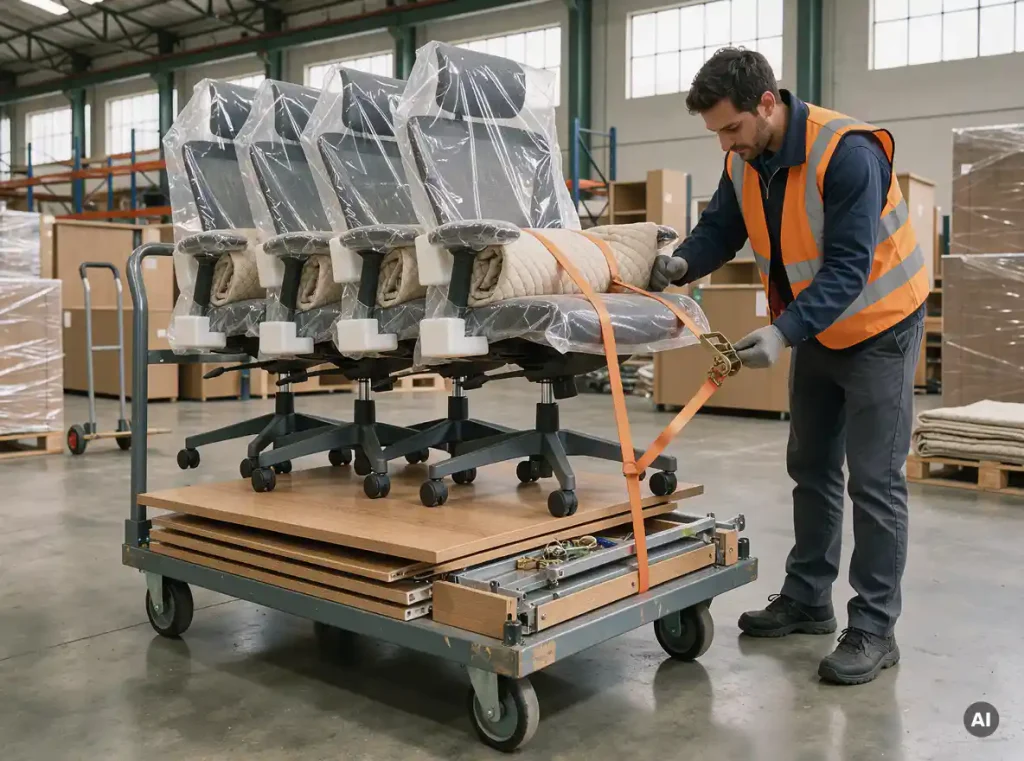
You can reuse office furniture across branches during refits by auditing what each site already owns, tagging pieces that still meet your standards, and redeploying them to branches that need them. Careful transport, short-term storage between phases, and a clear plan for leftovers keep the process cheap and low-risk.
The approach works best for multi-site organizations with several refits planned in sequence, because furniture released by one branch can furnish the next. Below, we answer the questions facility and project managers ask most often about office furniture redeployment.
Which Furniture Is Worth Moving to Another Branch?
Furniture is worth moving when its condition, quality, and fit with the destination branch outweigh the cost of transport and handling. Good candidates are premium task chairs, height-adjustable desks, storage units, and meeting tables that are structurally sound, still match your brand standards, and carry no safety or ergonomic concerns.
Use a simple filter to decide quickly:
- Condition: Frames, mechanisms, and surfaces should be intact. Cosmetic wear can often be fixed with refurbishing.
- Quality and lifespan: Well-built pieces from premium manufacturers usually justify moving. Low-cost items that are already worn rarely do.
- Fit: Check dimensions, finishes, and layout compatibility with the destination branch.
- Standardization: Pieces that match your existing furniture families are easier to combine across sites.
- Compliance: Ergonomic and fire safety requirements still need to be met at the receiving location.
As a rule of thumb, anything that is expensive to replace and robust enough to survive a move deserves a place on the redeployment shortlist. This is the core idea behind circular office furniture: keep high-value items in use for as long as possible.
How Do You Audit and Track Furniture Across Branches?
You audit furniture by building one central inventory that records every item at every branch, then tracking each piece through its status: keep, move, refurbish, or dispose. A furniture inventory audit turns scattered assumptions into a single source of truth you can plan against.
A practical audit follows these steps:
- Walk every branch and list each item with type, quantity, model or manufacturer, and location.
- Grade condition with a simple scale, for example good, needs refurbishing, or end of life.
- Tag each piece with a unique label or barcode so it can be traced through storage and transport.
- Match supply to demand by comparing what Branch A releases with what Branch B needs.
- Update the list after every move so the inventory always reflects reality.
A shared spreadsheet is enough for small projects. Larger programs benefit from asset management software or a logistics partner that tracks items in a warehouse system. Photos at the time of audit also help, since they document condition before the move and make damage claims straightforward.
How Should Furniture Be Moved Between Branches During a Refit?
Furniture should be moved in planned batches, matched to refit phases, using specialist handling, protective packing, and fixed delivery slots. Treating the move as office furniture relocation within a larger project, rather than an ad hoc job, prevents damage and keeps each branch on schedule.
Key principles for a smooth move:
- Plan in phases. Release furniture from one branch only when the next one is ready to receive it.
- Protect the pieces. Furniture blankets, edge protection, and careful loading reduce damage and cut down on single-use packaging.
- Disassemble where sensible. Flat-packed desks and shelving load more efficiently, and reassembly on arrival keeps transport movements down.
- Combine routes. Consolidating pickups and deliveries across branches reduces kilometers driven and cost.
- Use trained crews. Furniture handling is a specialist skill, and experienced teams work faster and more carefully.
For multi-site programs, specialist furniture transport takes much of this coordination off your plate. At Jan Krediet, we train our own drivers and installers in the careful handling of furniture, and we can deliver and assemble on location so branches are ready to use the day work finishes.
Where Can Furniture Be Stored Between Refit Phases?
Furniture can be stored in a managed warehouse close to your branches, in temporary on-site space, or in a logistics partner’s facility. For furniture warehousing between refits, an external warehouse is usually safest, because it protects pieces from damage and keeps your branches clear for contractors.
Your main options compare as follows:
- On-site storage: Cheap and convenient, but it clutters work areas and increases the risk of damage during building work.
- Self-storage units: Flexible for small volumes, but typically lack inventory tracking and specialist handling.
- Managed warehousing: Climate-aware, secure, and organized by item, with the ability to release stock in phases when each branch is ready.
Managed storage pays off when refits are staggered over weeks or months. With professional warehousing, each tagged item stays traceable and can be called off in the right order. We operate more than 60,000 square meters of warehouse space, which gives us room to hold furniture for several branches at once and deliver it exactly when it is needed.
What Should Happen to Furniture That Cannot Be Reused?
Furniture that cannot be reused should first be considered for refurbishment, then for resale or donation, and only then for recycling or responsible disposal. This order keeps the maximum value in the material and supports your sustainability goals.
Work through these options in sequence:
- Refurbish. New upholstery, replacement parts, or a fresh finish can give a worn piece a second life. We have given more than 1,000 office chairs a second life for a major financial services provider.
- Resell or donate. Schools, charities, start-ups, and second-hand dealers often welcome good-quality office furniture.
- Take back through suppliers. Some manufacturers and dealers offer buy-back or take-back schemes.
- Recycle. Separate metal, wood, textile, and plastic so materials can re-enter the supply chain.
- Dispose responsibly. Use this only as a last resort, and keep documentation for your sustainability reporting.
Deciding the fate of each item during the audit, not after the refit, avoids last-minute skip hire and gives you cleaner numbers for your circular office furniture reporting.
How Much Can Reusing Furniture Save on a Refit?
Reusing furniture can cut a refit budget noticeably, because every piece you redeploy is one you do not buy new. Savings depend on how much of your stock is reusable, but even partial reuse typically reduces purchase costs, delivery volumes, and waste disposal fees.
Rather than relying on a headline percentage, calculate your own business case with these inputs:
- Avoided purchase cost: The replacement price of each item you reuse.
- Handling costs: Transport, storage, refurbishing, and reassembly for those same items.
- Disposal savings: Fees you no longer pay to remove furniture that stays in use.
- Time value: Faster refits, since delivery lead times for new furniture can be long.
- Sustainability value: Lower material use and fewer transport movements, which support emissions targets.
High-value items like ergonomic chairs and sit-stand desks usually deliver the clearest return, while very cheap pieces often cost more to move than to replace. A well-run multi-site office refit blends both: redeploy the valuable core, replace the rest, and plan logistics so the savings are not eaten up by damage or delays.
If you are planning a refit across several branches, our project logistics team can help you map the audit, transport, storage, and installation into one coordinated plan. Feel free to get in touch to talk through your branches and timeline.