


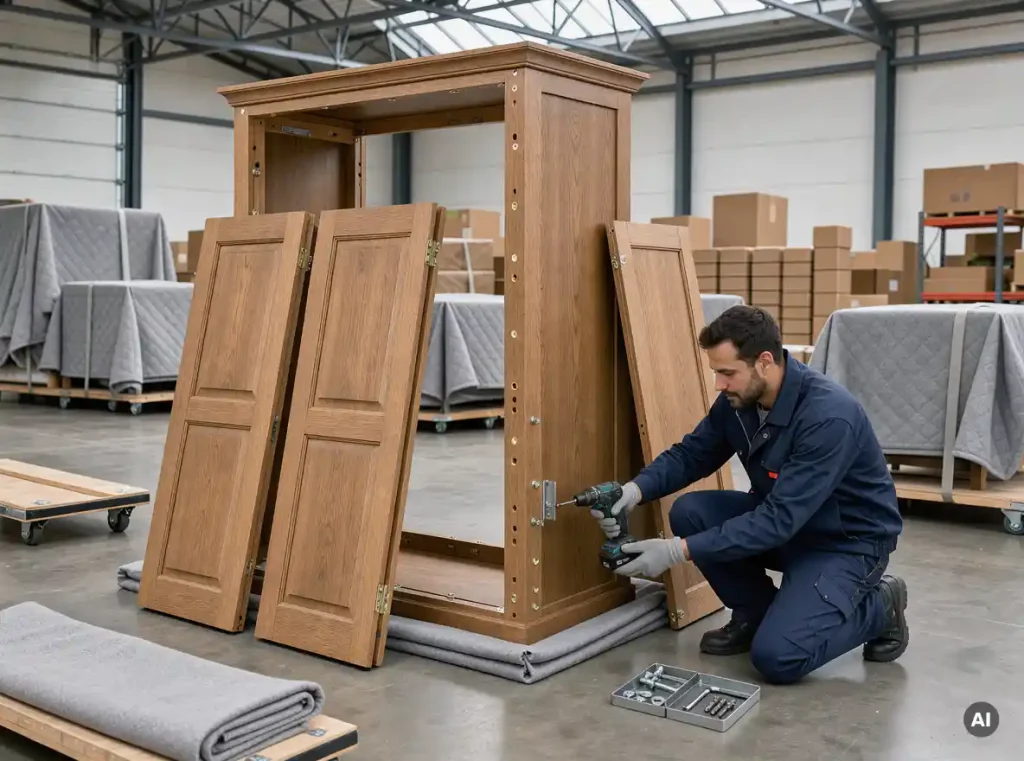
Yes, most large furniture can be dismantled and reassembled for delivery, including wardrobes, beds, sofas with removable legs, modular sectionals, desks, and kitchens. Taking pieces apart makes them easier to carry, load, and fit through tight spaces. The key is that trained specialists handle both steps with the right tools and care.
Whether it works well depends on the furniture’s construction, its value, and the access at the delivery address. The sections below cover which pieces can be taken apart, how the process works, the damage risks, and when full assembly is the better choice.
Which types of large furniture can be taken apart?
Most flat-pack style and modular furniture can be taken apart, including wardrobes, bed frames, bookcases, dining tables, desks, modular sofas, and kitchen units. Solid, glued, or one-piece items such as carved cabinets or upholstered armchairs with fixed frames usually cannot be dismantled without risking damage.
Furniture generally falls into three groups:
- Designed to be dismantled: wardrobes, beds, shelving systems, office desks, and many tables use bolts, cam locks, or dowels and come apart cleanly.
- Partly dismantlable: sofas with detachable legs or modular seats, extendable tables, and sideboards with removable doors or drawers.
- Not suitable for dismantling: glued joinery, antique pieces, stone or glass tops fixed to frames, and sculptural designer items.
If you are unsure which group a piece belongs to, check the manufacturer’s assembly instructions. They usually show how the item was put together and whether it is meant to be taken apart again.
How does professional furniture disassembly and reassembly work?
Professional disassembly follows a set sequence: inspect the piece, photograph its condition, remove parts in a logical order, label and bag all hardware, protect each component, then reassemble it on site in the correct room. Trained crews do this with the right tools, so the furniture ends up as it was designed.
A typical process looks like this:
- Inspection: the team checks the construction and notes any existing marks.
- Careful removal: doors, legs, shelves, and panels come off in order, while screws, bolts, and fittings are labeled and kept together.
- Protection: components are wrapped in furniture blankets or protective covers rather than single-use packaging where possible.
- Transport: pieces are loaded so nothing shifts or rubs against another surface.
- Reassembly: the crew rebuilds the furniture in the right room, checks alignment and stability, and removes the packaging.
Furniture logistics is a specialist profession, which is why we train our own people in-house. They learn on the job with a strong focus on respect and care for the furniture. You can read more about our furniture transport services if you want to see how this fits into the complete delivery chain.
Does taking furniture apart risk damaging it?
Dismantling carries a small risk of damage, mostly when untrained people do it. Stripped screw holes, chipped edges, lost hardware, and weakened joints are the usual problems. With trained staff, the right tools, and careful labeling, the risk is low and often smaller than the risk of forcing an assembled piece through a tight space.
The most common causes of damage are:
- Repeated assembly of particleboard, which can wear out screw holes
- Missing or mixed-up hardware
- Pressure on panels or finishes during handling
- Forcing a joint that was glued rather than bolted
Professionals reduce these risks by checking the construction before they start, using the correct fittings, and inspecting the result after reassembly. For vulnerable items such as high-end kitchens, we send two trained professionals and carry out a final inspection before departure. If a piece is too fragile or fixed to be taken apart safely, a good crew will say so rather than take a chance.
Is dismantled furniture cheaper and faster to deliver?
Dismantled furniture is often cheaper to transport because flat, compact components use less truck space and need fewer handling steps. Delivery can also be faster, since pieces move easily through doorways and stairwells. The saving is partly offset by the time needed for reassembly at the destination, so the total depends on the item.
The main advantages are:
- Higher load factors: flat components fill a vehicle more efficiently, which means fewer transport movements.
- Easier access: narrow stairs, lifts, and tight doorways become manageable.
- Less risk of knocks: compact parts are easier to secure during transit.
This approach also supports sustainability goals. Assembling goods at a later stage, either in the warehouse or at the final destination, reduces the number of kilometers driven. If your project involves storage before delivery, warehousing options can help you hold components until they are needed.
When should large furniture be delivered fully assembled?
Large furniture should arrive fully assembled when it cannot be safely taken apart, when disassembly would reduce its value or stability, or when the delivery address offers easy access. Antiques, glued designer pieces, and items with fragile finishes are typical examples.
Consider full assembly when:
- The manufacturer advises against dismantling
- The piece has bonded, stone, glass, or delicate veneer elements
- The item is high in value and sensitive to repeated handling
- Access at the destination is wide and straightforward
- The delivery is a one-off and the item is small enough to move safely as one piece
Access is the deciding factor most often. Measure doorways, stairwells, lift sizes, and turning corners before you decide. If an assembled piece does not fit, dismantling is usually the only practical route, even if you would prefer otherwise.
What should you look for in a furniture delivery partner?
Look for a partner with specialist furniture experience, trained staff, proper equipment, and a clear process from pickup to installation. The best partners take responsibility for the full job, communicate with the end customer, and guarantee that furniture arrives undamaged and on time.
Key criteria to check:
- Specialist knowledge: furniture is not general cargo, so look for crews trained specifically for it.
- Assembly and installation: the partner should offer white glove delivery with placement in the right room.
- Tracking and communication: you should know where your goods are and who is in contact with the customer.
- Experience with projects: offices, hotels, and schools need precise planning and dedicated teams.
- Network and capacity: a wide network helps if your deliveries cross borders.
We have been doing this since 1924 and handle complete installations through our project logistics team. If you have a specific delivery in mind, feel free to get in touch with us and we will help you work out the best approach.