


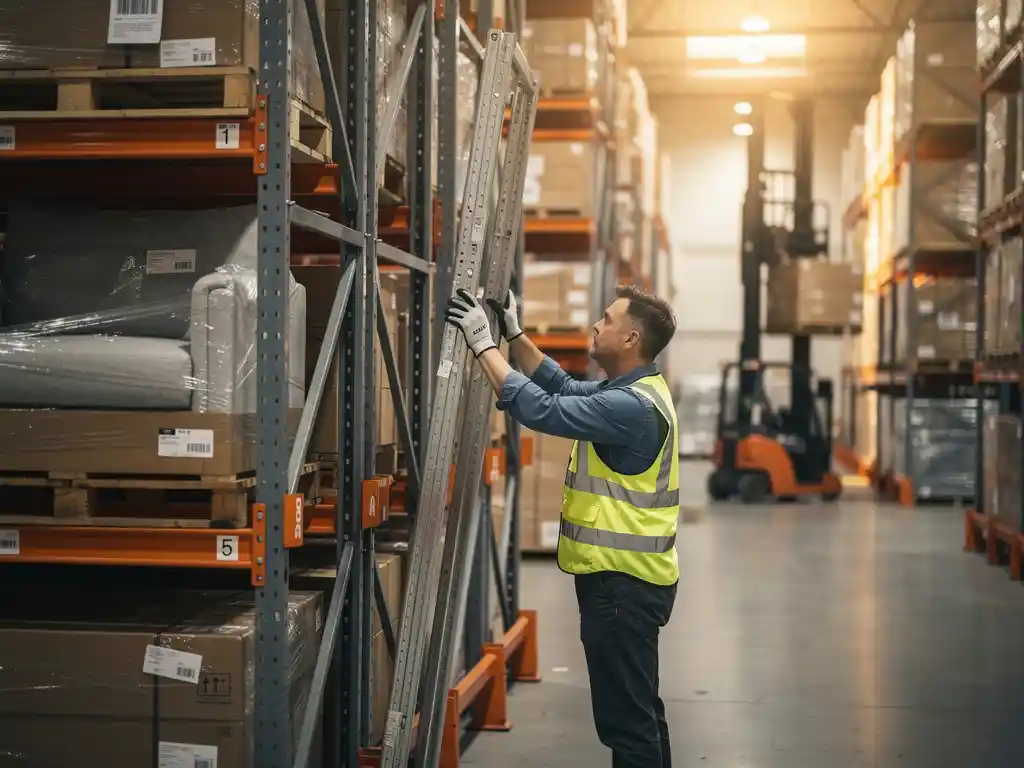
Yes, rack replacement can be done without service interruption in most warehouse environments. By working in clearly defined zones and sequencing the replacement in phases, operations in adjacent areas continue without pause. The key is structured planning, strong coordination between the logistics team and the installation crew, and a clear understanding of which risks require extra safeguards. The sections below walk through every dimension of that process.
What does rack replacement actually involve in a live warehouse?
Rack replacement in a live warehouse means removing existing storage racking systems and installing new ones while the facility continues to receive, store, and dispatch goods. The process involves unloading stock from the affected bays, dismantling the old structure, installing the new racking, and restoring inventory to the refreshed locations, all without halting the wider warehouse operation.
In practice, this is a staged activity. The team identifies which rack sections need replacing first, clears those bays of inventory by relocating stock to temporary positions elsewhere in the warehouse, and then hands the empty zone over to the installation crew. Once the new racking is in place and certified as safe, the zone reopens and the process moves to the next section.
The scope of a rack replacement project varies significantly. Some operations involve replacing a handful of damaged uprights after a forklift collision. Others require a full racking overhaul because the existing system no longer meets current load requirements, safety standards, or the operational demands of a changed product mix. In both cases, the fundamental challenge is the same: maintaining the flow of goods while a core piece of infrastructure is being rebuilt around it.
For warehouses handling high-value or fragile goods, such as premium furniture or kitchen products, the stakes during any infrastructure change are particularly high. Careful stock relocation and controlled access to active zones become even more critical when the inventory itself demands careful handling at every stage.
Why do warehouses replace racks without shutting down?
Warehouses replace racks without shutting down because a full operational halt carries significant commercial and logistical costs that most businesses cannot absorb. Stopping a warehouse entirely means pausing inbound deliveries, halting outbound shipments, and breaking service commitments to customers, consequences that often outweigh the complexity of managing a phased replacement.
In logistics environments where short lead times are non-negotiable, even a one-day shutdown can create a backlog that takes weeks to clear. Clients with time-sensitive supply chains, such as manufacturers who need same-day or next-day delivery of products, simply cannot accommodate a window where their logistics partner goes dark.
There is also a cost argument. A full shutdown requires alternative storage arrangements, rerouting of transport, and often contractual penalty clauses if delivery commitments are missed. Phased rack replacement, while more complex to coordinate, typically costs less in total when those downstream impacts are factored in.
Beyond cost, there is the question of continuity. A warehouse that remains operational throughout a rack replacement project demonstrates to clients that its infrastructure management does not come at their expense. That continuity is itself a service quality signal, particularly for logistics providers who position themselves as full unburdening partners where clients hand over responsibility and expect nothing to go wrong.
How is rack replacement carried out without stopping operations?
Rack replacement without stopping operations is carried out through a zone-by-zone phased approach, where only one section of the warehouse is taken offline at a time while the rest continues to function. The replacement team works through a pre-agreed sequence, and inventory is relocated systematically to maintain stock availability throughout.
The process typically follows this sequence:
- Audit and mapping: The existing racking layout is assessed, damaged or non-compliant sections are identified, and a replacement sequence is agreed upon based on operational priorities.
- Inventory relocation: Stock from the first zone is moved to temporary locations within the warehouse, using available buffer space or overflow areas.
- Zone handover: The cleared zone is handed to the installation crew, with physical barriers and clear signage marking it as a restricted construction area.
- Installation and inspection: New racking is installed, load-tested, and inspected before the zone is reopened to warehouse staff and equipment.
- Stock restoration: Inventory is returned to the new locations and updated in the warehouse management system.
- Repeat for subsequent zones: The cycle continues until all sections are replaced.
Effective communication between the warehouse operations team and the installation crew is what holds this process together. Daily briefings, clear zone demarcation, and a shared schedule prevent the two activities from conflicting. Warehouse management systems play a supporting role by tracking relocated stock in real time, ensuring that pickers can always find what they need even when the usual locations are temporarily unavailable.
Our warehousing operations are built around exactly this kind of structured flexibility, where infrastructure changes are absorbed into the operation rather than imposed on top of it.
What are the safety risks of replacing racks in an active warehouse?
The primary safety risks of replacing racks in an active warehouse are the coexistence of heavy installation equipment with moving forklifts and pedestrian staff, the structural instability of partially dismantled racking, and the hazard of falling components in areas adjacent to active operations. Each of these risks is manageable but requires deliberate controls.
Collision and proximity risks
When installation crews work in one zone while forklifts operate in adjacent aisles, the risk of collision increases. Physical barriers such as safety netting, temporary fencing, and floor markings must create a clear boundary between the construction zone and the live operational area. Traffic management plans, including defined forklift routes that avoid the active installation zone, reduce the chance of equipment or personnel coming into contact with the work in progress.
Structural and falling hazards
Partially dismantled racking is inherently unstable. A rack section that has had uprights removed but still carries residual load, or one that has been weakened by damage, can fail unpredictably during removal. Installation teams must follow a strict dismantling sequence and use appropriate bracing during the process. Overhead hazards, including beams, connectors, and load beams being moved at height, require exclusion zones directly beneath active lifting work. All personnel in the vicinity must wear appropriate personal protective equipment, including hard hats and high-visibility vests, regardless of whether they are directly involved in the installation.
Incident reporting during the replacement period should be treated as a live process rather than a retrospective one. Any near-miss or unexpected structural finding during dismantling should trigger an immediate review of the plan before work continues.
When should a full warehouse shutdown be considered instead?
A full warehouse shutdown should be considered when the scope of the rack replacement is so extensive that no meaningful portion of the facility can remain safely operational, or when the structural condition of the existing racking presents an immediate risk that cannot be isolated to a single zone. In these cases, the safety and logistical complexity of a phased approach outweigh its benefits.
Specific situations that point toward a full shutdown include:
- Systemic structural failure: When racking across the entire facility has been compromised, for example after a major impact event or a structural assessment revealing widespread corrosion or non-compliance, a phased approach is not viable because there is no safe zone to continue operating from.
- Full layout redesign: When the replacement project involves a complete reconfiguration of the warehouse layout, the interdependencies between zones make sequential replacement impractical.
- Low-volume periods: If the business has a predictable seasonal low point, a planned shutdown during that window can be less disruptive than a phased project spread over a busier period.
- Regulatory requirement: If a safety authority has issued a prohibition notice on the existing racking, continued operation in any part of the affected area may not be legally permissible.
The decision is ultimately a risk and cost calculation. A short, planned shutdown with alternative logistics arrangements in place is sometimes the more responsible and cost-effective choice compared to a months-long phased project that keeps operations running at reduced efficiency throughout.
Who is responsible for planning a rack replacement project?
Responsibility for planning a rack replacement project is shared between the warehouse operations manager, the racking supplier or installation contractor, and the health and safety lead. Each brings a distinct area of accountability, and the project only runs smoothly when all three are coordinating from the outset rather than working in sequence.
The warehouse operations manager owns the operational continuity plan. This means deciding which zones are replaced in which order, managing inventory relocation, communicating with clients about any service adjustments, and keeping the wider logistics team informed throughout the project. This role also holds accountability for ensuring that the replacement schedule does not create unacceptable service gaps.
The racking supplier or installation contractor is responsible for the technical execution: the structural design of the new system, the dismantling sequence, the installation methodology, and the final load certification. A reputable contractor will provide a method statement and risk assessment before work begins and will flag any structural findings during dismantling that require a plan change.
The health and safety lead, whether an internal role or an external adviser, is responsible for the site-specific risk assessment, the zone demarcation plan, personal protective equipment requirements, and the incident reporting protocol during the project. In many jurisdictions, a rack replacement project in a live warehouse also triggers specific obligations under construction safety regulations, which require a competent person to oversee the work.
For businesses that rely on a contract logistics partner, that partner’s operations team often takes on the coordination role, acting as the single point of accountability across all three areas and ensuring that the replacement is absorbed into the broader logistics operation without the client needing to manage the detail directly.