




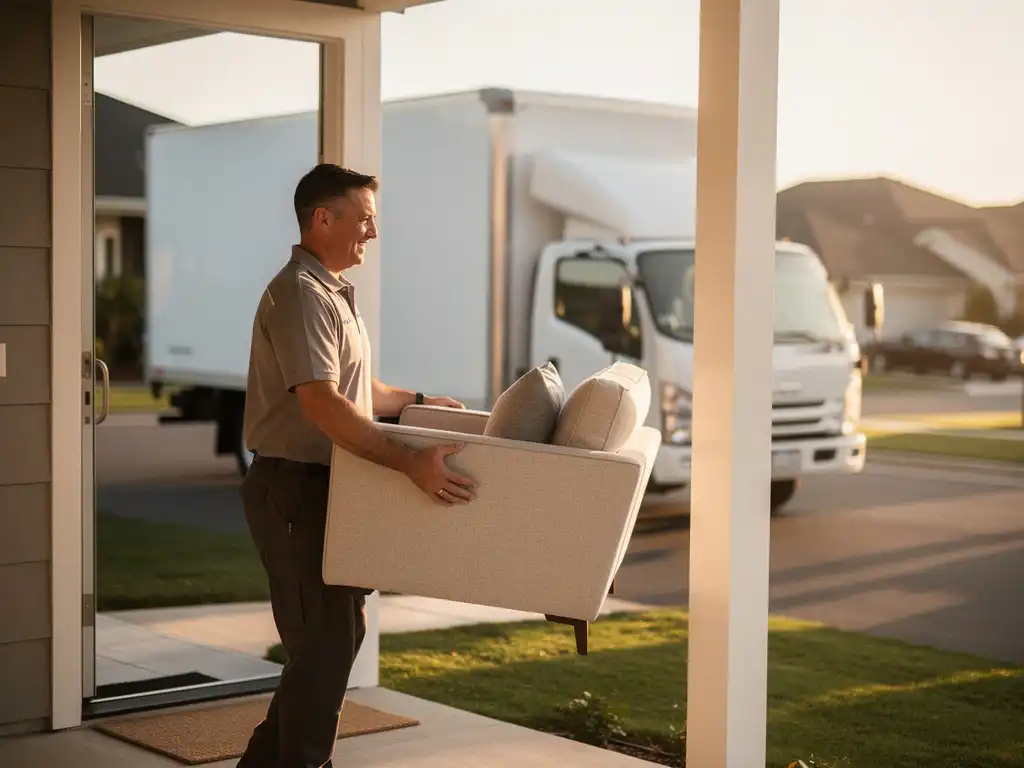
Furniture manufacturers increasingly face pressure to do more than build great products. Customers expect a seamless experience from the moment they place an order to the moment their sofa, cabinet, or kitchen is in place. Offering end-to-end delivery as a service is how furniture manufacturers turn logistics from a cost center into a competitive advantage.
This guide walks you through five practical steps to build and launch a delivery-as-a-service model for your furniture business. Whether you produce residential furniture, contract interiors, or kitchens, the process is the same: map what you have, define what you want to offer, find the right partners, connect your systems, and measure what matters.
Map your current delivery chain from factory to customer
Before you can build a better supply chain, you need to understand the one you already have. Start by documenting every step a product takes from the moment it leaves your production line to the moment it reaches the end customer. This exercise often reveals surprising gaps, handoff failures, and hidden costs that make scaling difficult.
- List every party currently involved in your logistics: internal warehouse staff, freight forwarders, regional carriers, last mile delivery providers, and installation crews.
- Identify every physical touchpoint: factory floor, outbound dock, transit hub, regional warehouse, delivery vehicle, and customer address.
- Note where ownership and responsibility transfer between parties, and where communication breaks down most frequently.
- Record average lead times, damage rates, and customer complaint patterns for each stage.
After completing this mapping exercise, you should have a clear visual picture of your current chain. Look for stages where delays consistently occur, where product damage spikes, or where customers lose visibility of their order. These are the weak points your end-to-end delivery service will need to address directly.
Define the scope of your end-to-end delivery service
Not every furniture manufacturer needs to offer the same service. Defining your scope early prevents over-promising to customers and under-delivering in practice. The goal is to design a service model that matches your product type, your customer base, and your operational capacity.
Start by deciding which service tiers you want to offer. A basic tier might cover transport and room-of-choice delivery. A premium tier could include white glove delivery, full assembly, installation, packaging removal, and even post-delivery inspection. Consider which of these your customers genuinely value and are willing to pay for.
- Standard delivery: Delivery to the door or ground floor, no assembly.
- Room-of-choice delivery: Placement in the designated room, packaging removal.
- White glove delivery: Full assembly, installation, inspection, and debris removal.
- Project delivery: Coordinated delivery and installation across multiple locations or large commercial sites.
Once you have defined your tiers, document the exact scope of each one in writing. This becomes the foundation for your partner briefings, your customer-facing service descriptions, and your internal quality standards. Clarity here prevents disputes and misaligned expectations down the line.
Select a logistics partner with furniture-specific capabilities
General freight carriers are rarely equipped to handle the demands of furniture logistics. Furniture is bulky, fragile, and high-value. It requires specialist handling, appropriate vehicle configurations, trained delivery crews, and experience with both residential and commercial environments. Choosing the wrong partner at this stage is the most common reason delivery-as-a-service projects fail.
When evaluating potential logistics partners, look beyond price per shipment. Assess their operational depth across the full delivery chain, including warehousing solutions, last mile capabilities, and value-added services like assembly and installation. A partner that can handle the entire chain under one roof reduces coordination overhead significantly.
- Confirm the partner has dedicated experience in furniture transport, not just general cargo.
- Verify their vehicle fleet includes appropriate configurations for large, fragile items.
- Ask specifically about their white glove delivery capacity and trained installation teams.
- Check their geographic coverage against your current and planned customer base.
- Request references from furniture manufacturers or retailers they currently serve.
We work with furniture manufacturers and retailers across Europe and beyond, offering specialist furniture transport that covers everything from single residential deliveries to large-scale project logistics across more than 150 locations worldwide. A partner with that kind of reach and specialization removes the need to stitch together multiple carriers across different regions.
After your partner conversations, verify that their service level commitments are contractually defined and that they have a clear escalation process for exceptions. A good partner does not just deliver furniture; they protect your brand reputation at the customer’s door.
Integrate order management with logistics operations
A delivery service only feels end-to-end to the customer when information flows as smoothly as the physical product. If your order management system and your logistics operations run in separate silos, customers will experience gaps: missed delivery windows, no tracking updates, and customer service teams without real-time visibility.
Integration does not have to mean a full IT overhaul. Start by identifying the minimum data exchanges needed to keep all parties aligned.
- Define the data your logistics partner needs at the point of order confirmation: product dimensions, delivery address, access constraints, assembly requirements, and preferred time window.
- Establish how and when order data is transmitted: via API connection, EDI, or a shared platform.
- Confirm that your logistics partner can push status updates back into your system so customers receive proactive tracking notifications.
- Set up exception triggers: automatic alerts when a delivery is delayed, rescheduled, or flagged for damage.
Once the data flow is live, test it end-to-end with a small batch of real orders before scaling. Verify that a customer placing an order today receives a delivery confirmation, a tracking link, and a delivery window notification without any manual intervention from your team. If any of those touchpoints require manual effort, identify the integration gap and close it before launch.
Set delivery standards and measure service performance
With your chain mapped, your service defined, your partner selected, and your systems connected, the final step is to establish the standards you will hold yourself and your partners to. A delivery as a service model only sustains itself when performance is consistently measured and actively managed.
Define your key performance indicators before you go live. Focus on the metrics that directly reflect the customer experience, not just internal operational efficiency.
- On-time delivery rate: Percentage of deliveries completed within the agreed window.
- First-attempt success rate: Percentage of deliveries completed on the first visit.
- Damage rate: Percentage of orders arriving with product damage.
- Customer satisfaction score: Post-delivery survey results tied to the delivery experience specifically.
- Assembly completion rate: For white glove tiers, percentage of assemblies completed correctly on the first visit.
Review these metrics with your logistics partner on a regular cadence, at minimum monthly in the first six months. When a metric falls below target, trace the failure back through the chain to find the root cause rather than treating it as an isolated incident. Consistent underperformance at a specific stage signals a process or resource problem that needs structural attention.
Strong delivery standards also give you something concrete to communicate to customers. Transparency about your service commitments builds trust and differentiates your brand in a market where many manufacturers still treat logistics as an afterthought. If you want to explore how a specialist logistics partner can support your delivery model from warehousing through to final installation, get in touch with our team to discuss your specific requirements.