


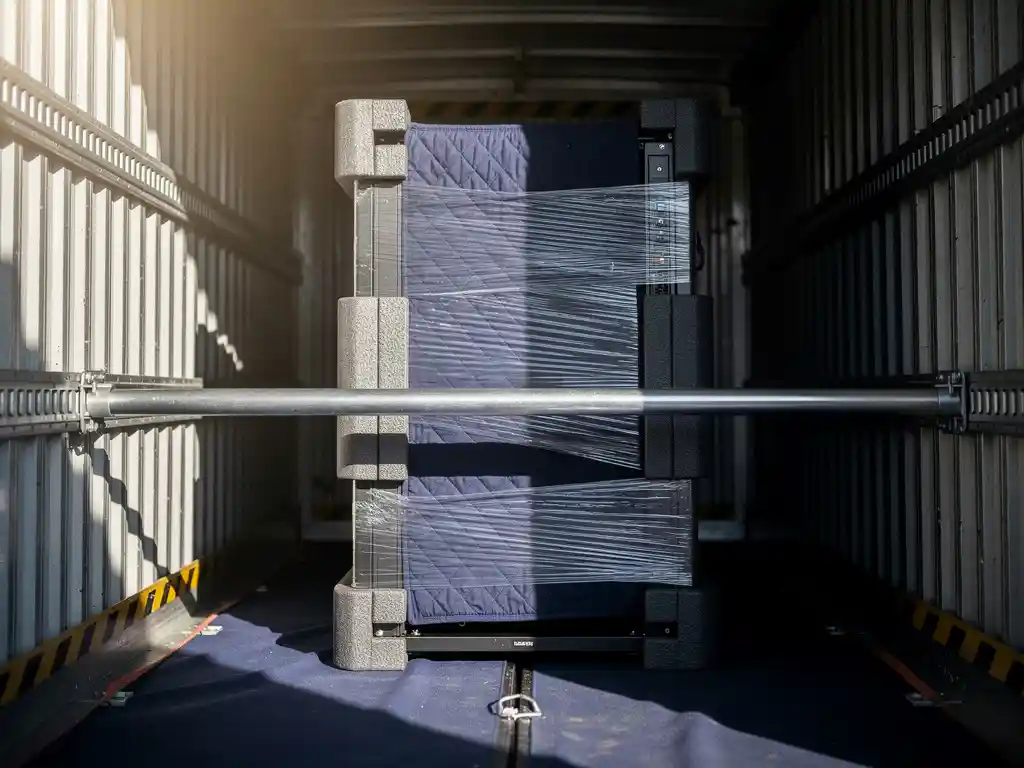
Server rack damage during transport can be prevented by combining proper preparation, purpose-built packaging, careful handling, and a specialist logistics partner who understands the sensitivity of high-tech equipment. The risk of damage rises sharply when racks are moved without internal component protection, with inadequate cushioning, or by handlers unfamiliar with the equipment. The sections below walk through each critical step, from the most common causes of damage to choosing the right transport method and partner.
What are the most common causes of server rack damage in transit?
The most common causes of server rack damage during transport are vibration, shock from sudden impacts, improper securing inside the vehicle, and inadequate packaging. These factors can cause mounted components to loosen, drives to fail, and structural panels to crack or deform, even when the rack itself appears undamaged on the outside.
Vibration is particularly damaging because it is continuous and cumulative. A long road journey exposes a rack to thousands of small jolts that gradually loosen screws, stress solder joints, and shift components out of alignment. A single hard impact, such as a vehicle braking sharply or a rack being dropped during loading, can cause immediate physical damage to drives, power supply units, or mounted switches.
Poor load securing is another major contributor. When a rack is not properly braced inside the trailer or container, it can shift or tip during cornering and braking. Even a small amount of lateral movement repeated over hundreds of kilometres adds up to significant stress on the rack’s frame and internal components. Finally, exposure to moisture and temperature extremes during transit, especially in unsealed or poorly conditioned vehicles, can cause condensation damage to sensitive electronics.
How should a server rack be prepared before shipping?
Before shipping a server rack, all removable and sensitive components should be taken out, individually wrapped, and packed separately. The rack itself must be secured internally so that remaining components cannot shift, and all cable management should be tidied and fastened to prevent movement during transit.
Start by removing hard drives, SSDs, and any other components that are particularly vulnerable to vibration and shock. These should travel in anti-static bags and then in padded, rigid boxes. Slide-out units such as servers, UPS systems, and patch panels should either be removed entirely or locked in place using their built-in rail-lock mechanisms where available.
Once the rack is stripped to a safe configuration, conduct a thorough internal inspection. Check that all remaining components are firmly mounted and that no cables are loose enough to swing and cause abrasion damage. Apply foam padding or bubble wrap to any internal surfaces where components could make contact during movement. Label all removed components clearly so reassembly at the destination is straightforward and accurate.
What packaging materials are best for shipping server racks?
The best packaging materials for shipping server racks are custom-cut foam inserts, anti-static bubble wrap, heavy-duty corrugated cardboard or wooden crating, and stretch wrap for securing the rack to a pallet. For high-value or particularly sensitive equipment, purpose-built flight cases or custom wooden crates provide the strongest level of protection.
Anti-static materials are essential for any packaging that comes into direct contact with electronics. Standard bubble wrap can generate static electricity that damages sensitive components, so anti-static alternatives should always be used. Foam inserts cut to the exact dimensions of the rack or individual components prevent movement inside the packaging and absorb shock effectively.
For the outer layer, a wooden crate offers the highest level of structural protection and is strongly recommended for international shipments or air freight, where handling conditions are less predictable. Palletised racks should be secured with ratchet straps and stretch wrap to prevent toppling. Corner protectors on the pallet help absorb impact during forklift handling. For less complex domestic shipments, heavy-duty double-walled cardboard combined with foam padding can be sufficient, provided the rack has been properly prepared internally.
Which transport methods are safest for server rack equipment?
Road transport in a dedicated, air-ride suspension vehicle is generally the safest method for shipping server racks domestically or within Europe. For international shipments, air freight is faster and involves less handling than sea freight, making it preferable for high-value or time-critical equipment. Sea freight in a sealed container can work well for less urgent shipments when crating is done correctly.
Air-ride suspension vehicles absorb road vibration far more effectively than standard spring suspension trucks, which makes a measurable difference for sensitive electronics over long distances. Dedicated vehicle space, rather than groupage or shared loads, also reduces the number of times the rack is handled and the risk of it being damaged by adjacent freight.
For international moves, air freight minimises transit time and reduces exposure to the humidity and temperature fluctuations that are more common in sea containers over long voyages. However, air freight involves more handling at airports, so robust crating is especially important. Sea freight in a full container load, where the rack occupies the entire container without other cargo, offers a stable and cost-effective solution for large or heavy racks that are too bulky for air transport.
Whichever mode is chosen, the vehicle or container must be temperature-controlled or at least sealed against moisture if the rack contains live components. Our general cargo transport services are built around exactly these principles, with a modern EURO 6 fleet and a global partner network covering all modalities.
Should server racks be shipped upright or on their side?
Server racks should always be shipped upright whenever possible. Transporting a rack on its side puts lateral stress on components, rails, and mounting hardware that are designed to bear weight vertically. Laying a rack flat also increases the risk of hard drives and other gravity-sensitive components being damaged by the change in orientation.
Most rack-mounted hardware, including hard drives and optical drives, is engineered to operate and withstand vibration in a vertical orientation. Shipping on the side changes the direction of gravitational force on internal components, which can cause platters to flex, bearings to stress, and mounting brackets to bend under the weight of the equipment above them.
If the rack is too tall to transport upright due to vehicle height restrictions, the safest alternative is to disassemble it into smaller sections that can each travel vertically. Where this is not practical, the rack should be laid on its front face rather than its side, with all drives removed beforehand. In all cases, the rack must be secured firmly to prevent any rolling or sliding during the journey.
What role does a specialist logistics partner play in preventing rack damage?
A specialist logistics partner prevents server rack damage by bringing trained personnel, appropriate vehicles, purpose-built handling procedures, and end-to-end accountability to every shipment. Rather than treating a server rack as standard freight, a specialist understands the sensitivity of the equipment and adapts every stage of the process accordingly.
The difference between a general freight carrier and a specialist shows up in the details. Trained handlers know not to stack other cargo on top of a rack, not to tilt it during loading, and how to secure it correctly inside the vehicle. A specialist partner also conducts pre-departure inspections to confirm that packaging is intact and that the load is properly braced before the vehicle leaves.
We at Jan Krediet bring this specialist mindset to high-tech logistics. Our team assembles server cabinets in a dedicated dust-free clean room within our warehouse and provides warehousing, refurbishment, and worldwide distribution for technology clients. Our project logistics approach means a dedicated team manages every phase of a complex shipment, from planning and packaging through to installation at the destination, so that nothing is left to chance.
A good logistics partner also provides a single point of contact who coordinates all carriers, customs documentation, and delivery scheduling. This removes the communication gaps that often lead to mishandling when multiple parties are involved in a shipment. For equipment as valuable and sensitive as server racks, that level of oversight is not a luxury but a necessity.