




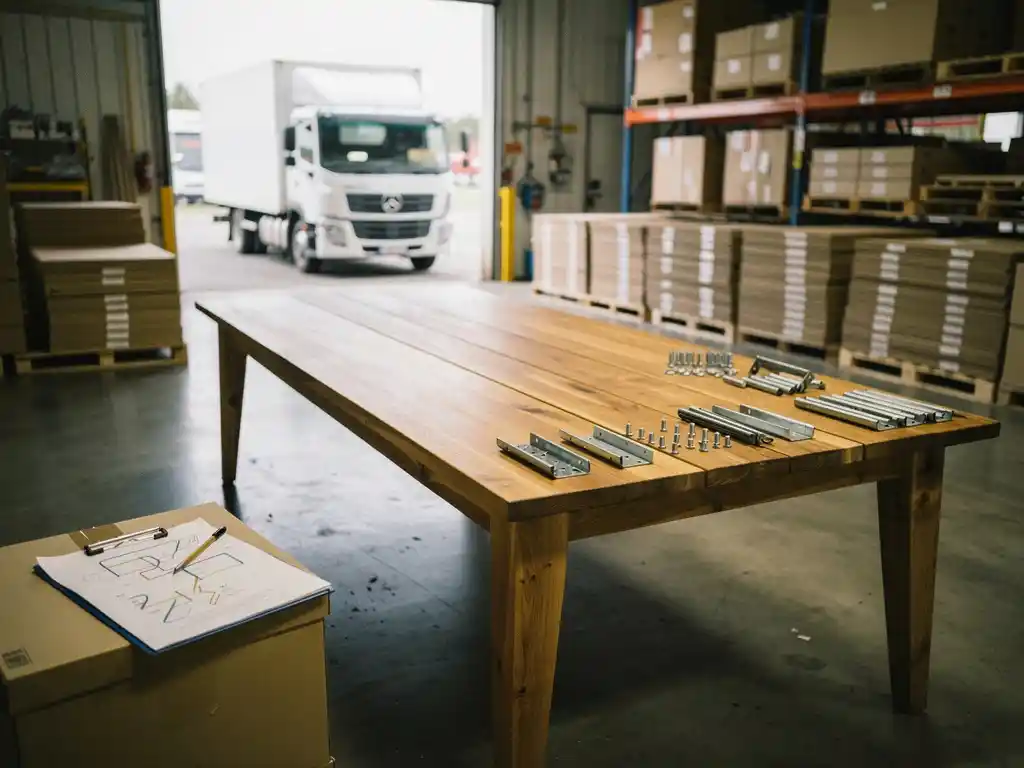
Getting furniture from the production floor to the customer’s door on time is harder than it looks. Production runs long, transport windows close early, and a single batch delay can cascade into missed deliveries across an entire week. The good news is that with a structured approach to production and transport planning, you can close the gap between what your factory outputs and what your logistics operation can actually move. This guide walks you through exactly how to do that, step by step.
Whether you manage a furniture manufacturer with in-house distribution or coordinate with a third-party logistics partner, the principles here apply directly to your furniture supply chain. Follow each step in order and you will have a repeatable planning framework that keeps production and transport in sync.
Map your production timeline against transport windows
Start by placing your production schedule and your available transport windows side by side in a single view. This is the foundation of any serious furniture logistics planning effort. Without this comparison, you are essentially guessing when goods will be ready and hoping a truck is available to take them.
- Pull your production schedule for the next four to eight weeks, broken down by product line, batch size, and expected completion date.
- List every confirmed transport window available from your logistics provider, including cut-off times, departure days, and destination routes.
- Overlay the two datasets in a shared planning tool, spreadsheet, or transport management system so mismatches are immediately visible.
- Flag every instance where a production completion date falls after a transport cut-off, or where a transport window has no confirmed goods to fill it.
After completing this step, you should have a clear visual of where your production output and transport capacity align and where the gaps are. If you see more than a handful of mismatches in a single week, that is a signal that your planning cycles are not synchronized, and the next steps will help you fix that.
Establish a shared data flow between production and logistics
A one-time comparison is not enough. Production timelines shift, and transport availability changes. To align production transport on an ongoing basis, you need a live or regularly updated data connection between your production team and your logistics planner.
- Define which production data points logistics needs to do their job: expected ready date, item count, dimensions, weight, and any special handling requirements.
- Agree on an update frequency. For most furniture operations, a daily update at the same time each morning is the minimum viable cadence.
- Choose a single shared tool where both teams enter and read data. This could be a shared ERP module, a transport management system, or even a structured shared spreadsheet if you are starting lean.
- Assign a named owner on each side: one person in production who is responsible for updating readiness status, and one logistics coordinator who acts on that information.
Once this data flow is running, logistics stops making transport bookings based on assumptions and starts working from actual production signals. Expect a short adjustment period of one to two weeks before both teams find the rhythm. The contract logistics solutions we offer are built around exactly this kind of integrated information flow, but the structure above works regardless of who handles your transport.
Build buffer rules for furniture production delays
Furniture production delays are not exceptional. They are a normal feature of the process. Wood dries unevenly, upholstery runs short, and quality checks catch issues at the last moment. Your planning framework needs to account for this rather than pretend it will not happen.
- Review your last three to six months of production data and calculate your average delay per product category. Upholstered pieces, for example, tend to run longer than flat-pack items.
- Set a standard buffer rule for each category. A common starting point is to schedule transport two working days after the expected production completion date rather than the same day.
- Create a tiered escalation protocol: if a batch is delayed by one day, the logistics planner holds the booking; if delayed by two or more days, the planner actively reschedules and notifies the customer.
- Document these rules in a shared planning policy so both teams apply them consistently, not on a case-by-case basis.
Buffer rules feel like lost time, but they actually recover time by eliminating the reactive scrambling that happens when a truck arrives for goods that are not ready. Check your on-time departure rate after four weeks of applying buffer rules. It should improve noticeably.
Coordinate load planning with production batch logic
With your data flow running and buffer rules in place, the next step is to make sure your load planning reflects how production actually groups work. Furniture factories typically produce in batches by product type, finish, or customer order. Transport planning that ignores this logic ends up with partial loads, mixed handling requirements, and unnecessary rehandling in the warehouse.
- Talk to your production manager and understand the batch logic they use: do they group by customer order, by material type, or by production line capacity?
- Map each batch type to a load unit: a full truckload, a groupage slot, or a dedicated vehicle for fragile or oversized pieces.
- Instruct your logistics planner to build loads around production batches rather than filling trucks by departure date alone.
- Where batches from different customers share a vehicle, confirm that handling requirements are compatible before combining them.
Aligning load planning with batch logic reduces the number of times a piece of furniture is touched between production and delivery. In furniture logistics, every unnecessary handling event is a risk to the product. Our warehousing operations use batch-aware staging to make sure goods are grouped correctly before they ever reach the loading dock.
Validate alignment before each dispatch cycle
Even a well-designed planning system needs a regular checkpoint. Before each dispatch cycle, run a short validation routine to confirm that what is scheduled to leave actually matches what is ready to go. This is your final quality gate for logistics planning in furniture operations.
- Twenty-four hours before each planned departure, cross-check the transport manifest against the production readiness list.
- Confirm that every item on the manifest has been quality-checked, labeled, and staged in the correct loading area.
- Flag any item that is not yet confirmed as ready and apply your buffer rule protocol immediately rather than waiting to see if it resolves itself.
- Sign off on the dispatch with both the production lead and the logistics coordinator, so accountability is shared.
This pre-dispatch validation step is where most planning breakdowns are caught before they become customer problems. Over time, track how many issues surface at this stage. A declining number of last-minute flags is a reliable indicator that your upstream planning is improving. If you consistently find the same type of issue in validation, trace it back to the relevant step in this guide and tighten that part of your process.
For teams handling complex or high-volume furniture distribution, working with a specialist logistics partner can take much of this coordination off your plate. We have been supporting furniture transport operations across Europe since 1924, and the planning framework described here is built into how we work with every client. Whether you run this process internally or with external support, the steps remain the same: map, connect, buffer, batch, and validate.