




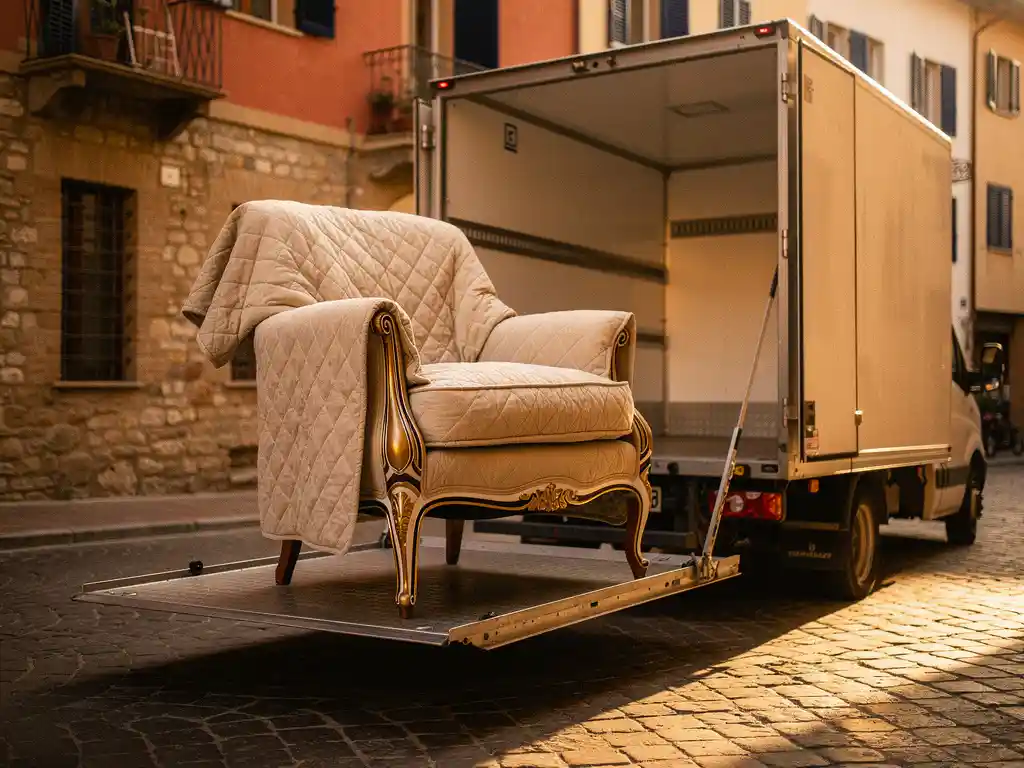
Italy is one of the world’s leading furniture manufacturing hubs, home to iconic production regions like Brianza, the Veneto, and the districts around Pesaro. Whether you are furnishing a hotel, outfitting a corporate office, or completing a residential project, sourcing furniture from Italian manufacturers brings exceptional quality. It also brings logistical complexity. International furniture shipping from Italy involves multiple parties, cross-border documentation, and careful coordination to get pieces to your site in perfect condition.
This guide walks you through exactly how to arrange furniture delivery from Italy to your project site, from the groundwork you need to lay before the first truck is booked, all the way through to final delivery and exception handling.
What you need before arranging furniture delivery from Italy
Before you contact any carrier or freight forwarder, gather the information and documents that every logistics provider will need to give you an accurate quote and plan your shipment correctly. Missing details at this stage can cause delays and cost overruns later, so treat this preparation as the foundation of the entire process.
- Supplier details: Full name, address, and contact information for each Italian manufacturer or supplier, including their VAT number for customs purposes.
- Volume and weight: Cubic metres and gross weight of the total shipment, broken down per supplier if you are consolidating from multiple locations.
- Item descriptions: Accurate product descriptions, HS (Harmonized System) tariff codes, and declared values for each item category.
- Delivery address specifics: Full site address, access restrictions (narrow streets, low bridges, no loading dock), and any site hours or permit requirements.
- Incoterms agreement: Confirm with your supplier whether the sale is EXW (you arrange everything from the factory door), DAP (supplier delivers to your named location), or another agreed term, as this determines who is responsible for each leg of the journey.
- Timeline: Your target delivery date and any hard deadlines tied to site handovers, contractor schedules, or opening dates.
Once you have these details documented, you are ready to approach logistics providers with a complete brief. This avoids the back-and-forth that typically adds days to the planning phase.
Choose the right transport mode for your shipment
The transport mode you select for your furniture transport from Italy determines cost, transit time, and the level of care your goods receive. For most furniture shipments within Europe, road freight is the standard choice, but the right configuration depends on your volume and urgency.
- Full Truck Load (FTL): If your shipment fills a standard trailer (roughly 33 loading metres or more), book a dedicated truck. FTL is faster, involves no handling at intermediate depots, and reduces the risk of damage to large or fragile pieces.
- Less than Truck Load (LTL) or groupage: For smaller consignments, your goods share space with other cargo on a consolidated service. Transit times are longer, and goods pass through a hub, but costs are significantly lower for partial loads.
- Air freight: Only practical for very small, high-value items with urgent deadlines. The cost per kilogram is far higher than road freight and is rarely justified for furniture volumes.
- Sea freight: Relevant if you are shipping outside Europe, for example to the Middle East, Asia, or the Americas. Container options (FCL for a full container, LCL for shared) apply the same logic as FTL versus groupage.
For furniture transport from Italy to European destinations, dedicated road freight in a curtainsider or box trailer is typically the best combination of speed, cost, and cargo protection. Confirm that your carrier uses load-securing equipment appropriate for furniture, including straps, blankets, and anti-slip matting, before committing to a booking.
Handle customs clearance and import documentation
If your delivery destination is within the European Union and your supplier is also based in the EU, there is no customs border to cross. However, if your site is in the UK, Switzerland, Norway, or outside Europe entirely, customs clearance becomes a critical step that must be planned well in advance of your shipment date.
- Obtain the commercial invoice: Your Italian supplier must provide a commercial invoice that includes the buyer and seller details, a full description of the goods, HS codes, quantities, unit prices, and the total declared value in the agreed currency.
- Request a packing list: A detailed packing list showing dimensions, weights, and contents of each package or pallet is required by customs authorities and your freight forwarder.
- Confirm the certificate of origin: For preferential tariff treatment under trade agreements (such as the EU-UK Trade and Cooperation Agreement), you may need a statement on origin from your supplier confirming that the goods meet rules of origin requirements.
- Appoint a customs broker: Unless you have in-house customs expertise, appoint a licensed customs broker in the destination country. They will file the import declaration, calculate applicable duties and VAT, and release the goods for onward delivery.
- Arrange duty and VAT payment: Understand whether duties and import VAT are due on arrival and ensure payment is in place before your goods reach the border. Delays at customs are almost always caused by missing documents or unpaid duties.
Once your customs broker confirms that the import declaration has been accepted and duties are settled, your shipment is cleared for delivery. Keep copies of all customs documents, as you may need them for VAT reclaim or audit purposes.
Coordinate last-mile delivery to your site
Last-mile delivery is where furniture logistics from Italy most often runs into problems. A truck arriving at a construction site, a hotel under renovation, or a high-rise office building faces challenges that standard pallet deliveries do not. Plan this leg with as much care as the international transport itself.
Confirm site access well before the delivery date. Measure access routes if you are in a city centre or a development with restricted vehicle access. Check whether your site requires a delivery booking or a time window, and whether there are noise restrictions or permit requirements for large vehicles. Share all of this with your logistics provider in writing.
- Brief the delivery team: Provide a site contact name and mobile number, the exact delivery address including floor or unit references, and any access codes or security procedures.
- Arrange unloading resources: Confirm who is responsible for unloading. Many international carriers deliver to the kerbside only. If you need goods carried inside, lifted to upper floors, or placed in specific rooms, this must be agreed and priced separately as a two-person delivery or installation service.
- Inspect on arrival: Before signing any delivery note, inspect all packages for visible damage. Note any discrepancies on the driver’s paperwork. Photograph damaged packaging before opening it.
For complex project deliveries involving multiple rooms, assembly, or installation, a specialist project logistics partner can manage the full on-site process, including pre-delivery planning using floor plans and data, coordination with other trades, and same-day assembly. We operate across more than 150 locations worldwide and handle exactly these kinds of demanding on-site scenarios.
Track your shipment and manage exceptions
Active shipment tracking is not optional when furniture is moving across borders on a fixed project timeline. Delays caused by traffic, mechanical issues, customs holds, or late dispatch by the supplier can cascade into significant cost if you are not monitoring progress in real time.
Request a tracking reference or portal login from your carrier at the point of booking. For road freight within Europe, most reputable carriers provide live GPS tracking or regular status updates at key milestones: collection confirmed, in transit, customs cleared, out for delivery. Set up notifications for each milestone so you are not chasing your carrier manually.
- Establish an escalation contact: Know exactly who to call at your freight forwarder or carrier if something goes wrong. A named operations contact is far more effective than a general customer service line when you need fast answers.
- Monitor customs status actively: If your shipment crosses a customs border, check the status with your broker the day after arrival at the border. Holds can occur due to additional document requests or random inspections, and early intervention prevents multi-day delays.
- Communicate proactively with your site team: If a delay is confirmed, notify your site manager, installation team, or client immediately. Adjust schedules where possible rather than waiting until the last moment.
- Document exceptions formally: If goods arrive damaged or short, raise a formal claim with your carrier within the timeframe specified in your contract. Photograph everything, retain original packaging, and submit your claim in writing with supporting evidence.
With your delivery complete and any exceptions resolved, review the full process with your logistics provider. What worked well, where did delays occur, and what documentation could be prepared earlier next time? For recurring furniture imports from Italy, building a standard operating procedure with a trusted partner makes each subsequent shipment faster and more predictable. If you are looking for a logistics partner with deep experience in international furniture shipping, get in touch with our team to discuss your next project.