


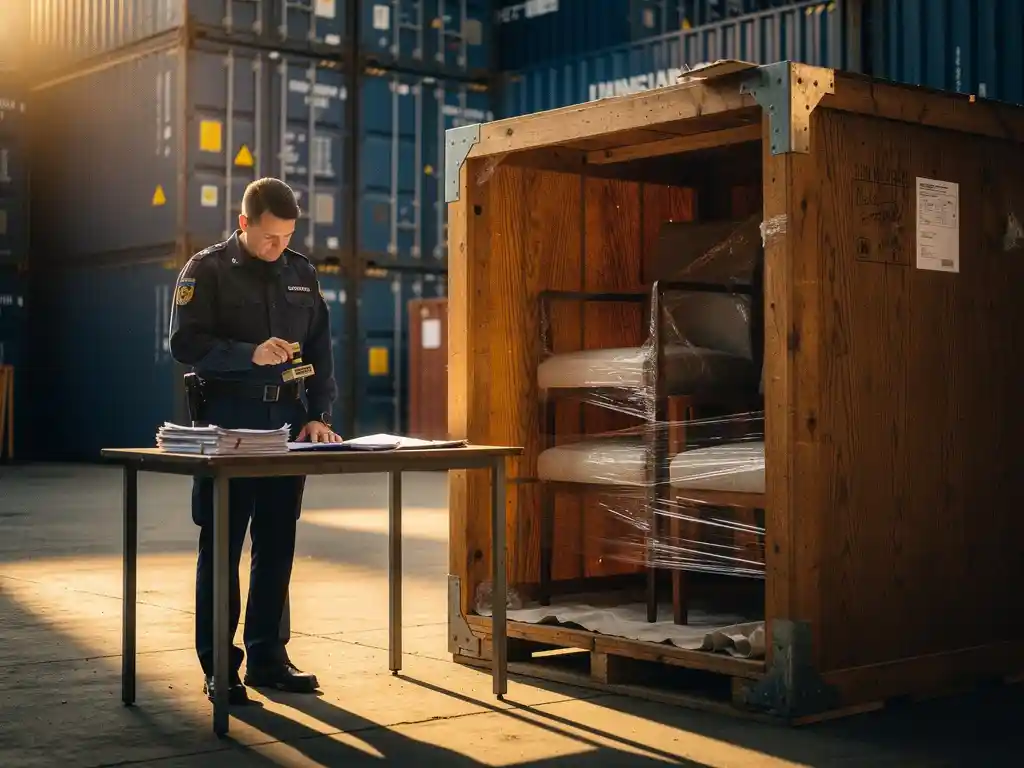
Importing furniture from outside the EU can be a smooth, cost-effective process, or it can turn into a costly standstill at the border. The difference almost always comes down to preparation. Customs delays for furniture imports are rarely random. They happen because of missing paperwork, incorrect product classifications, or declarations submitted too late. The good news is that every one of those causes is preventable.
This guide walks you through the six essential steps to clear EU furniture imports through customs without unnecessary delays. Whether you are sourcing sofas from Asia, dining sets from North America, or upholstered pieces from anywhere outside the European Union, these steps apply directly to your shipment.
Gather the right documents before shipment
Customs documentation for furniture is the single most common source of delays. Inspectors cannot clear what they cannot verify, so your paperwork needs to be complete and accurate before the goods ever leave the country of origin. Gathering documents after the shipment has departed almost always results in holds at the port of entry.
Prepare the following documents for every furniture import shipment:
- Commercial invoice — must include seller and buyer details, a full description of the goods, quantity, unit price, total value, and currency
- Packing list — itemised breakdown of every piece in the shipment, including dimensions and gross weight per package
- Bill of lading or airway bill — the transport contract issued by the carrier
- Certificate of origin — confirms where the furniture was manufactured, which determines applicable duty rates
- Conformity documentation — for furniture entering the EU, relevant safety or material compliance certificates may be required depending on the product type
Verify that the commercial invoice description matches the physical goods exactly. A mismatch between what is written and what is in the container is one of the fastest ways to trigger an inspection. Once your document set is confirmed complete, you are ready to move to product classification.
Classify your furniture with the correct HS codes
Every product crossing an international border needs a Harmonised System (HS) code, and furniture is no exception. The HS code tells customs authorities exactly what your product is, which determines the applicable import duty rate and any relevant trade regulations. Using the wrong code, even accidentally, can result in delays, fines, or goods being held pending reclassification.
Furniture generally falls under Chapter 94 of the HS nomenclature, but the specific subheading depends on the material, function, and construction of each piece. A wooden dining chair, a metal office desk, and an upholstered sofa all carry different codes with different duty implications.
- Identify the primary material of each furniture type in your shipment (solid wood, metal frame, upholstered, etc.)
- Determine the intended use of each item (domestic seating, office furniture, bedroom furniture, outdoor furniture)
- Look up the relevant heading in the EU Combined Nomenclature, which extends the six-digit HS code to eight digits for EU-specific classification
- Cross-check the code against the EU Customs Tariff database (TARIC) to confirm the applicable duty rate and any applicable trade measures
If you are unsure about a classification, request a Binding Tariff Information (BTI) ruling from the customs authority in the EU member state where you will be importing. A BTI gives you legal certainty on the code and protects you from reclassification disputes. With your HS codes confirmed, you can now calculate your full duty and tax obligations.
Understand EU import duties and VAT obligations
Knowing your duty rate before goods arrive is not just good planning, it is essential for avoiding financial surprises that can stall the release of your shipment. EU import duties on furniture vary depending on the product type and the country of origin. Preferential duty rates may apply if the exporting country has a trade agreement with the EU, which can significantly reduce your costs.
In addition to customs duties, VAT applies to all imports entering the EU. The VAT rate depends on the destination member state and is calculated on the customs value of the goods plus the import duty. In most EU countries, standard VAT rates apply to furniture imports, though you should confirm the applicable rate for your specific destination country.
Key financial obligations to calculate before your shipment departs:
- Customs duty — based on the HS code, country of origin, and customs value (CIF or FOB depending on the incoterm used)
- VAT on import — applied to the customs value plus duty, payable at the point of import unless a deferment account is in place
- Anti-dumping duties — certain furniture categories from specific countries carry additional duties; check TARIC for any applicable measures
Arrange your import duty payment method in advance. Many importers use a customs duty deferment account to avoid paying duties immediately upon arrival, which improves cash flow and prevents shipments from being held while payment is processed.
Submit customs declarations accurately and on time
With your documents gathered and duties calculated, the next step is submitting the customs declaration. In the EU, this is done through the Import Control System 2 (ICS2) for pre-arrival safety and security filings, followed by the formal customs declaration submitted in the member state of import.
Accuracy here is non-negotiable. Errors in the declaration, whether in the HS code, declared value, quantity, or origin, are among the leading causes of furniture import customs clearance delays. Customs authorities use automated risk assessment systems, and inconsistencies flag shipments for manual review.
- Submit the Entry Summary Declaration (ENS) through ICS2 before the goods depart or arrive, depending on the mode of transport
- File the formal import declaration (Single Administrative Document, or SAD) in the EU member state of release for free circulation
- Declare the correct customs value using the transaction value method, supported by the commercial invoice
- Attach all supporting documents digitally where required by the national customs authority
- Monitor the declaration status and respond to any queries from customs within the timeframe specified
After submission, you should receive a Movement Reference Number (MRN) confirming the declaration is registered. Keep this reference accessible. If customs selects your shipment for documentary or physical examination, this number is your primary point of reference throughout the process.
Work with a freight forwarder experienced in furniture logistics
Even with thorough preparation, furniture imports involve enough complexity that working with an experienced freight forwarder makes a measurable difference. A forwarder who specialises in furniture transport understands the specific classification challenges, the documentation requirements for upholstered goods and treated wood, and the practical realities of moving large, fragile items through customs without damage or delay.
We have been handling European furniture logistics since 1924, and our team understands what customs authorities look for when examining furniture shipments. As part of the MACH-3000 network, we coordinate logistics across more than 150 locations worldwide, which means we can support customs clearance at the point of origin as well as at the EU point of entry. A forwarder with this kind of reach can identify potential issues before they become delays.
When selecting a freight forwarder for EU furniture imports, look for:
- Direct experience with furniture and home furnishings customs clearance
- Customs brokerage capabilities or established partnerships with licensed customs brokers in the destination country
- Familiarity with TARIC, anti-dumping measures, and preferential origin rules relevant to your sourcing countries
- Established relationships with port authorities and customs offices at major EU entry points
With a capable logistics partner managing the declaration process, you reduce the risk of procedural errors and gain access to expertise that is difficult to replicate in-house, particularly for businesses that do not import furniture at high volume. With this support in place, you are well positioned to handle the final challenge: inspections.
Handle inspections and customs queries without losing time
Even well-prepared shipments are sometimes selected for inspection. EU customs authorities use risk-based selection, which means any shipment can be flagged, regardless of how complete your documentation is. What matters is how quickly and clearly you respond when that happens.
There are two types of examination you may encounter. A documentary check requires you to provide additional paperwork to support the declaration. A physical inspection means customs officers will examine the actual goods, which takes more time but is manageable if your shipment is correctly packed and labelled.
To handle inspections without losing time:
- Keep all original documents accessible and organised so you can respond to documentary requests within hours, not days
- Ensure your packing list matches the physical shipment exactly, including item counts, descriptions, and package markings
- Designate a single point of contact at your company or your freight forwarder who can respond to customs queries immediately
- If goods are held for inspection, confirm the estimated timeframe with the customs office and notify your end customer or project team accordingly
- Do not attempt to release goods before customs has formally cleared them. Doing so creates legal liability and can complicate future imports
Most inspections are resolved within one to three working days when documentation is in order and the importer responds promptly. The businesses that experience the longest delays are typically those that are slow to respond or unable to produce supporting documents quickly. Keeping your paperwork organised and your contacts informed is the most effective way to minimise the impact of any inspection on your delivery timeline.
Avoiding customs delays for furniture imports is a process that rewards preparation. Get your documents right, classify correctly, understand your financial obligations, file accurately, work with people who know furniture logistics, and respond to queries without hesitation. Follow these steps consistently and your EU furniture imports will clear customs reliably, shipment after shipment. If you want to discuss how we handle customs clearance as part of a complete logistics solution, get in touch with our team.