


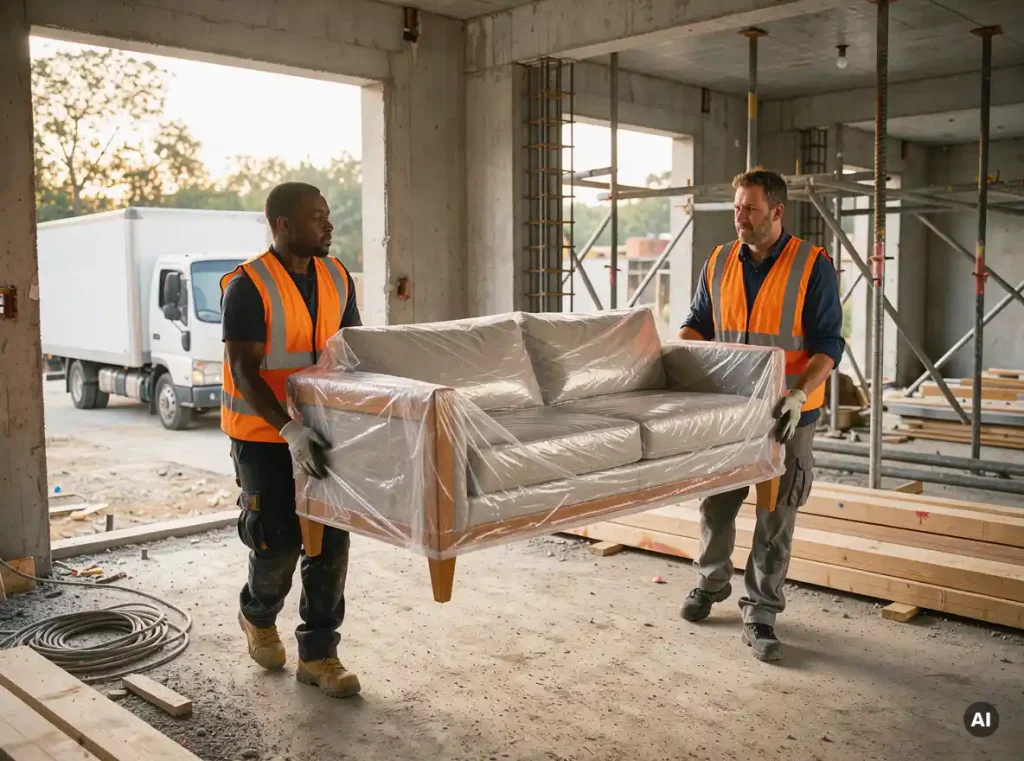
You deliver furniture on an active construction site by agreeing on access, timing, storage and responsibilities with the site manager in advance, then delivering just in time, in protected condition, with trained crews who unpack and install on the spot. The key driver is coordination: furniture is the last, most vulnerable and most visible item on a project.
We handle this every week through our project logistics team, and the questions below cover what actually decides whether a delivery goes smoothly or turns into damaged goods and lost days.
What Should Be Arranged With the Site Manager Before Delivery?
Before delivery, agree on site access, delivery windows, unloading space, lift or stairwell availability, safety rules and a named contact on site. These practical points decide whether a vehicle can even reach the building and whether the furniture can travel from truck to final room without delays.
A solid pre-delivery checklist covers the following:
- Access and routing: vehicle height and length limits, road closures, crane or hoist schedules, and whether the entrance is shared with other trades.
- Delivery slot: a confirmed time window, plus a fallback if the site cannot receive on that day.
- Unloading zone: a clear, level area close to the entrance, ideally under cover.
- Vertical transport: working lifts, their maximum load and door dimensions, or clear stairwells.
- Safety and admission: site inductions, PPE requirements and permits for every crew member.
- Single point of contact: one person on site who can make decisions on the day.
Put these agreements in writing and share them with the driver and installation crew. Verbal arrangements tend to disappear the moment the site manager changes shift.
How Do You Time Furniture Delivery With Construction Phases?
Furniture should arrive only after the building is weathertight, dust-generating work is finished and floors, walls and ceilings are complete. In practice, that means scheduling delivery after painting, flooring and ceiling work, and coordinating it with a just-in-time plan that matches the final fit-out milestones.
Construction schedules shift, so a fixed delivery date set months ahead rarely survives. A better approach is to link delivery to completion milestones rather than calendar dates. Ask the site manager for an updated schedule one to two weeks before delivery, and confirm again 48 hours ahead.
Just-in-time delivery keeps furniture out of harm’s way. When goods arrive close to installation, they spend less time exposed to dust, moisture and passing trades. This only works with reliable planning on both sides, which is why our project managers coordinate routes, lead times and installation crews as one chain. For larger fit-outs, we often phase deliveries floor by floor so each area is finished before the next one begins.
Where Can Furniture Be Stored if the Site Isn’t Ready?
If the site isn’t ready, store furniture in a clean, dry, climate-suitable warehouse offsite and release it in planned batches as areas are completed. Storing goods inside an unfinished building exposes them to dust, moisture, theft and accidental damage, so an external warehousing solution is usually the safer choice.
Offsite storage also gives you flexibility. When the schedule slips by a week or a month, the furniture simply waits in the warehouse instead of blocking corridors or sitting in a container. Good storage setups include:
- Inventory registration per item or per room, so the right pieces are called off in the right order.
- Consolidation of shipments from several suppliers into one coordinated delivery.
- Pre-assembly or quality checks before items leave the warehouse.
Warehouse capacity also lets you receive early production runs from manufacturers without forcing the site to take them before it is ready.
How Is Furniture Protected From Damage During Site Delivery?
Furniture is protected during site delivery through specialist transport equipment, protective wrapping, trained two-person crews, and careful handling routes from truck to room. Damage on construction sites usually comes from tight spaces, dust, moisture and rushed unloading, so prevention starts with preparation rather than repair.
Key protective measures include:
- Furniture-specific vehicles: we use swap bodies with a double loading floor, which increases capacity and reduces loading and unloading time, so drivers can pay more attention to careful handling.
- Reusable protection: furniture blankets instead of single-use packaging protect pieces in transit and cut waste.
- Route protection: corner guards, floor protection and door protection along the path inside the building.
- Trained staff: furniture logistics is a specialist profession, so we train our own people in-house with a focus on respect and care for the product.
- Final checks: inspect the goods before they leave and again on arrival, and document any issues with photos.
For high-end pieces, a pre-delivery walkthrough of the route with the site manager prevents surprises such as a lift that is too small or a door frame that is still unfinished.
Who Handles Unpacking, Installation and Waste Removal?
The delivery partner can handle unpacking, installation and waste removal when this is agreed in the contract, which is the cleanest option. Otherwise the responsibility must be assigned explicitly to the contractor, the furniture supplier or an installation team, because unclear ownership is a common source of delays and disputes.
With full-service delivery, the same crew that unloads the goods also places them in the correct rooms, assembles them, connects equipment where needed and removes packaging. This removes handoffs between parties and keeps accountability in one place. We offer this through our team of installers and project managers, who oversee every aspect of a project from start to finish, which gives you a single contact person instead of several parties to chase.
Clarify these points in advance:
- Who unpacks and positions the furniture in each room.
- Who assembles and installs, and to what standard.
- Who removes and recycles packaging, and where waste containers stand.
- Who signs off the delivery and records any defects.
Packaging that is minimized, returned or recycled also reduces on-site clutter and supports sustainability goals. Our project cases show how this works on larger installations.
What Are Common Delivery Mistakes on Construction Sites?
The most common mistakes are delivering too early, assuming access that doesn’t exist, skipping a route check, leaving responsibilities unclear and storing goods inside the unfinished building. Almost all of them trace back to missing communication between the planner, the site manager and the delivery crew.
Watch out for these pitfalls:
- Delivering before the site is finished: dust, moisture and ongoing trades put furniture at risk.
- Underestimating access: lifts that are out of service, narrow stairwells and blocked entrances cause hours of delay.
- No fallback plan: without alternative storage or a backup date, a delayed site means a wasted trip.
- Unclear ownership of tasks: unpacking, installation and waste removal fall through the cracks.
- Missing documentation: without photos and signed delivery notes, damage claims become hard to resolve.
- Too many suppliers, too little coordination: separate deliveries from many parties clog the site and increase transport movements.
The fix is simple but requires discipline: confirm the schedule shortly before delivery, check the route, assign every task to a named party and keep one coordinator across the whole chain. If you are planning a fit-out and want a second pair of eyes on the logistics, you can get in touch with our team and we will gladly think it through with you.