


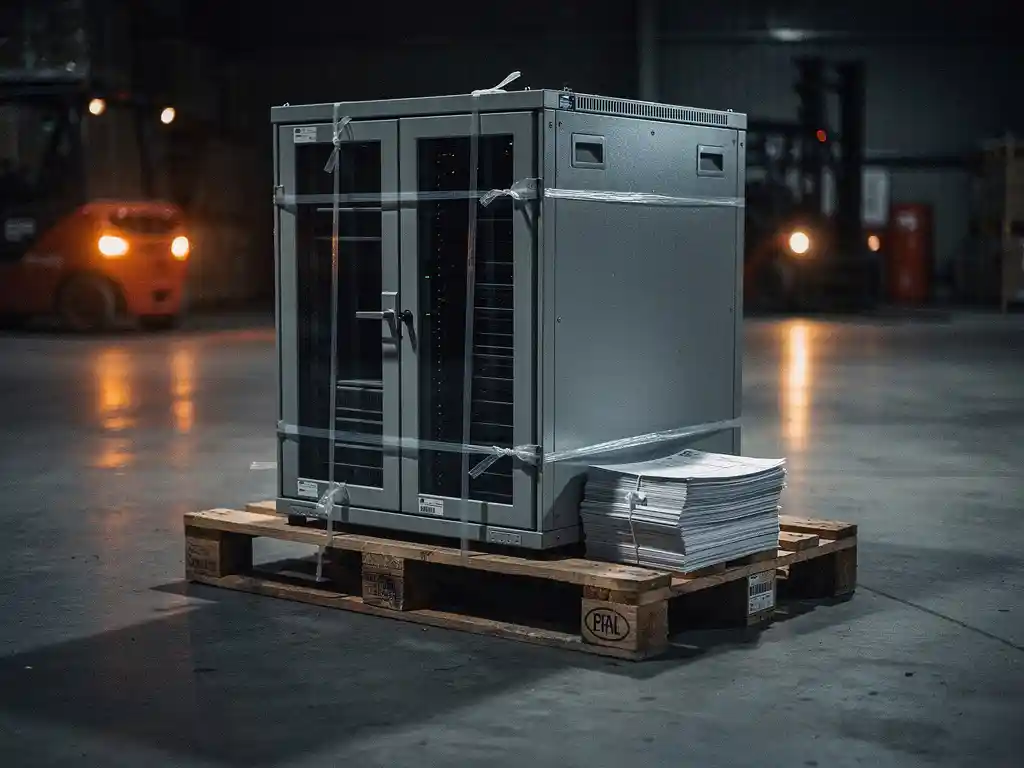
Handling compliance when moving servers abroad requires addressing data protection laws, export control regulations, customs requirements, and documentation obligations before a single piece of hardware leaves its current location. The specific rules that apply depend on where the servers are moving from, where they are going, and what data they hold or process. The sections below answer the most common compliance questions organizations face when relocating servers internationally.
What compliance risks come with relocating servers internationally?
Relocating servers internationally exposes organizations to several overlapping compliance risks: data sovereignty violations, export control breaches, customs penalties, and audit failures. Each risk operates independently, meaning a shipment that clears customs perfectly can still trigger a data protection investigation if personal data crosses a border without the correct legal basis.
The most significant risk for most organizations is data sovereignty. Many countries require that certain categories of data, particularly personal data, financial records, and health information, remain within their borders or within approved jurisdictions. Moving a server that processes or stores such data without first establishing a lawful transfer mechanism can result in regulatory action even before the server reaches its destination.
Export controls present a separate layer of risk. Server hardware, particularly high-performance processors and certain networking components, can be subject to export licensing requirements under frameworks such as the US Export Administration Regulations (EAR) or the EU Dual-Use Regulation. Shipping controlled hardware without the correct documentation can result in fines, seizure of goods, or criminal liability.
Finally, organizations often underestimate the audit risk. Regulators and internal auditors expect a clear, documented chain of custody for any system that handles sensitive data. A server move that is poorly documented creates gaps that are difficult to explain after the fact, even if the move itself was compliant.
Which countries have the strictest data residency laws for servers?
The countries with the strictest data residency requirements for servers include Russia, China, India, and several Gulf states, all of which mandate that specific categories of data be stored on servers physically located within their territory. These requirements apply regardless of where the organization operating the servers is headquartered.
Russia’s Federal Law No. 242-FZ requires that personal data of Russian citizens be stored and processed on servers located within Russia. China’s Cybersecurity Law and Data Security Law impose similar requirements for data generated within China, with particularly strict rules for operators of critical information infrastructure. India’s data protection framework, which has been evolving significantly, is moving toward strong localization requirements for sensitive personal data.
Within the European Union, data residency is not mandated by default, but the rules governing cross-border transfers of personal data are stringent and effectively function as residency requirements in practice for many organizations. Several EU member states also impose sector-specific residency rules in areas such as healthcare and financial services.
For organizations planning a server relocation, the destination country’s laws matter as much as the origin country’s laws. A server moving from Germany to Singapore must satisfy both GDPR transfer requirements on departure and Singapore’s Personal Data Protection Act requirements on arrival.
How does GDPR affect moving servers out of the EU?
GDPR restricts the transfer of personal data to countries outside the European Economic Area unless an approved transfer mechanism is in place. Moving a server that processes EU personal data to a non-EEA country without such a mechanism is a violation of GDPR, regardless of whether the physical hardware move is otherwise lawful.
The approved transfer mechanisms under GDPR include adequacy decisions, standard contractual clauses (SCCs), binding corporate rules (BCRs), and, in limited circumstances, specific derogations. An adequacy decision means the European Commission has determined that the destination country offers an equivalent level of data protection. Countries with current adequacy decisions include the UK, Japan, Canada (for commercial organizations), and a small number of others. For countries without an adequacy decision, organizations must rely on SCCs or BCRs.
What counts as a data transfer under GDPR?
A data transfer occurs whenever personal data is made accessible to a party in a third country, including through remote access. Physically moving a server is one of the clearest forms of data transfer, because the data moves with the hardware. However, even leaving data on a server in the EU while granting access to personnel in a non-EEA country can constitute a transfer requiring a legal basis.
What happens if a server move violates GDPR?
Violations of GDPR’s transfer rules can result in fines of up to four percent of global annual turnover or 20 million euros, whichever is higher. Supervisory authorities can also issue temporary or permanent bans on data processing, which in practice means ordering the organization to stop using the relocated server until compliance is restored. Reputational damage and customer notification obligations can compound the financial impact significantly.
What customs and export controls apply to IT hardware?
IT hardware moved across international borders is subject to customs duties, import tariffs, and potentially export licensing requirements depending on the technical specifications of the equipment and the countries involved. High-performance servers, certain processors, and advanced networking equipment may qualify as dual-use goods, meaning they have both civilian and potential military applications and are therefore subject to stricter controls.
In the European Union, the Dual-Use Regulation (EU 2021/821) governs the export of goods that could be used for both commercial and military purposes. Organizations exporting controlled hardware from the EU must check whether an export authorization is required before shipment. The United States applies similar controls through the Export Administration Regulations, administered by the Bureau of Industry and Security, and these rules can apply to US-origin technology even when it is re-exported from a third country.
On the customs side, accurate classification of server hardware under the Harmonized System (HS) codes is essential. Misclassification, even unintentional, can result in penalties, delays, and retrospective duty assessments. Temporary importation regimes exist in many countries and can be used when servers are being relocated for a defined period rather than permanently, but these regimes require specific paperwork and strict compliance with time limits.
Practical steps organizations should take before shipping include obtaining a commodity jurisdiction determination for any hardware with advanced specifications, verifying whether the destination country has import restrictions on encryption-capable equipment, and engaging a customs broker with experience in IT hardware to prepare the correct documentation.
How do you document a server move to satisfy auditors?
Satisfying auditors after a server relocation requires a documented chain of custody that covers every stage of the move: pre-move inventory, physical transit, arrival verification, and post-move data integrity confirmation. Auditors look for evidence that no unauthorized access occurred during transit and that the organization maintained control of the data at all times.
The documentation package for a compliant server move typically includes the following elements:
- A pre-move asset register listing each server’s serial number, hardware specifications, and the data it processes
- A data transfer impact assessment if personal data subject to GDPR or equivalent regulations is involved
- Signed chain of custody records for each handover point during transit
- Evidence of the legal basis for any cross-border data transfer, such as executed standard contractual clauses
- Customs and export documentation, including any licenses obtained
- A post-move verification report confirming that hardware arrived intact and that data integrity was maintained
- Updated records in the organization’s data processing register (Article 30 records under GDPR)
Organizations operating under ISO 27001 or SOC 2 frameworks should also update their risk registers and asset management systems to reflect the new physical location of the hardware. Auditors reviewing these frameworks will cross-reference asset records against physical location data, so any discrepancy between the two creates a finding that requires explanation.
Should you use a specialist logistics provider for server relocation?
Yes, using a specialist logistics provider for server relocation significantly reduces compliance risk, physical damage risk, and documentation gaps. General freight carriers are not equipped to handle the combination of technical handling requirements, clean-room conditions, chain of custody documentation, and customs expertise that a server move demands.
Server hardware is sensitive to electrostatic discharge, vibration, and temperature fluctuations. A specialist provider will use anti-static packaging, climate-controlled transport, and secure loading procedures designed for high-value IT equipment. Beyond the physical handling, a specialist provider understands the documentation requirements that customs authorities and data protection auditors expect and can prepare and manage that paperwork as part of the service.
We have direct experience in this area. At Jan Krediet, we assemble server cabinets in a dust-free clean room within our warehouse and provide warehousing, refurbishment, and worldwide distribution for high-tech clients. Our project logistics team builds dedicated teams around each client’s specific requirements, covering planning, coordination, and execution so that no compliance detail is left unmanaged.
When evaluating a logistics provider for server relocation, organizations should verify that the provider has experience with IT hardware, can demonstrate familiarity with dual-use export controls, offers documented chain of custody procedures, and has a network capable of handling customs clearance in both the origin and destination countries. A provider that treats every logistics challenge as an opportunity to develop a tailored solution, rather than applying a one-size-fits-all approach, is far better positioned to navigate the compliance complexity that international server relocation involves.
For organizations that want to understand the full scope of what a specialist logistics partner can offer, our contract logistics solutions page provides a detailed overview of how we structure end-to-end logistics support for complex, compliance-sensitive moves.