


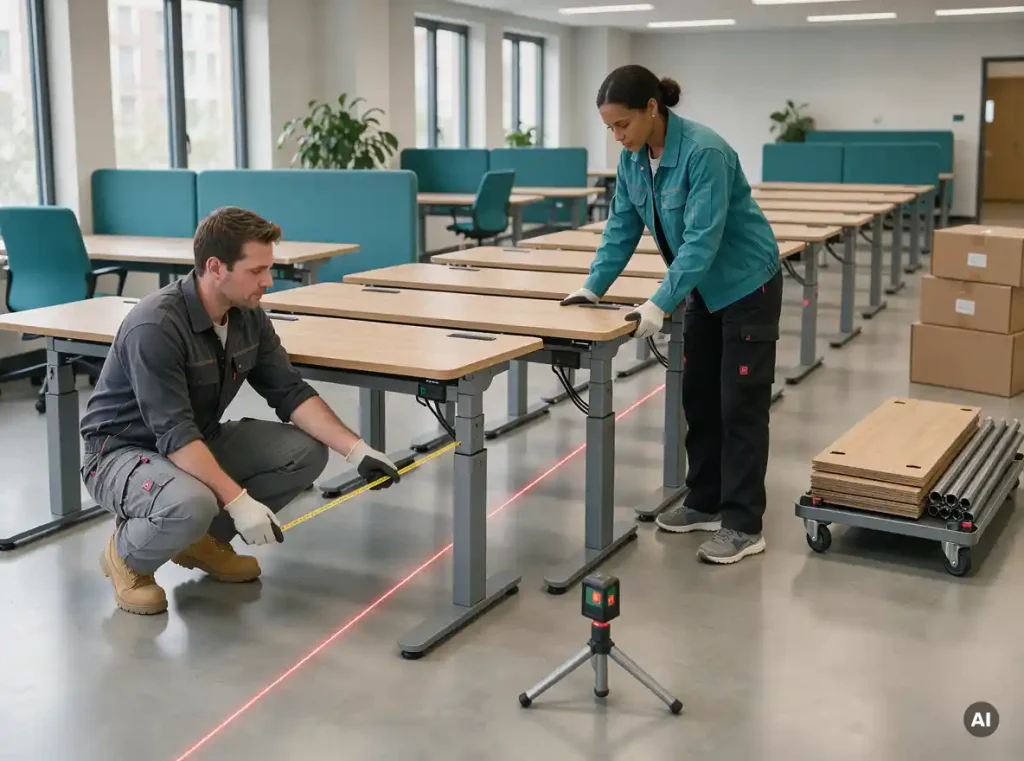
You keep global coworking furniture installs consistent by defining one written installation standard, briefing every installer on it, and controlling the logistics chain from factory to final handover. Consistency comes from repeatable processes, one accountable coordinator, and quality checks on every site, not from hoping local teams interpret a design the same way.
Most variation appears when product deliveries arrive in the wrong order, installers read plans differently, or a site constraint forces an improvised fix. The sections below show how to prevent each of these in a multi-site furniture rollout.
What should a global install standard include?
A global install standard is a single reference document that describes exactly how every coworking location must look and be built. It should cover layouts, product placement, assembly methods, finishing details, delivery sequence, and acceptance criteria, so installers in Berlin, Cape Town, and Paris produce the same result.
Strong installation standards usually include:
- Scaled floor plans and placement rules, including distances between desks, sightlines, and the position of wall decoration and plants.
- Assembly instructions per product, with photos of the correct end result and common mistakes to avoid.
- Tools, hardware, and fixings, so installers do not substitute parts locally.
- Handling and unpacking rules, covering packaging removal, protection of finished surfaces, and waste handling.
- A handover checklist that defines what “finished” means.
Keep the document visual and short enough that installers will use it on site. A standard nobody reads does not create consistency. If you want to see how we approach our standards, that is a useful reference point for structuring your own.
How do you align installers across different countries?
You align installers by giving every team the same briefing, the same documentation, and the same definition of a finished site. Combine a pre-project briefing with a pilot install, and keep one project team in contact with all local crews so questions get one consistent answer.
Practical steps that work well:
- Run a kickoff briefing with every installer, ideally remotely and recorded, so late joiners get the same information.
- Complete a pilot site first and use it as the visual benchmark for all following locations.
- Share a single question channel so answers given to one team reach all of them.
- Use experienced, trained crews wherever possible. Furniture installation is a specialist skill, and teams that know how to handle premium products make fewer judgment errors.
Language and local habits matter too. Photos and step-by-step visuals travel better than long text, and they reduce misreadings between countries.
How can logistics planning prevent install variations?
Logistics planning prevents install variations by making sure the right products arrive at the right site, in the right sequence, and in undamaged condition. Many “installation inconsistencies” are really delivery problems: missing items, wrong colors, or goods arriving after the crew has left.
Good planning for coworking fit-out logistics includes:
- Central consolidation of products before shipping, so each location receives a complete, checked kit.
- Clear labeling by site, floor, and room, so installers place items correctly the first time.
- Delivery sequencing that matches the install order, for example, furniture first, then decoration and plants.
- Buffer stock for replacements, since damaged or missing items are the most common cause of improvised fixes.
- Warehousing close to the rollout, which lets you stage goods and release them site by site. Our warehousing solutions support exactly this staging approach.
When transport, storage, and installation sit under one plan, there are fewer handovers between parties and fewer chances for details to get lost.
What quality checks catch inconsistencies before handover?
The most effective quality checks are a checklist-based self-inspection by the install crew, a photo report compared against the benchmark site, and a final walkthrough by the project manager. Together they catch placement errors, damage, and missing items before the client sees the space.
Build your furniture installation quality control around three layers:
- Crew self-check: installers tick off every item on the handover checklist as they finish each zone.
- Photo documentation: standardized photos from fixed angles in every room, which can be compared directly with the pilot site.
- Final walkthrough: a project manager, remote or on site, confirms the result against the standard and signs off.
Keep a shared snag list, and make sure every fix is logged and re-photographed. This also gives you data for later rollouts, because repeated issues show where the standard needs to be clearer.
How do you handle site-specific constraints without losing consistency?
You handle site-specific constraints by deciding in advance what is fixed and what may flex. Define non-negotiable elements, such as brand look, product choice, and key spacing, and allow controlled adjustments for things like column positions, lift sizes, or local building rules, approved by one central contact.
Useful ways to manage this:
- Survey every site early to find access limits, delivery restrictions, floor loading, and lift dimensions before products ship.
- Create a deviation process. If a layout must change, the installer proposes the change, the coordinator approves it, and the decision is recorded.
- Provide pre-approved alternatives for common problems, so crews do not invent their own solutions.
- Plan for local rules such as building access hours and, for international shipments, customs paperwork.
This approach keeps flexibility visible and controlled. Each exception becomes a documented decision rather than a silent inconsistency.
Who should coordinate a multi-country furniture rollout?
A single project manager or project team should coordinate a multi-country furniture rollout, holding responsibility for planning, logistics, installers, and quality sign-off. One accountable owner removes conflicting instructions and gives the client one point of contact across every location.
The coordinator should be able to:
- Own the master schedule and adjust it when sites shift.
- Manage transport, warehousing, and installation as one connected process.
- Brief and support local crews in their own context.
- Approve deviations and keep the documentation current.
This is the model we use in our project logistics work: a dedicated project team that handles the complete process from planning through installation. We have completed installs at more than 150 locations worldwide, including coworking buildings in cities such as Berlin, Cape Town, and Paris. You can read more about similar work in our customer cases.
If you are preparing a rollout in 2026 and want a second opinion on your standard or planning, get in touch with our team. We are happy to help you think it through.